
 Nakalama John
Typical household energy bills are set to decrease by 7% starting in April, a welcome announcement from the energy regulator Ofgem, following a significant shake-up in charges introduced by the government. This reduction marks the largest drop since last summer, offering a degree of relief to millions of households across England, Wales, and Scotland, regardless of their current energy tariff.
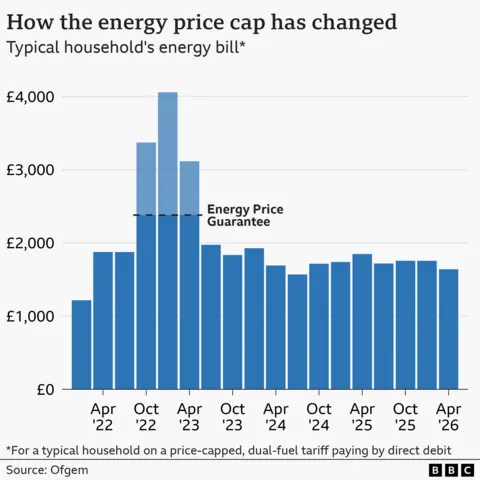
For the vast majority of households on variable tariffs, which are governed by Ofgem’s quarterly price cap, the adjustment translates to an estimated saving of approximately £10 per month for those consuming a typical amount of gas and electricity. This monthly saving accumulates to about £120 over a year. While this decline is certainly good news, it’s crucial to acknowledge that energy prices remain stubbornly high, still hovering around a third higher than they were before the full-scale invasion of Ukraine in February 2022. The broader financial landscape also presents challenges, with household energy debts having ballooned to over £4 billion collectively. Consumers are therefore strongly advised to remain vigilant, monitor their energy usage, and actively explore competitive deals to maximize their savings.

The upcoming 7% fall in the price cap is a direct result of several converging factors. While the government had previously indicated a potential £150 annual reduction for a typical household in April due to policy changes, this anticipated saving has been somewhat diluted by an increase in the underlying costs associated with running the energy network. This interplay of policy adjustments and operational expenses means the final saving for billpayers is slightly less than initially projected, though still a substantial decrease.
Understanding how energy bills are calculated is key to grasping these changes. Domestic gas and electricity bills are a complex amalgamation of various components: charges for energy policy initiatives, the operational costs of maintaining and upgrading the energy network, and the fluctuating wholesale price of gas and electricity itself.
The government’s role in this reduction primarily stems from changes announced in the Autumn Statement last November. The Chancellor, Jeremy Hunt, outlined reforms to energy policy costs, specifically by scrapping the Energy Company Obligation (ECO) scheme and reallocating some charges onto general taxation. The ECO scheme, a Conservative government initiative, was designed to mandate energy suppliers to help households improve their energy efficiency, typically through measures like insulation and boiler upgrades for low-income or vulnerable customers. By removing this direct levy from energy bills and shifting certain associated costs to the broader tax base, the government aimed to reduce the direct burden on consumers. However, this re-evaluation of policy costs means that while a notional £150 annual reduction was discussed, the practical saving for a household governed by Ofgem’s price cap, using a typical amount of energy, will amount to £117 annually, bringing the new typical annual bill down to £1,641.

Ofgem’s price cap is a crucial regulatory mechanism designed to protect consumers from excessive energy charges. It is reviewed quarterly and sets a maximum price that suppliers can charge for each unit of gas and electricity, as well as the daily standing charge. The "typical household" benchmark used for these calculations is defined as one consuming 11,500 kWh of gas and 2,700 kWh of electricity per year, with a single bill for both gas and electricity, settled by direct debit. It’s important to remember that individual bills will vary significantly based on actual consumption.
While the reduction is welcome, it’s essential to note that the discount on each household’s individual energy bill will not be uniform. It will depend heavily on the size and type of household, as well as its specific energy consumption patterns. The primary mechanism for this reduction is a lower price per unit of electricity used. This means that households with higher electricity consumption, which can include vulnerable individuals reliant on medical equipment, are likely to experience the most significant financial benefit. Conversely, those who use relatively little electricity but a substantial amount of gas may see a more modest saving.
Furthermore, the changes to policy costs will also extend a reduction to customers on fixed-rate deals, not just those on variable tariffs. These customers can expect to be contacted by their energy supplier in the coming weeks with specific details on how their tariff will be adjusted.
Tim Jarvis, Ofgem’s director general of markets, welcomed the price drop as "welcome news for many households." He also highlighted "encouraging signs of greater engagement and competition," noting a nearly 20% increase in switching activity year-on-year. This suggests that as the market stabilizes, more suppliers might introduce competitive fixed deals, providing further options for consumers to manage their costs.
However, the energy market remains susceptible to global dynamics. The wholesale cost of gas, which saw unprecedented spikes following Russia’s invasion of Ukraine four years ago, continues to be relatively volatile and difficult to predict accurately. This inherent unpredictability makes it challenging to forecast what will happen to domestic energy bills beyond the immediate future. Energy consultancy Cornwall Insight, a respected authority in market analysis, offers a cautious outlook. Dr. Craig Lowrey, its principal consultant, stated, "This reduction in the cap will bring real relief to households after a prolonged period of pressure on their energy bills. However, our early view for July suggests that this is where the big falls stop." This forecast implies that while the current reduction is significant, consumers should not expect continuous, substantial drops in the latter half of the year, and potential geopolitical shifts or changes in global demand could still influence prices.
Experts consistently urge people to continue monitoring and managing their energy use to keep costs down. Eileen Jordan, a resident of Ripon in North Yorkshire, shared her experience, telling the BBC’s Your Voice how she and her husband have actively worked to keep their energy consumption in check. She explained that they intentionally do not heat two bedrooms in their home, a measure that has contributed to their finances remaining in good shape. "How some people manage is beyond my comprehension," she remarked, acknowledging her fortunate position but emphasizing that it comes from being "frugal." Her sentiment reflects the ongoing struggle many households face.

While energy bills are falling, the broader cost of living crisis means that households will continue to face financial pressures from other directions. Water bills are set to rise sharply in some areas across the UK, council tax increases are anticipated, and various other essential household costs, from food to transport, are also expected to climb. While some families may see adjustments to benefits, the broader picture remains one of rising household costs, underscoring the necessity for continued financial prudence.
The accumulated energy debt to suppliers, which now exceeds £4 billion, highlights the severe challenges many households are enduring. Dhara Vyas, chief executive of Energy UK, the trade association representing energy suppliers, stressed that companies are ready to help. "They are giving them different tariffs, extra help and support, offer white goods such as efficient fridges, but they can only do this if they know who is in your household and what your circumstances are," she explained. This underscores the critical importance of customers communicating with their suppliers if they are struggling, as bespoke support and payment plans can often be arranged.
In conclusion, the upcoming reduction in energy bills offers a much-needed reprieve for households across Great Britain. However, this welcome news arrives within a complex economic environment where overall living costs continue to climb, and energy prices remain historically elevated compared to pre-crisis levels. Vigilance in energy consumption, proactive engagement with suppliers, and a continued focus on household budgeting will remain essential strategies for navigating the persistent financial squeeze.




 George Anjay
 Ramos Leo
 Roy Suryo
 atisusanti