
 Nana Banana
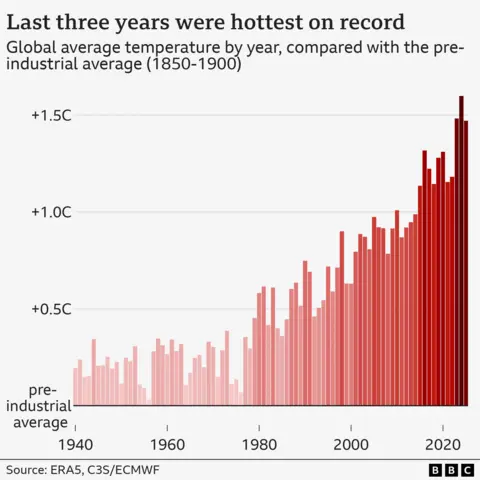
Despite a temporary reprieve from the relentless upward climb of global temperatures, 2025 registered a slight dip compared to the preceding year, primarily due to the natural cooling influence of the La Niña weather pattern in the Pacific Ocean. However, this momentary deceleration offers little comfort to climate scientists, who caution that this is merely a blip in an overarching and accelerating warming trend. New data released by the European Copernicus Climate Change Service and the UK Met Office confirms that the last three years, encompassing 2023, 2024, and 2025, remain the world’s warmest on record, pushing the planet ever closer to breaching critical international climate targets.
The phenomenon of La Niña, characterized by cooler-than-average sea surface temperatures in the equatorial Pacific, typically has a global cooling effect. Yet, the fact that 2025 was still exceptionally warm, far exceeding temperatures recorded even a decade ago, underscores the powerful and persistent impact of humanity’s ongoing carbon emissions. These greenhouse gases continue to accumulate in the atmosphere, trapping heat and driving up the planet’s baseline temperature. This relentless human-induced warming, scientists unequivocally state, will inevitably lead to further temperature records being shattered in the coming years, bringing with them an escalation of extreme weather events, unless global emissions are drastically and swiftly reduced.
Dr. Samantha Burgess, the deputy director of Copernicus, offered a sobering perspective on the current situation. "If we go twenty years into the future and we look back at this period of the mid-2020s," she remarked, "we will see these years as relatively cool." Her statement highlights the alarming trajectory of climate change, suggesting that even these historically hot years will be overshadowed by far warmer ones in the near future. This forward-looking assessment serves as a stark warning against complacency, indicating that the planet is entering a new, more intense phase of warming.

According to the combined data from Copernicus and the Met Office, the global average temperature in 2025 stood at more than 1.4 degrees Celsius above "pre-industrial" levels, a benchmark referring to the average temperatures of the late 1800s, before widespread industrialization and the burning of vast quantities of fossil fuels significantly altered atmospheric composition. While precise figures might vary slightly between major climate monitoring groups due to minor differences in calculation methodologies for the pre-industrial baseline, there is an overwhelming scientific consensus regarding the undeniable and accelerating long-term warming trend of the planet.
Prof. Rowan Sutton, director of the Met Office Hadley Centre, reiterated the fundamental science behind this trend. "We understand very well that if we continue to pump greenhouse gases into the atmosphere, the concentrations of those gases increase in the atmosphere, and the planet responds by warming," he explained. This basic principle of atmospheric physics forms the bedrock of climate science and explains the observed warming.
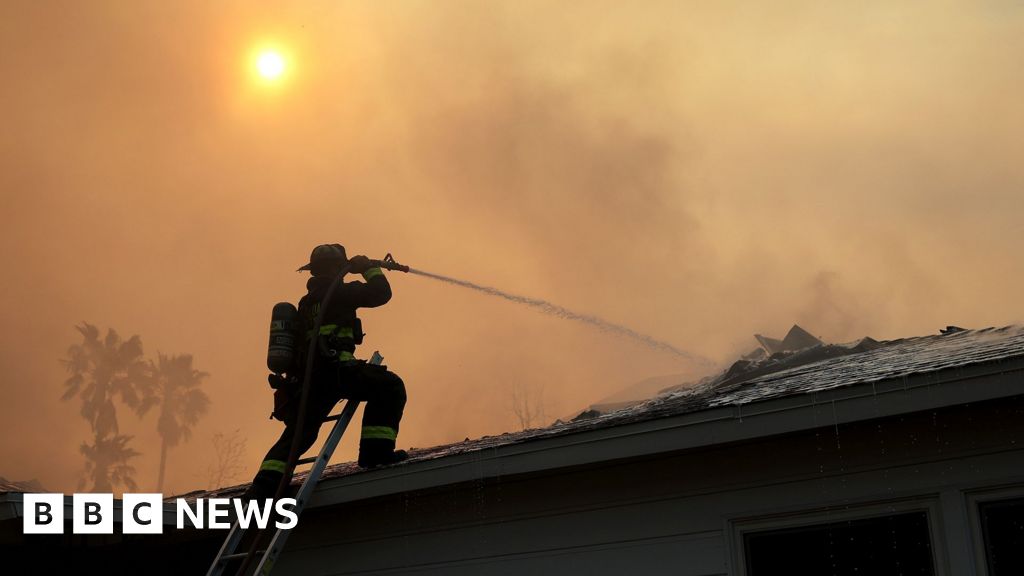
Despite 2025 not being the absolute hottest year on record globally, it was far from tranquil. The year continued to witness a barrage of extreme weather events unequivocally linked to global warming. January 2025, for instance, saw the devastating California fires, an inferno that raged across vast swathes of the state, fueled by abnormally dry conditions and high winds. These fires were not only a human tragedy but also ranked among the most expensive weather-related disasters in US history, causing billions in damages and displacing thousands. Later in the year, in October, Hurricane Melissa unleashed catastrophic flooding and widespread devastation across Haiti and other parts of the Caribbean. Global warming significantly amplifies the intensity of such tropical cyclones, contributing to stronger winds, heavier rainfall, and more destructive storm surges, exacerbating their impact on vulnerable communities. Other regions around the globe also grappled with unprecedented heatwaves, prolonged droughts, and flash floods, demonstrating the pervasive and varied nature of climate impacts.
The 1.5 degrees Celsius threshold is a critical target established by nearly 200 countries in the 2015 Paris Agreement. This ambitious goal aims to limit global warming to well below 2C above pre-industrial levels, and ideally to 1.5C, to avert the most catastrophic and irreversible consequences of climate change. Breaching this 1.5C limit, even temporarily, signals a significant escalation in climate risk, potentially triggering tipping points that could lead to widespread ecosystem collapse, accelerated sea-level rise, increased food insecurity, and mass displacements. Dr. Burgess’s projection that "it looks like we’ll exceed that 1.5-degree level of long-term warming by the end of this decade" underscores the urgency of the situation and the rapidly closing window for effective climate action.

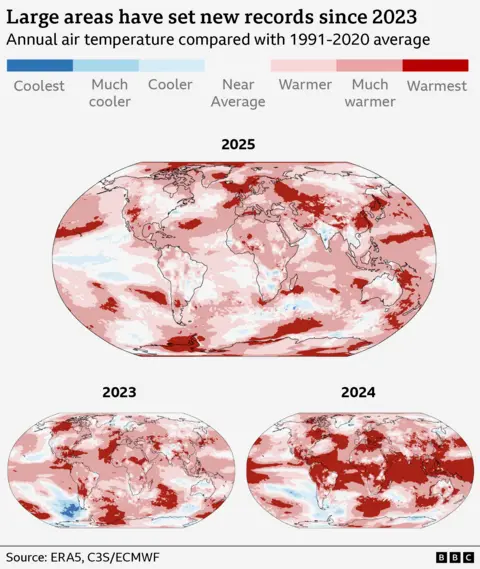
While human activities are the primary drivers of long-term warming, natural climate variability, such as the El Niño-La Niña Southern Oscillation (ENSO), can influence individual year-to-year temperature fluctuations. El Niño conditions typically correlate with warmer global average temperatures, while La Niña phases tend to be cooler. The return of La Niña conditions in 2025 is precisely what suppressed the warmth, preventing it from surpassing the record set in 2024. However, the fact that global temperatures remained remarkably high even during a La Niña year "is a little worrying," according to Dr. Zeke Hausfather, a climate scientist at Berkeley Earth in the US. This suggests that the underlying anthropogenic warming signal is so strong that it largely overrides even significant natural cooling influences. The consistent breaking of monthly temperature records since 2023, as illustrated by Copernicus data showing every month achieving its warmest on record within the last three years, further highlights the unprecedented and pervasive nature of the current warming trend.
Scientists are also exploring other potential factors contributing to the observed "rapid warming at the upper end of our longer-term expectations." Theories under investigation include changes to cloud cover and the role of tiny atmospheric particles known as aerosols. Aerosols, often produced by human activities like burning fossil fuels, can reflect sunlight back into space, thereby exerting a cooling effect. A reduction in aerosol emissions, for example, due to cleaner air policies, could paradoxically lead to more warming by allowing more solar radiation to reach the Earth’s surface. While these complex interactions require further research and more data before firm conclusions can be drawn, as Prof. Sutton emphasized, they hint at the intricate and interconnected systems governing Earth’s climate.
Despite the dire warnings, scientists maintain that the future impacts of climate change are not predetermined. The trajectory of global warming remains largely dependent on human choices and actions. "We can strongly affect what happens," stated Sutton, underscoring the agency humanity still possesses. This involves a dual approach: "mitigating climate change – that’s by cutting greenhouse gas emissions to stabilise warming – and of course also by adapting, by making society more resilient to ongoing changes." Mitigation strategies include transitioning to renewable energy sources, improving energy efficiency, developing carbon capture technologies, and protecting natural carbon sinks like forests. Adaptation measures, on the other hand, involve building resilient infrastructure, developing early warning systems for extreme weather, implementing water conservation techniques, and fostering climate-resilient agriculture.
In conclusion, while 2025 offered a fleeting dip in global temperatures, a natural variation influenced by La Niña, it serves as a stark reminder of the planet’s increasingly precarious position. The underlying, human-driven warming trend continues unabated, propelling us towards an era of more frequent and intense heat records and extreme weather events. The scientific community’s urgent message is clear: the window for meaningful action to reduce emissions and adapt to a changing climate is rapidly closing, and the choices made today will profoundly shape the world for generations to come.



 George Anjay
 Nakalama John
 atisusanti
 Ramos Leo
 Roy Suryo