Nana Banana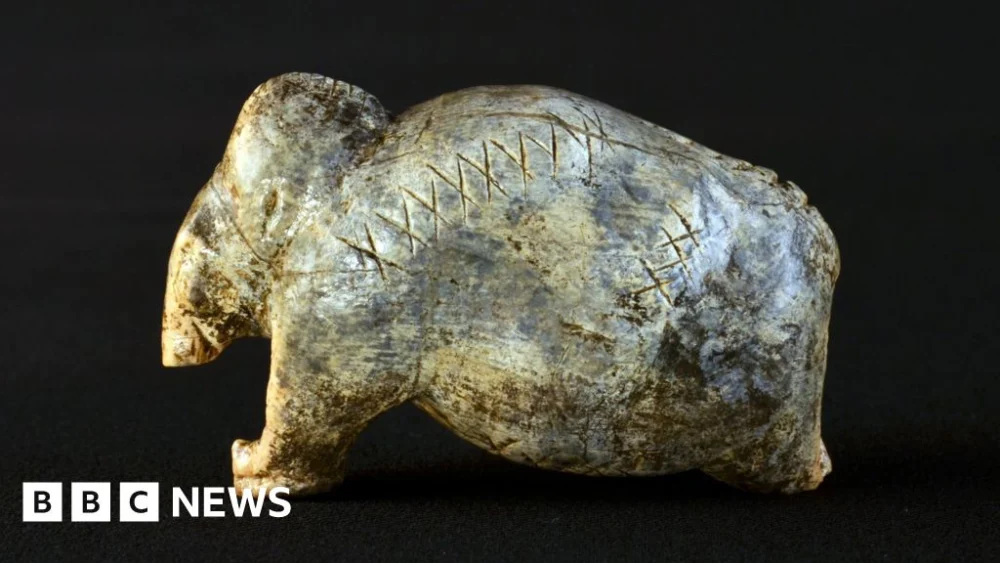
Researchers have meticulously discerned intricate patterns of meaning embedded in lines, notches, dots, and crosses etched onto various objects, most notably mammoth tusks. These remarkable artifacts, unearthed from ancient caves in Germany, have been dated as far back as 45,000 years. This places the origins of such sophisticated symbolic systems firmly within the Upper Paleolithic era, a period long before the advent of what was traditionally recognized as the first forms of writing.
Historically, historians and linguists have pinpointed the birth of written language to the proto-cuneiform scripts developed approximately 5,000 years ago in the fertile crescent of ancient Iraq, known as Mesopotamia. This early system, emerging around 3,000 BCE, was characterized by its pictographic nature, primarily serving administrative and economic purposes within nascent urban societies. Following proto-cuneiform, hieroglyphics in Egypt, and later complex writing systems in China and Mesoamerica, were thought to represent the subsequent stages of writing’s evolution. The German discovery profoundly challenges this established narrative, suggesting a much deeper, more ancient root for human engagement with symbolic inscription.
While the precise meaning of the symbols discovered in Germany currently remains an enigma, their structured and repetitive nature points strongly towards a deliberate attempt at communication. These ancient objects hail from a crucial period in human history, just before early Homo sapiens migrations into Europe from Africa, where they encountered and interacted with Neanderthal populations. This era was a crucible for significant cognitive and cultural development, making the presence of such advanced symbolic systems particularly compelling.
Professor Christian Bentz from Saarland University, a key author of the new research, articulates the significance of these findings, stating, "The Stone Age sign sequences are an early alternative to writing." This perspective redefines what constitutes "writing," moving beyond the strict definition of phonetic or logographic scripts to embrace structured symbolic systems capable of conveying information. The implications are profound, suggesting that the cognitive capacity for abstract thought and complex communication, previously attributed to later agricultural societies, was already well-developed in hunter-gatherer communities of the Paleolithic era.
Ewa Dutkiewicz from Berlin’s Museum of Prehistory and Early History underscores the intellectual prowess of these ancient peoples, noting that "the work suggests that Stone Age people were as clever as modern-day humans." She further emphasizes the potential for future discoveries, observing, "So far, we’ve only scratched the surface of what can be found in terms of symbol sequences on a wide variety of artifacts." This sentiment highlights the vast untapped potential for understanding early human symbolic behavior that lies within archaeological records.
The research team undertook an exhaustive analysis, examining over 3,000 individual characters inscribed on 260 distinct objects. Through this meticulous process, they sought to uncover what they describe as the "DNA of writing"—the fundamental structural and statistical properties that underpin communicative symbolic systems. Many of these artifacts originate from the Lonetal, a vast 37-kilometer-long cave system located in Baden-Württemberg, southern Germany, renowned for its rich trove of Upper Paleolithic art and tools.
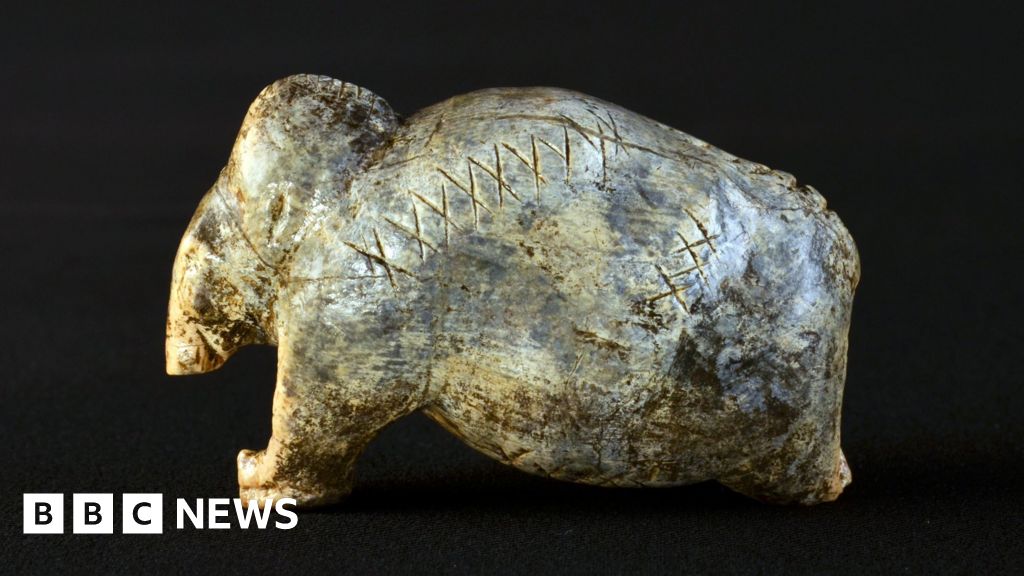
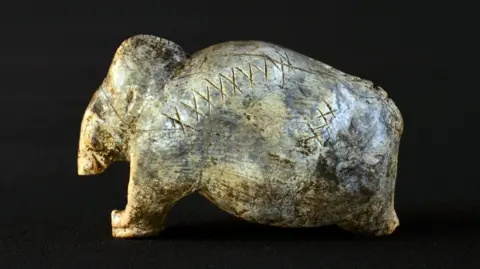
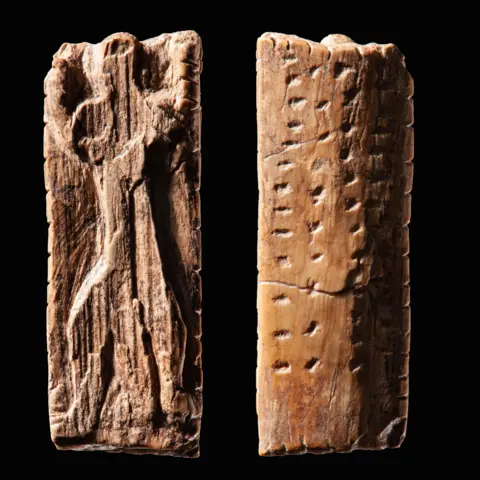
One particularly striking example is a small mammoth figurine, exquisitely carved from a mammoth tusk and dated approximately 40,000 years old. On its surface, researchers identified carefully engraved rows of crosses and dots. The deliberate placement and repetition of these marks suggest a patterned intent, transcending mere decoration. Another significant artifact, known as the "adorant," discovered in the Geißenklösterle cave within the Achtal valley, further exemplifies this symbolic sophistication. This ivory plaque depicts a unique lion-human creature, a common motif in Paleolithic art, adorned with distinct rows of dots and notches. The researchers theorize that the specific arrangement of these marks, especially the dots on the back of the figurine, functioned as a means of communication, conveying a message or meaning relevant to its creators and users.
The core belief uniting the research team is that Stone Age people consciously and purposefully carved these symbols to transmit messages, imbue objects with meaning, and express complex thoughts. This intentionality is crucial in distinguishing these marks from random carvings or artistic flourishes.
Bentz further elaborates on the statistical significance of their findings: "Our results also show that the hunter-gatherers of the Paleolithic era developed a symbol system with a statistically comparable information density to the earliest proto-cuneiform tablets from ancient Mesopotamia – a full 40,000 years later." This comparison is startling. It suggests that despite the vast temporal and cultural gap, the underlying principles of information encoding in these ancient symbolic systems bear a striking resemblance to those of the earliest recognized writing.
The key to discerning meaning, the researchers explain, lies in the density and predictability of the symbols. They observed a high frequency of repetition and a discernible predictability in the sequence of subsequent symbols, a characteristic that is statistically "comparable to much later proto-cuneiform." This suggests that the arrangement of these symbols was not arbitrary but followed a structured grammar or convention, much like a rudimentary language. Interestingly, denser patterns of symbols were found on figurines, suggesting they might have held a different, perhaps more complex or sacred, communicative function compared to symbols found on tools.
This discovery underscores the profound importance of communicating information for Paleolithic people. In a world without written records, verbal tradition, mnemonic devices, and symbolic representations would have been vital for transmitting knowledge, preserving cultural narratives, coordinating group activities, and reinforcing social cohesion. These carved objects could have served as portable repositories of information, aiding in storytelling, tracking lunar cycles, recording hunting successes, or even conveying complex mythological or spiritual concepts.
Dutkiewicz highlights the practical aspects of these artifacts: "They were skilled craftspeople. You can tell they carried the objects with them. Many of them fit very well in the hand, just the right size to fit in the palm." This detail emphasizes their personal significance and utility. These were not static artworks but portable items, perhaps cherished talismans, instructional tools, or personal mnemonic aids that traveled with individuals or groups, facilitating the continuous exchange of information within their communities. The craftsmanship itself speaks to a high level of skill and dedication, indicating that the creation of these symbolic objects was a significant cultural practice.
While the specific messages encoded in these ancient patterns remain to be deciphered, their existence undeniably rewrites a substantial chapter in the history of human communication. It challenges archaeologists, linguists, and cognitive scientists to broaden their definitions of "writing" and to re-evaluate the intellectual capabilities of our earliest ancestors. The discovery opens up exciting new avenues for research, prompting further exploration of other Paleolithic artifacts for similar patterns and deeper insights into the origins of human symbolic thought. This ongoing work, published in the esteemed journal PNAS, promises to continue unraveling the intricate tapestry of human intellectual evolution.




 Roy Suryo