Nana Banana
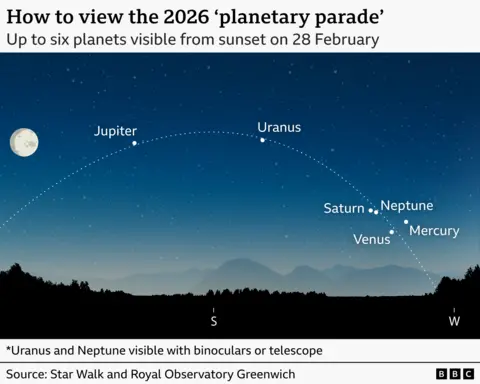
This weekend, observers will have the chance to witness Mercury, Venus, Saturn, Jupiter, Uranus, and Neptune clustered together in the same sector of the sky shortly after sunset. This apparent gathering occurs when these planets, though vast distances apart in their orbits, appear to line up from our unique vantage point on Earth. For those in the UK, the prime viewing opportunity is anticipated on Sunday, February 28th, when conditions are expected to be most favorable. To maximize the experience, enthusiasts are advised to seek out locations offering an unobstructed panorama of the western horizon.
Four of the six planets – Mercury, Venus, Saturn, and Jupiter – are expected to be bright enough to be observed without binoculars or a telescope, presenting a rare chance to see multiple major celestial bodies simultaneously. However, the more distant ice giants, Uranus and Neptune, will undoubtedly necessitate the use of specialized equipment such as binoculars or a telescope to be properly discerned amidst the twilight glow.
A planetary parade is a fascinating astronomical phenomenon where multiple planets appear to align in a roughly straight line across the sky from Earth’s perspective. Dr. Becky Smethurst, a Royal Astronomical Society Research Fellow at the University of Oxford and a popular science YouTuber, clarifies that while they appear in a line on our curved sky, this doesn’t mean they are physically lined up in their orbits. Instead, it’s a consequence of the solar system’s architecture. "All the planets orbit in the same flat plane," Dr. Smethurst explains, likening it to a "bowl of pizza dough" that flattens out when spun. This shared orbital plane means that "when we look up at the night sky, all the solar system objects take roughly the same path." She further notes that the planets are not actually lining up in a row in their individual orbits but are simply positioned on the same side of the solar system from our vantage point at this particular moment in time.
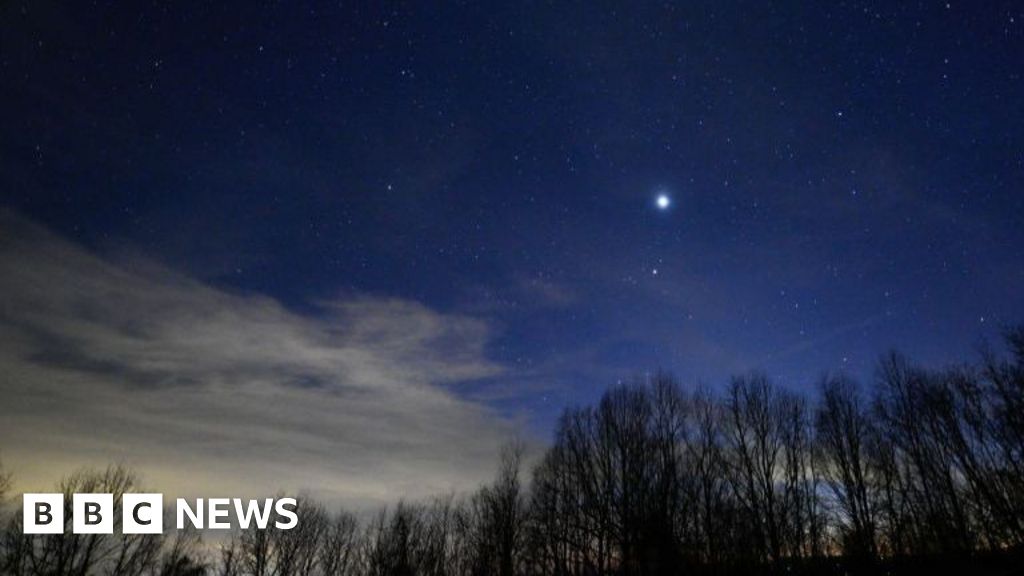
The positioning for this particular parade will see Mercury, Venus, Saturn, and Neptune appearing relatively low in the western sky just after the sun dips below the horizon. Spotting Mercury and Venus, being closest to the sun and often obscured by atmospheric haze, will require the clearest possible view of the horizon. Venus, often dubbed the "Evening Star," will likely be the brightest object in this low-lying group, while Mercury, swift and elusive, will only be visible for a brief window before setting. Saturn, with its characteristic steady glow, will offer a distinct presence. Neptune, being the furthest of this quartet, will be a challenge even with binoculars, appearing as a faint, bluish-green speck.
Higher in the sky, Uranus will be found nestled within the constellation Taurus. This placement means it will remain above the horizon until around midnight, affording skywatchers with appropriate magnification a longer window to locate and observe it. Uranus, another ice giant, will appear as a small, teal-colored disc through a telescope.
The easiest of the six planets to locate will undoubtedly be Jupiter, the solar system’s largest planet. Shining brilliantly in the constellation Gemini, Jupiter’s luminous presence will be high enough in the sky to remain visible for a significant portion of the night. Its immense brightness makes it discernible even from urban areas with moderate light pollution, offering a guiding beacon for those new to stargazing. With a good pair of binoculars or a small telescope, observers might even catch a glimpse of Jupiter’s four largest moons – Io, Europa, Ganymede, and Callisto – appearing as tiny pinpricks of light flanking the giant planet.
While the appearance of six planets together in the night sky is a captivating event, it is not as astronomically rare as one might assume. However, a full seven-planet parade, encompassing all the major planets (excluding Earth), is a much rarer occurrence. One such grand alignment took place as recently as February 2025, and it will be many years before all seven terrestrial and gas giants can again be observed together in such close proximity from our planet. This year’s six-planet display thus offers a significant opportunity for celestial observation.
According to the Star Walk app, which provides detailed astronomical information, the planets will appear most closely grouped on February 28th, 2026. However, the precise optimal viewing date can vary slightly depending on an observer’s geographical location. For instance, peak visibility is anticipated on February 25th in São Paulo, February 28th in major cities like Athens, New York, Mexico City, and Tokyo, and March 1st for residents of Beijing, Berlin, London, and Mumbai. Reykjavik is projected to experience its best views on March 2nd. These variations are due to the planets’ continuous motion and Earth’s rotation, altering their apparent positions relative to the horizon at different longitudes. Jess Lee, an astronomer at the Royal Observatory Greenwich, highlights the unique appeal of such an event: "A planetary alignment like this can be particularly exciting as it gives you the opportunity to see various worlds during one evening."
To make the most of this extraordinary viewing opportunity, preparation is key. Dr. Smethurst offers valuable advice for optimizing the stargazing experience. A crucial first step is allowing your eyes sufficient time to adapt to the darkness before stepping outside. She recommends "waiting sort of in the warm of my kitchen for five or 10 minutes in the dark before I step out," which provides "the immediate reward of being able to spot even the faint things in the night sky straight away." This period of dark adaptation allows the rods in your eyes, responsible for low-light vision, to become more sensitive.
Comfort is equally paramount for an enjoyable viewing session, especially when scanning the sky for extended periods. Instead of straining your neck, Dr. Smethurst suggests "laying down a picnic blanket on the ground or sitting in some sort of lounge chair." Furthermore, given that stargazing often involves being stationary outdoors, it’s vital to "wrap up warm because if you’re not moving, it gets very cold," particularly in late winter or early spring evenings.
Once your eyes have adjusted to the darkness, it’s important to avoid exposure to bright lights, which can instantly undo the adaptation process. If using a smartphone application to help locate the planets, enable its red light feature. "The red light won’t affect your night vision as much as a bright white light would," Dr. Smethurst advises, as red light has a less disruptive effect on the eye’s rhodopsin, the pigment essential for night vision.
Even if unfavorable weather or other commitments prevent viewing on the peak day of the parade, hopeful skywatchers need not despair entirely, as some of the planets will remain visible for several days or even weeks. While Mercury, with its rapid orbit, will likely be lost from view by early March, other planets will continue to offer viewing opportunities. Notably, "on March 7th and March 8th, Venus and Saturn are going to be very close together on the sky, making it easier to spot both of them," Dr. Smethurst confirms, extending the celestial show for persistent observers. Local astronomy societies often host public viewing events, providing access to powerful telescopes and expert guidance, which can be an excellent alternative for those without their own equipment or seeking a communal experience.
The biggest variable for any astronomical event is, of course, the weather. The forecast for the upcoming weekend is currently looking rather mixed across various regions, with significant variations in the amount of clear sky expected over the coming nights. For Friday night, the clearest skies are most likely to be found across Scotland and Northern Ireland, offering the best chances for early bird stargazers in those areas. Conversely, much of England is predicted to experience mostly cloudy conditions, with some scattered rain across parts of the country.
As the weekend progresses, fortunes are set to reverse for Saturday night. England and Wales are anticipated to have the best of the clear skies, creating prime viewing conditions for many. However, cloudier conditions are expected to begin increasing from the north and west later in the night, potentially obscuring views for some. By Sunday night, the peak viewing evening for the UK, any clear skies are projected to be quite limited, primarily to eastern and southern parts of England. Stargazers are strongly advised to consult localized, up-to-date weather forecasts closer to the time to ascertain their best chances of witnessing this remarkable planetary alignment.
Additional reporting by BBC Weather presenter Simon King.



 Roy Suryo