
 Ramos Leo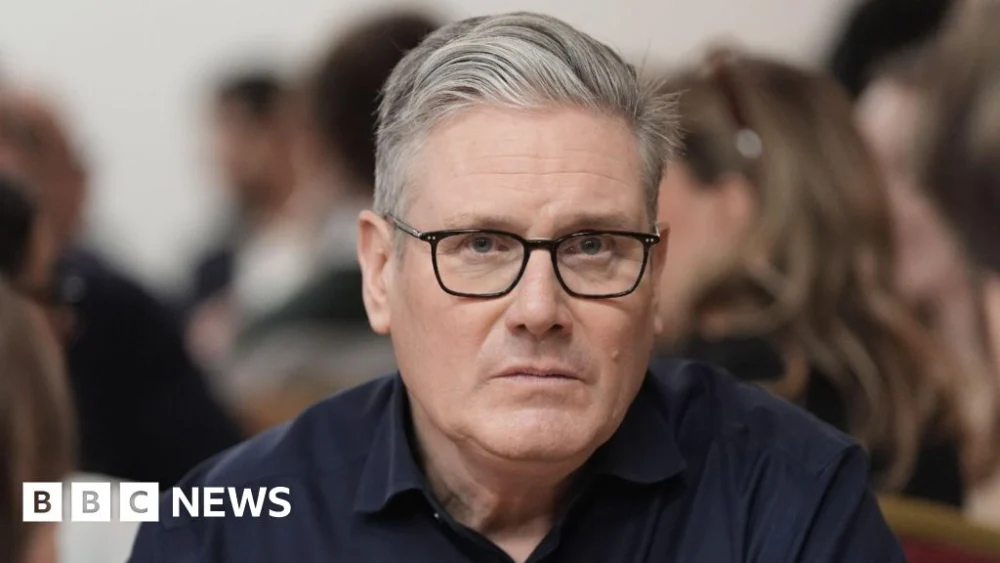
Sir Keir Starmer has defiantly vowed to "keep on fighting" after Labour suffered a crushing by-election defeat to the Green Party in the historically red Greater Manchester constituency of Gorton and Denton. The result, which saw Labour, a party that secured over 50% of the vote in the 2024 general election in this very seat, pushed into an unprecedented third place behind the surging Reform UK, has sent shockwaves through Westminster and reignited fierce debate over Starmer’s leadership.
Addressing the fallout, the Labour leader described the outcome as "disappointing" but maintained his resolve, pledging to "fight against extremes in politics" on both the left and the right that "want to tear our country apart." His comments underscore the perceived threat from both the Green Party’s progressive appeal and Reform UK’s populist right-wing stance, suggesting Labour is being squeezed from multiple directions. The by-election, triggered by the resignation of former Labour health minister Andrew Gwynne following his suspension from the parliamentary party over offensive WhatsApp messages a year prior, exposed deep vulnerabilities within Labour’s traditional support base.
In a stunning upset, Green Party leader Zack Polanski declared the victory a clear sign that there were no longer any "no-go areas" for his party. The newly elected Member of Parliament for Gorton and Denton, Hannah Spencer, a plumber and local councillor from Trafford, echoed this sentiment, confidently stating, "this is only the beginning." Her win marks a significant milestone for the Greens, securing their fifth MP and their first parliamentary seat in the north of England, transforming what was considered their 127th target seat into a triumphant stronghold.
The loss in a constituency Labour has held for nearly a century has inevitably intensified criticism of Sir Keir’s leadership from within his own party. Several prominent Labour MPs have openly called for him to re-evaluate his position or even step down. This renewed pressure comes at a critical juncture for the Prime Minister, ahead of crucial May elections in Scotland, Wales, and various English councils, where Labour’s performance will be under intense scrutiny.
Angela Rayner, the former Deputy Prime Minister and a figure often tipped as a potential challenger to Sir Keir, weighed in, stating the result "must be a wake-up call" and urging the government to be "braver." Her comments, while not a direct challenge, highlight a growing sentiment that Labour’s current direction may be too cautious or failing to inspire its core electorate. The controversy was further fuelled by the decision to block Andy Burnham, the popular Mayor of Greater Manchester, from standing as Labour’s candidate. While Sir Keir publicly backed the chosen candidate, Angeliki Stogia, some Labour MPs argued that Burnham, with his immense local popularity, would have offered the party its strongest chance of retaining the seat. The internal debate over candidate selection highlights a deeper tension between central party control and local preferences.
Responding to questions about the devastating defeat, Sir Keir acknowledged voter frustration. "Incumbent governments quite often get results like that mid-term, but I do understand that voters are frustrated. They’re impatient for change," he conceded, attempting to frame the loss within a broader historical context of by-election swings against governing parties. When pressed on whether he had considered resigning, he reaffirmed his unwavering commitment: "I came into politics late in life to fight for change for those people who need it… I will keep on fighting for those people for as long as I’ve got breath in my body." He also defended the decision to block Burnham, stating, "We had an excellent candidate, absolutely rooted in her community," despite the electoral outcome.
In a subsequent letter circulated to Labour MPs, Sir Keir launched a strong counter-attack, accusing Hannah Spencer of being "more interested in dividing people than uniting them." He further alleged that the Greens had opportunistically capitalised on an endorsement from George Galloway’s Workers Party of Britain – which had secured 10% of the vote in the constituency in 2024 but did not contest this by-election – and benefited from what he termed Galloway’s "divisive, sectarian politics." The Prime Minister also took aim at a specific Green Party policy, highlighting their stance on legalising all drugs, and asserted that they "simply do not have the resources, the activist base or the local knowledge to replicate this victory across the country," attempting to dismiss the Gorton and Denton result as an isolated incident rather than a trend.
However, Spencer quickly dismissed accusations of sectarian politics, insisting her party had successfully united voters around common concerns. She highlighted issues such as the escalating cost-of-living crisis, the deteriorating state of public services, and the ongoing conflict in Gaza as key drivers for her victory, demonstrating a broad appeal that transcended traditional party lines.
The Conservative Party, reeling from its own abysmal performance, offered little comfort to Labour. Conservative leader Kemi Badenoch seized on the result, declaring that it "shows Keir Starmer’s premiership is finished" and suggesting the Prime Minister would resign "if he had any integrity." This criticism, however, comes despite the Conservatives themselves suffering a catastrophic outcome, finishing fourth with a mere 706 votes – their worst ever by-election result in terms of vote share.
While initial public condemnation of Sir Keir has primarily emanated from long-standing critics within his own party, the depth of feeling is palpable. Labour MP Karl Turner branded the result "catastrophic," directly attributing it to the controversial decision to block Burnham and the party’s "unpopular" policies. Richard Burgon, a prominent figure on Labour’s left wing, went further, asserting that blame for the defeat "lies squarely with Keir Starmer and his clique," accusing them of "put[ting] factional interests over having the candidate best placed to win." Burgon emphatically stated, "If Labour is to be the ‘Stop Reform’ party, then the leadership must stop treating progressive voters with contempt – and start appealing to them." Fellow left-wing MP Nadia Whittome echoed this call for introspection, arguing her party needed "change at the top" and "should be true to the progressive values that Labour is meant to stand for."
The disquiet extends beyond the usual suspects, with several Labour MPs speaking to the BBC on condition of anonymity, openly calling for the Prime Minister to step down. One described the by-election result as "a punch in the face for the Labour Party and for Keir Starmer’s premiership." Another starkly observed, "Keir must reflect on how unpopular he is with the public." A particularly vivid analogy was offered by a third anonymous MP: "Cabinet ministers might be doing good interviews on the airwaves in tough circumstances but they’re like cabin crew successfully calming passengers in a plane that’s crashing. If they manage to calm things down, the plane is still crashing. And who is in the cockpit is what matters."
Amidst the chorus of criticism, some voices within Labour advised caution, warning against "knee-jerk responses that address the concerns of one wing of the support we need at the expense of losing the other." These MPs urged a focus on the core agenda of "tackling the cost of living crisis and improving public services," issues they believe resonate with all voters Labour needs to win back. Another MP pragmatically noted that there was "no obvious alternative" to Sir Keir, cautioning that "a leadership contest will be disastrous" at such a delicate political moment.
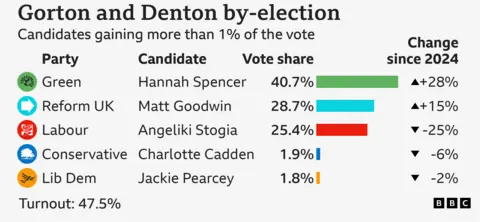
Despite the internal turmoil for Labour, the Green Party is basking in the glow of its historic triumph. Spencer’s victory, achieved with nearly 41% of votes cast and a comfortable majority of over 4,000, has injected new momentum into the party. She underscored the significance of the result in demonstrating that the Greens "can win anywhere," predicting further gains in the upcoming elections to English councils and the Welsh Senedd in May. Green Party leader Zack Polanski reiterated that the outcome represented an "existential crisis" for Labour, particularly given their attempt to frame the by-election as a direct contest with Reform UK, only to find themselves relegated to third. "No longer can they try and scare people into saying they have to vote for something because they’re worried about the least-worst option," Polanski asserted, highlighting a potential shift in voter behaviour.
Reform UK candidate Matt Goodwin, whose party secured an impressive second place with a 29% vote share (up 15% from 2024), also claimed a moral victory, stating his party had "embarrassed Labour in one of their strongest seats." Goodwin, however, sparked controversy by describing the Green victory as a "coalition of Islamists and woke progressives," a statement that has been criticised for marking "the emergence of a dangerous sectarianism in British politics." This by-election, therefore, not only reshapes the political landscape in Greater Manchester but also offers a stark pre-election warning to all major parties about the evolving and increasingly fragmented nature of the British electorate.



 Roy Suryo

 Nakalama John
 atisusanti
