Nana Banana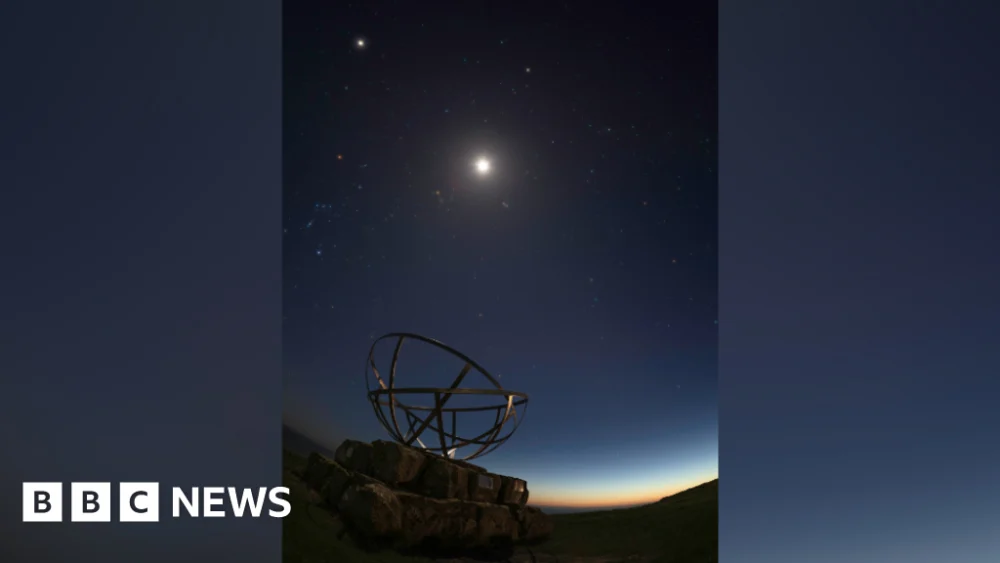
Dury, known for his dedication to documenting the wonders of the night sky, undertook a challenging journey to secure this iconic shot. On Tuesday, just after 18:30 GMT, he pointed his wide-angle lens towards the heavens from the historic vantage point of a radar memorial, a site chosen for its minimal light pollution and unobstructed views of the horizon. The resulting photograph is a testament to both his skill and perseverance, perfectly illustrating the delicate "string of pearls" alignment of celestial bodies across the twilight sky.
The planets featured prominently in Dury’s panoramic capture include Mercury, Venus, Jupiter, Saturn, Uranus, and Neptune, all visible in a rare sequential arrangement from Earth’s perspective. Earth itself anchors the foreground, providing a grounding context to the vastness of our solar system, while the Moon adds its familiar glow to the cosmic tapestry. This unique grouping allowed for an unparalleled view of our planetary neighbours, providing a profound sense of scale and our place within the grand celestial mechanism.
A planetary parade, scientifically termed a planetary alignment, occurs when several planets appear to gather on one side of the Sun from an observer’s viewpoint on Earth. It’s crucial to understand that this is an optical illusion, not a physical alignment in space where planets line up in a straight row. Due to their varying orbital paths and speeds around the Sun, they simply happen to be situated in a way that makes them visible in the same general area of the sky. While minor alignments involving two or three planets are relatively common, witnessing six or more planets simultaneously is a much rarer and more spectacular event, drawing considerable attention from both professional astronomers and amateur stargazers.
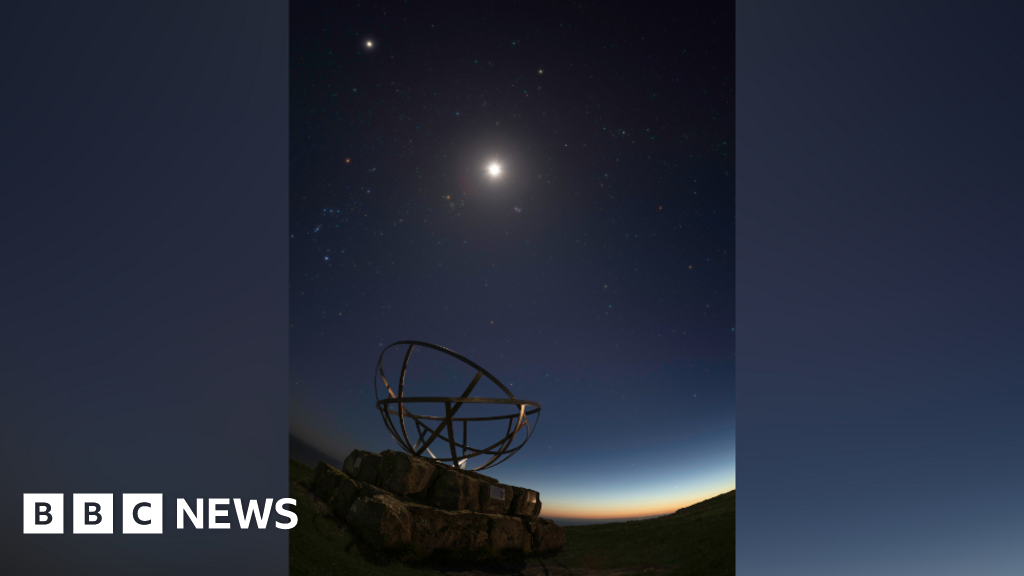
Dury’s journey to Dorset was far from straightforward, transforming what should have been a two-hour drive into a gruelling four-hour odyssey due to unexpected road closures. This unforeseen delay added immense pressure to an already time-sensitive mission. "It was a matter of arriving on location and seeing the sun go down to get into position to wait for the sky to darken," Dury recounted, highlighting the race against the fading light. Astrophotography demands precise timing, as the optimal window for capturing such phenomena is often fleeting, balancing the need for sufficient darkness to reveal faint objects with the planets’ low position near the horizon during twilight.
He described the experience as a "battle against time," where every minute counted. Upon arrival at Worth Matravers, a location steeped in history and offering some of the darkest skies in Southern England, Dury had to quickly set up his specialised equipment. His choice of a wide-angle lens was pivotal. This allowed him to capture a nearly 180-degree field of view, encompassing the vast sweep of the sky where the planets were arrayed. This broad perspective was essential for rendering the "string of pearls" effect, where the planets appeared strung out in a graceful arc, each a distinct point of light against the darkening canvas. The precision required to focus on multiple celestial objects at varying distances while maintaining a clear foreground demanded exceptional technical prowess.
The moment the shot was captured filled Dury with an overwhelming sense of accomplishment. "I was positively overwhelmed when I captured the shot," he shared, his voice reflecting the excitement of the experience. "It was wonderful to see the developmental stages of the parade happen." For an astrophotographer, such a successful capture is the culmination of meticulous planning, technical expertise, and often, a touch of luck with weather and atmospheric conditions. He emphasised the rarity of the image: "It’s quite a rare photograph purely because it’s that line-up of how they appear in the night sky. It just really puts into perspective our place among the solar system." This sentiment underscores the profound impact such cosmic spectacles can have, reminding us of the grandeur and order of the universe.
For those inspired by Dury’s capture, another opportunity to witness a planetary parade is set to grace the UK skies from sunset on Saturday. This upcoming event will feature six planets: Mercury, Venus, Saturn, Neptune, Uranus, and Jupiter. While not all seven planets captured by Dury will be easily visible, it still promises to be a spectacular display for patient observers.
To make the most of this celestial show, prospective skywatchers should plan their viewing carefully. The planets will begin to become visible just after sunset, as the last vestiges of daylight fade. A key challenge will be spotting Mercury and Venus, which will appear very low in the western sky, close to the horizon. Their proximity to the Sun’s glare and the Earth’s atmosphere makes them difficult targets, often requiring a perfectly clear and unobstructed view of the western horizon. Any hills, buildings, or trees in the way could obscure them.
For those without access to personal binoculars or a telescope, attending a local astronomy society event is highly recommended. These societies often host public viewing nights, providing high-quality equipment and expert guidance to help identify and appreciate the fainter planets. Experienced astronomers can offer invaluable tips on navigation and observation, enhancing the viewing experience significantly.
Beyond Mercury and Venus, the other planets offer varying degrees of visibility. Saturn and Neptune will also be relatively low in the western sky, though slightly higher than their inner solar system counterparts. Neptune, being an ice giant and much farther away, will require binoculars or a telescope to be seen clearly, appearing as a faint, bluish dot. Saturn, famous for its magnificent ring system, will be a more prominent target, especially with optical aid, revealing its iconic features.
Higher in the sky, Uranus will be situated within the constellation Taurus. This ice giant, too, will demand binoculars or a telescope for a discernible view. It won’t set until around midnight, offering a more extended viewing window for those equipped with the right tools and patience to track it down. Uranus’s distinctive greenish-blue hue makes it a rewarding sight for dedicated observers.

Jupiter, the largest planet in our solar system, will undoubtedly be the easiest of the six to locate. Shining brilliantly in the constellation Gemini, its immense size and reflective cloud tops make it an unmissable beacon in the night sky. Jupiter will be high enough to remain in view for much of the night, even from moderately light-polluted towns and cities, making it accessible to a broader audience. Its four largest moons, the Galilean moons, are often visible through binoculars, appearing as tiny pinpricks of light flanking the gas giant.
For optimal viewing, finding a spot with the clearest possible view of the horizon is paramount. Rural areas, national parks, and coastal locations with minimal light pollution are ideal. Light pollution scatters ambient light into the atmosphere, making fainter objects difficult to discern. Dressing warmly, bringing a comfortable chair, and allowing your eyes time to adjust to the darkness (at least 20-30 minutes) will also enhance the experience. Utilizing stargazing apps on smartphones can also be incredibly helpful for identifying constellations and pinpointing the exact locations of the planets.
Historically, planetary alignments have held significant cultural and astrological importance across various civilisations, often interpreted as omens or harbingers of change. While modern astronomy provides a scientific explanation for these phenomena, the sense of wonder they inspire remains undiminished. These celestial spectacles serve as powerful reminders of the dynamic nature of our solar system and the incredible astronomical ballet that unfolds above us. Josh Dury’s stunning photograph from Dorset not only captures a scientific event but also encapsulates this timeless human connection to the cosmos, inviting us all to look up and marvel at the universe.



 Roy Suryo