Nana Banana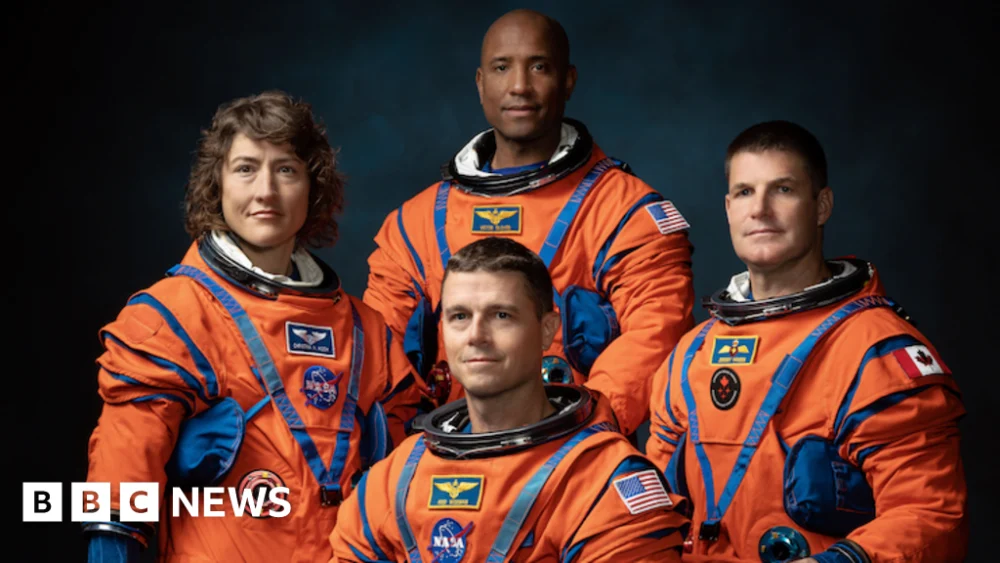
With the March launch window closed, the next potential opportunities for Artemis II are now being evaluated for April 1, 3, 4, 5, and 6. These revised dates come after a series of technical hurdles. A potential February launch was previously ruled out when a critical pre-flight test, known as a wet dress rehearsal, was prematurely halted. This rehearsal involved fueling the colossal Space Launch System (SLS) rocket, but it was cut short due to a hydrogen rocket fuel leak detected from an umbilical connection linking the launch tower to the rocket itself. This incident highlighted the complex engineering challenges involved in preparing such a powerful vehicle for flight. Beyond resolving these technical issues, mission planners must meticulously align the launch with specific astronomical windows when the Moon is in the optimal part of its orbit relative to Earth. This requirement dictates a pattern of roughly one week at the beginning of each month offering launch opportunities, followed by approximately three weeks where no such windows exist, underscoring the precise timing necessary for lunar missions. The delays underscore NASA’s cautious approach, prioritizing crew safety and mission success above all else, even if it means pushing back timelines. Each component of the SLS rocket and Orion capsule must function flawlessly to ensure a safe journey to and from the lunar vicinity.
The Artemis II crew of four is a diverse and highly experienced team, comprising NASA commander Reid Wiseman, pilot Victor Glover, and mission specialist Christina Koch. They are joined by a second mission specialist, Jeremy Hansen, from the Canadian Space Agency, marking a historic step in international space collaboration.
Reid Wiseman, the mission commander, is a seasoned US Navy veteran with 27 years of service. An accomplished pilot and engineer, he hails from Baltimore, Maryland. Wiseman was selected as an astronaut by NASA in 2009 and gained significant spaceflight experience as a Flight Engineer aboard the International Space Station (ISS) for Expedition 41 in 2014, spending 165 days in orbit. His leadership and extensive operational background will be vital in navigating the complexities of this pioneering mission around the Moon.
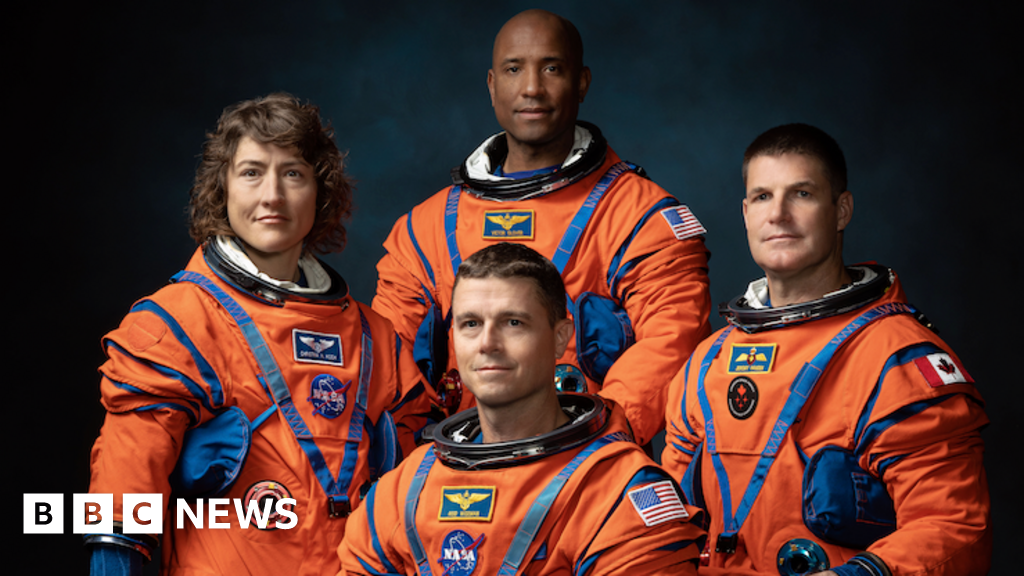
Victor Glover, the mission pilot, was selected as a NASA astronaut in 2013. He has an impressive academic record, holding three master’s degrees, and previously served as the pilot of SpaceX Crew-1, the first operational crewed flight of a SpaceX Dragon spacecraft to the ISS. During his time on Crew-1 and Expedition 64/65, Glover spent 168 days in space and conducted four spacewalks. Born in California, he is married with four children. His experience with commercial crew vehicles and deep space operations will be invaluable for the Orion capsule’s intricate maneuvers.
Christina Koch, a mission specialist, grew up in Michigan and joined the astronaut corps in 2013. She is renowned for her groundbreaking achievements on the International Space Station in 2019, where she set a record for the longest single spaceflight by a woman, spending 328 consecutive days in orbit. Furthermore, Koch was a participant in the historic first all-female spacewalk, solidifying her place as a pioneer in human spaceflight. Her scientific background and extensive experience in long-duration spaceflight will be crucial for the mission’s scientific objectives and understanding the effects of deep-space travel on the human body.
Jeremy Hansen, the second mission specialist, joined the Canadian Space Agency (CSA) in 2009, following a distinguished career as a fighter pilot in the Royal Canadian Air Force. He made history by becoming the first Canadian to lead astronaut training at NASA’s Johnson Space Centre. Hansen’s selection for Artemis II makes him the first Canadian ever to venture to the Moon, highlighting Canada’s significant contribution to the Artemis program and expanding the international footprint in lunar exploration. His experience as a test pilot and his role in astronaut training bring a unique skillset to the crew.
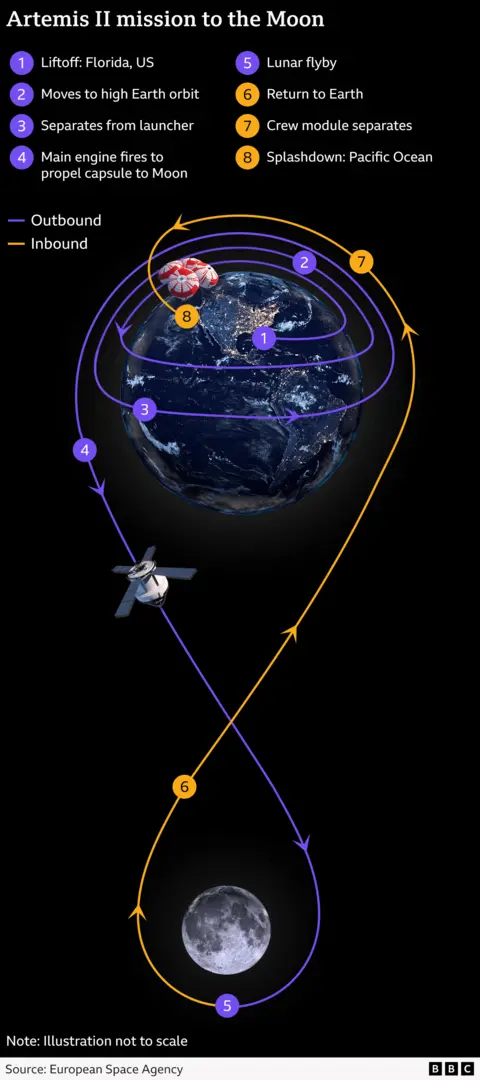
The Artemis II mission marks the inaugural crewed flight of NASA’s gigantic Space Launch System (SLS) rocket and the Orion space capsule. Once the crew is safely in Earth orbit, a critical phase of the mission begins: testing Orion’s capabilities. The astronauts will manually fly the capsule in Earth orbit, practicing steering and alignment maneuvers essential for future Moon landings. This manual control test is crucial to ensure the crew can take over if automated systems fail, a lesson learned from early spaceflight. Following these initial tests, the SLS upper stage will perform a powerful translunar injection burn, propelling Orion and its crew towards the Moon. They will then head out to a point thousands of kilometers beyond the Moon, specifically targeting a free-return trajectory that will bring them back to Earth without requiring a major propulsive maneuver at the Moon. This trajectory is a safety feature, ensuring a return path even if certain systems encounter issues. During this journey, the astronauts will meticulously check Orion’s life-support, propulsion, power, and navigation systems under the extreme conditions of deep space, far from Earth’s protective magnetic field.
Beyond their operational duties, the crew will also serve as vital medical test subjects. They will continuously transmit health data and imagery from deep space, allowing scientists to monitor the physiological effects of extended exposure to higher radiation levels compared to those experienced on the ISS, which orbits within low-Earth orbit. This data is indispensable for understanding and mitigating the risks associated with future long-duration missions to the Moon and Mars. The astronauts will live and work within Orion’s small cabin, approximately nine cubic meters of living space, experiencing weightlessness for the duration of their 10-day journey. Upon their return to Earth, the astronauts will brace for a high-speed, bumpy re-entry through the atmosphere, culminating in a precision splashdown off the west coast of the United States, in the Pacific Ocean, where recovery teams will be waiting.
Crucially, Artemis II will not land on the Moon. This mission is a vital precursor, designed to validate the SLS rocket and Orion spacecraft with a human crew, thereby laying the essential groundwork for a future lunar landing. The first human landing in the Artemis program is planned for the Artemis III mission, currently targeting 2027. Ahead of that, NASA plans another crewed test mission, Artemis IV, in 2028. Artemis IV will rehearse Orion’s rendezvous and docking procedures with one or more lunar landers and will also serve as an opportunity to test new spacesuits designed for lunar surface operations, should they be ready in time.
NASA has selected two rival commercial lunar landers for the Artemis program: SpaceX’s Starship and a craft designed by Jeff Bezos’s company Blue Origin. The agency will decide closer to the time which vehicles will fly which specific missions. When Artemis III finally flies, astronauts will be heading to the Moon’s south pole, a region of immense scientific interest due to the confirmed presence of water ice in permanently shadowed craters. This ice is a critical resource, potentially providing fuel, breathable air, and drinking water for future lunar bases. Following this, the aim is to have another landing later in 2028 with the Artemis V mission, progressively building up the capability for a sustained human presence on the Moon. Further Artemis missions will focus on assembling Gateway, a small modular space station that will orbit the Moon, serving as a staging point for lunar surface missions and a science outpost. This will be followed by more Moon landings, additional modules being added to Gateway, and new robotic rovers sent to explore the surface. The Artemis program also emphasizes international collaboration, with more countries expected to join the effort, leading to astronauts from a widening group of nations living and working on and around the Moon for longer stays, fostering a truly global lunar community.
The last crewed Moon mission was Apollo 17, which landed in December 1972 and returned to Earth later that month. In total, 24 astronauts have journeyed to the Moon, and 12 of them have walked on its surface, all during the Apollo program. Of these 24 lunar travelers, just five are still alive today. America’s initial push to the Moon in the 1960s was primarily driven by the geopolitical Space Race with the Soviet Union, aiming to assert technological and ideological dominance. Once that monumental goal was achieved with the successful Apollo landings, political enthusiasm and public interest gradually waned, leading to a significant reduction in funding for future Moonshots. The Artemis program, in contrast, emerged from a renewed desire to return humans to the Moon, but this time with a different philosophy: establishing a long-term, sustainable presence built upon new technological advancements, international partnerships, and commercial collaborations, with an eye towards eventually venturing to Mars.
Beyond NASA’s ambitious plans, several other countries harbor their own aspirations to send people to the Moon, primarily targeting the 2030s. European astronauts are already set to participate in later Artemis missions as part of the European Space Agency’s contributions, and Japan has also secured seats on future flights. China is rapidly advancing its independent lunar program, developing its own sophisticated spacecraft and targeting a first landing near the Moon’s south pole by 2030. Russia continues to vocalize plans to fly cosmonauts to the lunar surface and construct a small base sometime between 2030 and 2035. However, ongoing international sanctions, significant funding pressures, and technical setbacks mean its timetable remains highly optimistic and faces considerable challenges. India has also expressed bold ambitions to one day see its own astronauts walking on the Moon. Following the resounding success of its Chandrayaan 3 mission, which achieved a historic landing near the lunar south pole in August 2023, India’s space agency has set out a long-term goal of sending astronauts to the Moon by approximately 2040, as part of a broader strategy to expand its human spaceflight program beyond low Earth orbit. This burgeoning international interest underscores a new era of lunar exploration, driven by scientific discovery, resource potential, and the ultimate goal of interplanetary travel.
Additional reporting by Kevin Church and Emily Selvadurai.



 atisusanti
 Roy Suryo
 Nakalama John
 George Anjay