
 Ramos Leo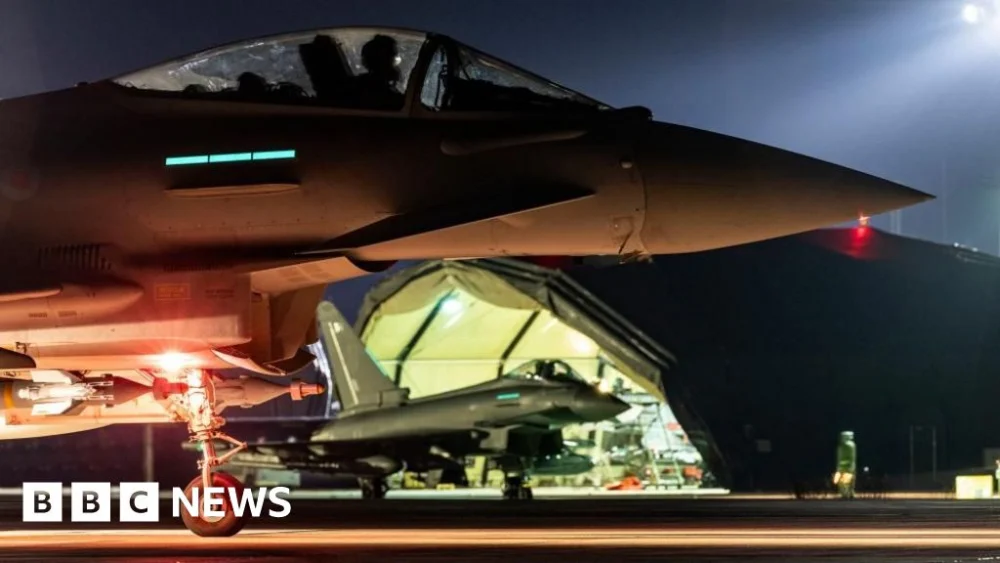
The immediate aftermath of the crash saw no reported casualties and the base sustained only "minimal damage," a testament to the robust defensive infrastructure in place. However, as a precautionary measure, the MoD announced that family members stationed at the base would be relocated to alternative accommodation. A spokesperson for the MoD underscored the seriousness of the situation, stating, "Our force protection in the region is at the highest level and the base has responded to defend our people." This declaration highlighted the heightened alert status across UK military installations in the Middle East and surrounding areas.
The incident at RAF Akrotiri unfolded amidst a backdrop of escalating hostilities following a series of retaliatory strikes initiated by Iran. Tehran’s actions were a direct response to a suspected Israeli airstrike on its consulate in Damascus, Syria, which resulted in the deaths of several senior Iranian military officials. Iran subsequently launched a barrage of ballistic missiles and drones targeting various US assets and allied nations across the region, including Israel, Bahrain, Kuwait, Qatar, the United Arab Emirates, and Jordan. This wide-ranging offensive demonstrated Iran’s significant missile and drone capabilities, underscoring the broad threat it poses to regional stability.
Adding another layer of complexity to the regional security landscape, Prime Minister Sir Keir Starmer had earlier confirmed that the UK had granted a US request to utilize British military bases for "defensive" strikes. This agreement allows the United States to launch operations from UK sovereign territory for specific, limited defensive purposes in response to the volatile situation. Sir Keir articulated that the decision was rooted in the principle of "collective self-defence" for allies and a commitment to protecting British lives. He further accused Iran of pursuing a "scorched-earth strategy," indicating the severity with which the UK government views Tehran’s actions.
The BBC understood that the US was likely to employ RAF Fairford in Gloucestershire and Diego Garcia in the Indian Ocean for potential strikes against Iranian missile sites. RAF Fairford, a prominent forward operating location for US long-range bombers, offers strategic reach into the Middle East, while Diego Garcia provides an invaluable platform in the Indian Ocean, further extending operational capabilities. This arrangement underscores the enduring "special relationship" between the UK and US and the intertwined nature of their defense strategies.
Despite the UK’s agreement to facilitate US defensive operations, Sir Keir Starmer emphasized a cautious approach, asserting that the UK had "learned lessons from the mistakes of Iraq" and would not be involved in any initial offensive strikes against Iran, nor would it "join offensive action now." This statement aimed to delineate the UK’s role as a supportive ally rather than an active participant in direct offensive military action, reflecting a desire to avoid being drawn into a broader conflict.
On Monday morning, an MoD spokesperson reaffirmed the operational status of the Cypriot base: "Our base and personnel continue to operate as normal protecting the safety of Britain and our interests." The Sovereign Base Areas Administration (SBAA), which governs RAF Akrotiri, confirmed it was planning the "temporary dispersal of non-essential personnel" from the station. This measure, however, was explicitly stated to apply only to the military base, with no requirement for residents of the nearby Akrotiri village to evacuate. The SBAA reassured the local population that "All other locations, workplaces, businesses and facilities will remain open as normal and there are no restrictions in place," seeking to mitigate panic and maintain civilian life.
The strategic significance of RAF Akrotiri cannot be overstated. Located on the southern coast of Cyprus, it is one of two Sovereign Base Areas maintained by the UK since Cypriot independence in 1960. It serves as a vital staging post for operations across the Middle East, including reconnaissance, surveillance, and strike missions. Its proximity to volatile regions makes it a critical asset for both UK and allied forces, often used in operations against ISIS and, more recently, in monitoring and responding to threats emanating from the Red Sea and the wider Gulf region. An attack on such a base, even if minimal in damage, represents a direct challenge to UK sovereignty and regional security.
The incident garnered international attention, with EU Commission President Ursula von der Leyen stating she had been briefed on the attack by Cypriot President Nikos Christodoulides. In a statement on social media, she conveyed strong EU solidarity: "While the Republic of Cyprus was not the target, let me be clear: we stand collectively, firmly and unequivocally with our Member States in the face of any threat." Her words underscored the European Union’s commitment to defending its member states and their territories, even when indirectly affected by regional conflicts.
Defence Secretary John Healey had earlier warned on Sunday that British troops and civilians stationed in the Middle East were increasingly being put at risk from "indiscriminate attacks" by Iran. In a separate, earlier incident, Healey mentioned two ballistic missiles fired towards Cyprus, though he was "pretty sure" the island itself was not being targeted. This assessment was later reinforced by a Cypriot government spokesman, who confirmed that Sir Keir Starmer had "clearly confirmed that Cyprus was not a target" during a telephone conversation with President Christodoulides. These clarifications aimed to reassure Cypriot citizens that their nation was not a direct target, but rather an incidental location caught in the crossfire of a wider geopolitical struggle.
The UK demonstrated its defensive capabilities in the face of Iranian aggression. On Sunday, an RAF Typhoon jet operating out of Qatar successfully intercepted and shot down an Iranian drone during a "defensive air patrol." This marked a significant moment as it was the first time a UK fighter aircraft had brought down an Iranian drone since the recent escalation of US and Iran strikes. Earlier, a UK counter-drone unit stationed in Iraq had also successfully neutralized an Iranian drone that was on a trajectory towards a coalition base housing UK service personnel. These actions underscore the advanced technological capabilities and readiness of British forces to protect personnel and assets in the region.
The drones and ballistic missiles deployed by Iran are part of a sophisticated arsenal developed over decades, often through indigenous programs and some foreign assistance. Iran’s drone capabilities range from surveillance UAVs to armed ‘suicide’ drones, capable of precision strikes over long distances. Its ballistic missile program, a key pillar of its military doctrine, includes various short, medium, and potentially long-range missiles, some of which are designed to overwhelm air defenses. The use of these weapons against multiple targets simultaneously highlights a coordinated strategy aimed at demonstrating force and deterring further actions against Iranian interests.
The broader implications of the drone crash at RAF Akrotiri are profound. It represents a direct military interaction between Iran and a NATO-aligned nation on sovereign territory, even if unintended. While Cyprus was not the target, the incident emphasizes the geographical reach of the conflict and the inherent risks to neutral parties or those hosting foreign military installations. The diplomatic repercussions will be closely watched, as the UK and its allies navigate the delicate balance between deterrence and de-escalation in a region already fraught with deep-seated tensions. The incident serves as a stark reminder of the volatile nature of the Middle East and the potential for rapid escalation, drawing in unexpected actors and locations.




 Roy Suryo

 Nakalama John
 atisusanti
