
 Ramos Leo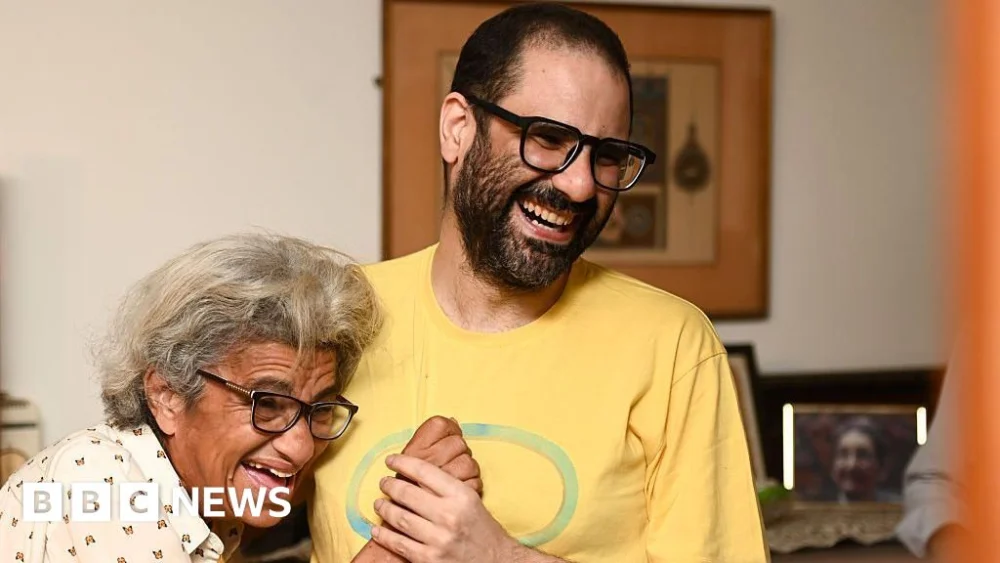
Abd El Fattah’s journey to the UK on Friday marked a significant moment, reuniting him with his family for the first time in 12 years. His release followed extensive international pressure from human rights organizations and diplomatic efforts by the British government, which had long championed his case, arguing that he had been unfairly detained. He is a hugely symbolic figure, having risen to international prominence during Egypt’s 2011 uprising that ultimately led to the resignation of then-President Hosni Mubarak. For over a decade, he has been a vocal critic of successive Egyptian governments, enduring long periods behind bars. His most recent incarceration, which began in September 2019, culminated in a 2021 conviction for "spreading fake news" after he shared a Facebook post detailing alleged torture in prison. This trial was widely condemned by human rights groups as a politically motivated travesty of justice, lacking due process and fair evidence.
Upon his arrival in the UK, his release was initially welcomed by many, including the Prime Minister, who posted a welcoming message on X (formerly Twitter). However, this initial optimism quickly dissolved as old social media posts attributed to Mr. Abd El Fattah resurfaced. These posts contained shocking and inflammatory content, including calls for the killing of Zionists and police officers. The revelation ignited a fierce political firestorm, drawing immediate and widespread criticism from across the political spectrum and raising serious questions about the vetting processes that preceded his entry and the government’s advocacy for his release.
Sir Keir Starmer, the leader of the Labour Party, swiftly condemned the resurfaced posts, describing them as "absolutely abhorrent." He stated he was previously unaware of the comments and indicated that the government was "taking steps to review the information failures in this case," suggesting a systemic breakdown in intelligence sharing or assessment. The emergence of these comments, particularly amidst a global surge in antisemitism and recent horrific attacks, added significantly to the distress of many in the Jewish community in the UK, who voiced profound concerns about the implications of such rhetoric. In response to the growing outcry, Foreign Secretary Yvette Cooper formally requested a senior civil servant to launch a comprehensive review into why ministers in both the current and previous governments were not made aware of Mr. Abd El Fattah’s controversial previous comments during the period of intense diplomatic engagement for his release.
In an apparent attempt to mitigate the damage, Mr. Abd El Fattah issued an apology in a statement released in the early hours of Monday morning. In his statement, he acknowledged that he understood "how shocking and hurtful" the posts were, attributing them to "expressions of a young man’s anger." This apology was initially welcomed by Downing Street, with the Prime Minister’s spokesman describing it as a "fairly fulsome apology and that’s clearly the right thing to do." The government seemed keen to draw a line under the controversy and move forward.
However, the fragile truce proved short-lived. Within hours of his public apology, BBC News established that Mr. Abd El Fattah’s official Facebook account, which had earlier shared a heartwarming photo of him being reunited with his 14-year-old son Khaled in the UK, liked another user’s post. This post described the burgeoning criticism against him as a "relentless smear campaign" being waged by powerful entities, specifically naming "the richest man in the world, a couple of Middle East intelligence services, and a few Zionist organisations." Further exacerbating the situation, Shadow Justice Secretary Robert Jenrick highlighted a second post liked by Mr. Abd El Fattah’s Facebook account on the same day, which similarly claimed he was a victim of a campaign orchestrated by Zionists. While BBC News confirmed seeing a screenshot of this second message, the original post subsequently appeared to have been deleted, adding another layer of suspicion.
These subsequent social media interactions ignited a fresh wave of outrage, with critics arguing that they undermined the sincerity of his earlier apology. Robert Jenrick was particularly vocal, asserting that the two liked posts "show El Fattah’s apology was insincere and scripted." He continued, "Far from distancing himself from his earlier extremist views, he confirms that he still holds them. Far from showing contrition, he is presenting himself as the victim of a conspiracy." Jenrick’s strong words suggested that Abd El Fattah was not genuinely remorseful but rather strategically positioning himself as a victim of external forces, thereby reinforcing, rather than repudiating, the very sentiments that had caused the initial uproar.
The gravity of these developments led Jenrick to suggest that the threshold for revoking Mr. Abd El Fattah’s British citizenship "could be met." He argued that Abd El Fattah "was, and remains, a threat to national security, and his presence in the UK is clearly not conducive to the public good." This call to revoke citizenship quickly gained traction among certain political factions. Both the Conservatives and Reform UK have publicly urged the government to strip him of his British citizenship and deport him, citing the extreme nature of his past comments and his apparent endorsement of conspiracy theories.
The Home Secretary possesses statutory powers to strip a dual national of their citizenship if it is deemed not to be "conducive to the public good." In practice, however, this power has typically been reserved for the most serious cases, predominantly those linked to terrorism or severe organised crime, where an individual is demonstrably considered a national security threat. Despite the mounting political pressure, it is understood that Downing Street currently believes that the high legal bar required for such an extreme measure is not met in Mr. Abd El Fattah’s case. Furthermore, any decision to revoke citizenship is almost invariably met with a potentially lengthy and expensive legal challenge, which the government would likely prefer to avoid unless absolutely necessary. The activist was granted British citizenship in December 2021, while the Conservatives were in power, a status he was eligible for through his London-born mother. This background further complicates the political narrative, as the government had actively championed his cause.
This is not the first time Mr. Abd El Fattah’s online comments about Israel have caused controversy. A decade ago, in 2012, he was withdrawn as a nominee for a human rights prize due to similar online statements. This historical pattern suggests a consistent thread in his views, making his recent apology and subsequent social media activity all the more scrutinized. Rail minister Lord Hendy reiterated the government’s commitment to investigating the "information failures," stating, "What he said was clearly quite abhorrent. Nobody would subscribe to that – certainly not the government. And now there is an inquiry by the Foreign Office about how these tweets were overlooked."
The unfolding saga highlights the intricate challenges faced by governments in balancing human rights advocacy with national security concerns and domestic political pressures. It underscores the immense power of social media to resurrect past statements, shape public opinion, and influence policy decisions. The case of Alaa Abd El Fattah has transformed from a story of a celebrated dissident’s liberation into a deeply divisive debate about free speech, extremism, and the responsibilities of citizenship in an increasingly polarized world. The Foreign Office inquiry continues, and the government faces persistent questions about how it will navigate the complex legal and political ramifications of an activist whose past and present online activities continue to generate significant controversy.



 Roy Suryo

 Nakalama John
 atisusanti
