Nana Banana
In a move that has ignited significant debate and drawn sharp criticism from environmental groups, Lincolnshire County Council (LCC) has formally abandoned its ambitious target to achieve carbon neutrality by 2050. The decision, spearheaded by the newly elected Reform UK administration, was made at a contentious council meeting on Tuesday, where financial viability concerns were prioritized over the existing climate commitment. The council leader, Sean Matthews, unequivocally declared the previous 2050 net-zero goal "completely unachievable," citing an undue financial burden on local taxpayers.
The original carbon-neutral target, established in 2021 by the preceding Conservative-led administration, aimed to bring the council’s operations and, by extension, influence across the county, to net-zero emissions within three decades. This commitment aligned with the UK government’s national target for net-zero by 2050, reflecting a growing consensus at the time that local authorities had a crucial role to play in tackling climate change. However, the political landscape in Lincolnshire has shifted dramatically, leading to a re-evaluation of these priorities.

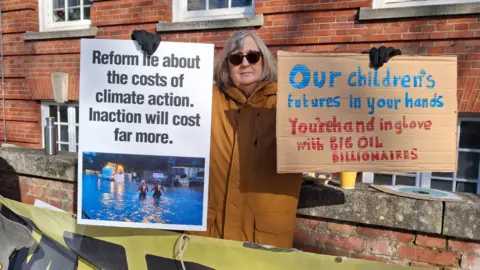
The Tuesday council meeting in Lincoln was not without drama, experiencing two disruptions by environmental protestors who vocalized their dismay at the proposed policy change. Members of Extinction Rebellion were present, holding signs and attempting to highlight the perceived urgency of climate action. Following the meeting, Reform UK council leader Sean Matthews articulated his administration’s revised philosophy: "We think it’s better to make the planet a better place in slow time rather than rush to it." This statement encapsulates a more gradualist approach, contrasting sharply with the immediate and decisive action called for by climate activists.
Eddie Francis, an Extinction Rebellion member who witnessed the proceedings, condemned the council’s decision as "completely irresponsible to drop net zero by 2050." He emphasized the scientific consensus on the accelerating climate crisis and the imperative for swift decarbonization. Christine Brookman, another Extinction Rebellion activist, echoed these concerns, stating her profound worry for the future of her children and grandchildren. She accused the Reform UK leadership of "ignoring the fact that there’s a climate emergency," suggesting a dangerous disconnect between local governance and global environmental realities.
The core of the Reform UK administration’s argument rests on economic pragmatism. Councillor Danny Brookes, the executive member for the environment, asserted that the 2050 net-zero goals were "unachievable goals that the government has set for us, but hasn’t given anybody any money to do it. They’ve expected the taxpayer to fund it all." This highlights a significant tension often faced by local authorities: the expectation to meet national environmental targets without adequate central government funding, forcing councils to consider how such ambitious projects would be financed within already stretched budgets. Achieving net-zero for a large rural county like Lincolnshire would indeed involve substantial investment in areas such as electrifying council vehicle fleets, retrofitting public buildings for energy efficiency, developing local renewable energy sources, and adapting waste management strategies – costs that the Reform UK administration deemed prohibitive for local taxpayers.

Council leader Sean Matthews further elaborated on his priorities, stating: "My priority is looking after the people of Lincolnshire. That means money and a better environment for them to live in." He linked this to a specific local concern, adding, "It means no solar farms destroying our wonderful crops." This comment touches upon a contentious issue in many agricultural regions, where the expansion of solar energy projects raises debates about land use, food security, and landscape preservation. Matthews also expressed skepticism about the local impact on global climate change, remarking on greenhouse gases as "some gas that we make no difference to," suggesting a belief that Lincolnshire’s emissions are too insignificant to warrant such an aggressive and costly target. This perspective, while controversial, reflects a common argument in some political circles that local action is futile without broader international consensus and participation.
Instead of the 2050 carbon-neutral target, the council has adopted a new "Green Masterplan." While the specifics of this new plan were not fully detailed in the immediate aftermath of the meeting, it is understood to represent a shift towards a more localized, less prescriptive approach to environmental management. The previous carbon-neutral target involved a comprehensive strategy to reduce direct emissions from council operations (e.g., energy consumption in buildings, vehicle fleet, waste) and indirect emissions influenced by council policies (e.g., through procurement, planning, and encouraging county-wide decarbonization). The new Green Masterplan is likely to focus on practical, cost-effective environmental improvements that the council believes will directly benefit residents without imposing what they perceive as unsustainable financial burdens. This could include initiatives related to local biodiversity, waste reduction, or specific energy-saving measures, but without the overarching, time-bound commitment to carbon neutrality.
The geographical and economic context of Lincolnshire makes the debate particularly pertinent. As a predominantly rural and agricultural county, Lincolnshire is highly vulnerable to the impacts of climate change. Rising sea levels pose a direct threat to its extensive coastline and low-lying areas, while changes in weather patterns, including increased frequency of extreme weather events like floods and droughts, could devastate its agricultural sector. Eddie Francis of Extinction Rebellion highlighted this, asserting that "You only have to look at the news to know extreme weather events are a big concern for Lincolnshire." The county has historically experienced significant flooding, and its agricultural economy relies heavily on stable climatic conditions. Environmentalists argue that foregoing a robust climate target now will inevitably lead to higher costs in the future, as the county will need to adapt to more severe climate impacts.
The decision by Lincolnshire County Council also places it within a broader national discourse about the feasibility and cost of net-zero targets for local authorities. While the UK government remains committed to its national 2050 net-zero goal, the financial pressures on local councils are immense, exacerbated by years of austerity and rising demand for public services. Some councils across the UK have faced similar dilemmas, weighing their environmental ambitions against immediate budgetary constraints. However, many other councils are actively pursuing ambitious climate action plans, often through innovative funding models and collaborations.
The reaction from other councillors has been mixed. Independent councillor Ashley Baxter expressed his disappointment, calling the new plan a "backward step" for the county’s environmental progress. This sentiment reflects a concern that by removing the overarching target, the council loses a crucial driver for integrated and long-term climate action. Conversely, Chris Miller, the head of environment at the authority, offered reassurance that despite the scrapping of the explicit 2050 target, the council would still continue its efforts to reduce its carbon emissions. This suggests that some environmental work will persist, albeit without the pressure of a specific, legally-binding net-zero deadline.
The implications of Lincolnshire County Council’s decision are far-reaching. For environmental advocates, it represents a significant setback and a worrying precedent for other local authorities. For the Reform UK administration, it is presented as a fiscally responsible move, prioritizing the immediate economic well-being of its constituents. The effectiveness and scope of the new "Green Masterplan" will now be under intense scrutiny, as will the long-term environmental and economic consequences for a county uniquely exposed to the challenges of a changing climate. The debate over balancing economic realities with environmental imperatives in local governance continues to intensify.




 Roy Suryo