
 Nana Banana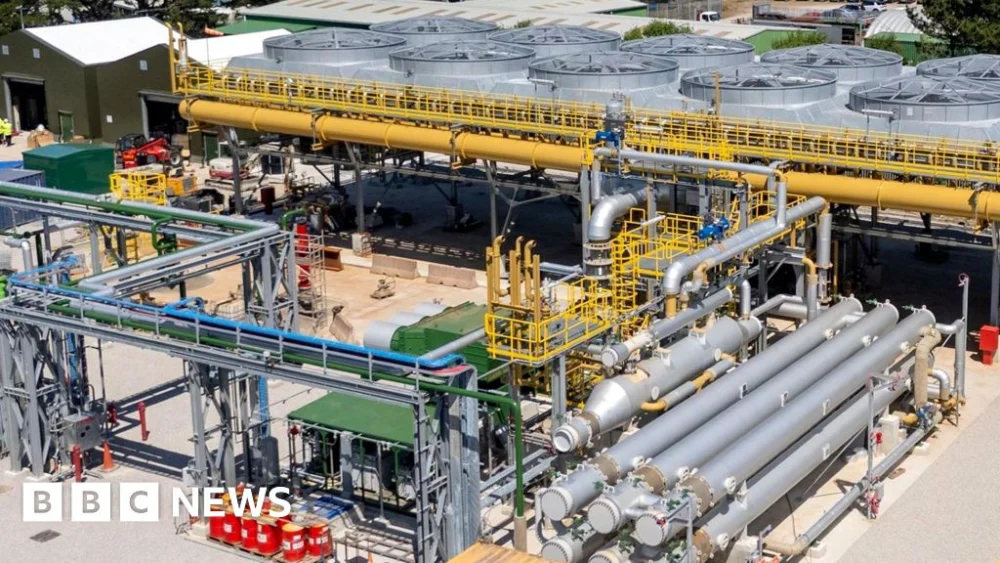
The United Kingdom has achieved a significant milestone in its journey towards a sustainable energy future with the activation of its inaugural deep geothermal power plant in Cornwall. This pioneering facility, located at United Downs near Truro, represents a completely new frontier in the UK’s renewable energy landscape, harnessing the Earth’s natural heat to generate a continuous supply of clean electricity. The plant, developed by Geothermal Engineering Ltd (GEL), officially switched on Thursday morning, marking the culmination of nearly two decades of intensive development and intricate engineering.
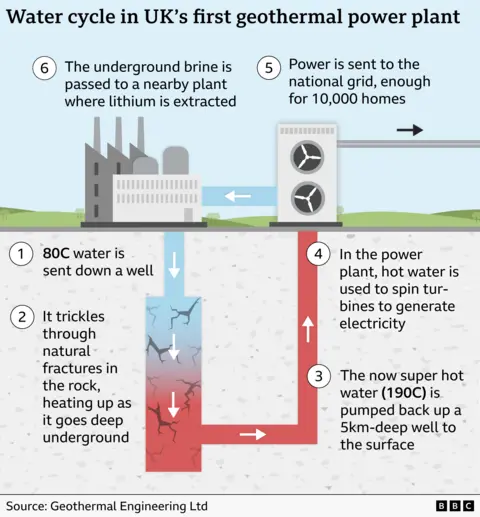
At the heart of this groundbreaking project lies the deepest on-shore well ever drilled in the UK, a testament to the technical ambition required to tap into this subterranean power source. The process involves circulating water deep underground, where it is super-heated by the Earth’s naturally occurring geothermal gradients within the granite rock formations. This intensely hot water is then brought back to the surface, where its thermal energy is used to drive turbines, generating electricity for approximately 10,000 homes. This "always-on" characteristic distinguishes deep geothermal from intermittent renewables like wind and solar, offering a crucial baseload power source that can operate irrespective of weather conditions.
Beyond its primary function of electricity generation, the United Downs plant also holds immense strategic importance as it will provide the UK’s first domestic supply of lithium. This critical mineral is indispensable for modern green technologies, particularly in the manufacturing of batteries for electric vehicles (EVs) and energy storage systems. The ability to extract lithium alongside electricity positions the plant as a dual-purpose asset, contributing significantly to both the UK’s clean energy goals and its critical mineral security.
Experts from the British Geological Survey (BGS) have hailed the project as a "major step forward" for geothermal energy in the UK, acknowledging its potential to diversify the national energy mix. However, they also highlighted the substantial financial investment and technical challenges associated with drilling to such extreme depths, suggesting that replicating the project on a wider scale could face hurdles due to high upfront costs. The United Downs project itself has incurred costs of approximately £50 million to date, funded through a combination of private investors and a significant £15 million grant from the European Development Fund, a mechanism the UK had access to prior to its departure from the European Union.
Geothermal energy, at its core, leverages the heat generated within the Earth’s crust. While shallow geothermal applications, such as ground source heat pumps, are already employed in some parts of the UK to warm homes and businesses, deep geothermal technology like that at United Downs taps into far greater depths and temperatures to generate electricity. At three miles (approximately 4,800 metres) below the surface, temperatures can soar to nearly 200°C. Dr. Monaghan, head of geothermal at the BGS, explained the mechanism: "You drill deep boreholes into the ground, and then fractures within the granite rock are used to circulate the water that pick up the heat [that is] used for electricity production." Cornwall’s geology, characterized by its abundant granite, makes it particularly well-suited for this technology, as granite is highly effective at retaining and conducting the Earth’s heat.
Ryan Law, CEO of GEL, expressed immense satisfaction at the plant’s operational status, stating, "[I’m] tremendously excited after 15 years of hard graft, difficulties, we’re finally there." He underscored the strategic importance of geothermal power for the UK, particularly its immunity to the price fluctuations that plague fossil fuels like gas. "And unlike other renewable sources like wind and solar we are constantly on, 24/7 electricity," Law added, emphasizing its reliability as a baseload power source.
The electricity generated at the United Downs site has been secured by Octopus Energy, a leading energy supplier, and will be fed into the national grid to power up to 10,000 homes. An Octopus spokesperson lauded the project as a "genuine game-changer," highlighting that "for the first time, we’re tapping into ‘always-on’ green power in the UK, providing a steady stream of clean, home-grown energy." This partnership demonstrates a growing confidence in geothermal as a viable and valuable component of the UK’s future energy infrastructure.
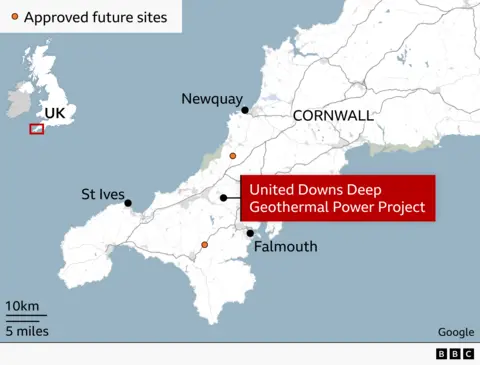
GEL has ambitious plans for further expansion, with two additional sites already approved for development into power plants in Cornwall. However, one proposed site has faced initial rejection due to environmental concerns, though the company is actively appealing the decision. The potential for deep geothermal extends beyond Cornwall, with similar geological conditions in regions like Scotland and the Northeast of England also making them technically feasible locations for such projects, though no approved plans currently exist in these areas.
Anne Murrell, head of the industry body Geothermal UK, voiced her belief that the UK possesses a significant, untapped energy resource beneath its surface. She stressed that while the cost of deep geothermal is comparable to other forms of electricity generation over its lifespan, the substantial upfront capital expenditure, primarily for drilling, presents a barrier. "The challenges we have include investment, and to unlock investment and increase investor confidence, we need a supportive government policy framework – geothermal needs to be recognised by government as a key part of our energy strategy," Murrell urged. This call for policy support echoes the sentiment within the nascent geothermal sector for clearer governmental backing to de-risk investments and accelerate deployment.
In a move signaling increasing governmental interest, Lord Whitehead was appointed as the country’s first geothermal minister late last year. Commenting on the United Downs project ahead of its switch-on, Lord Whitehead hailed it as a "groundbreaking moment for UK energy innovation," underscoring the government’s recognition of geothermal’s potential role in achieving net-zero targets and enhancing energy security.
While deep geothermal for electricity generation is just beginning in the UK, shallow geothermal applications are already more widespread. Approximately 30,000 ground source heat pumps are currently installed in UK homes, with government grants available to mitigate installation costs. Businesses and local authorities are also adopting the technology; for instance, Gateshead council utilizes heat from flooded abandoned coal mines to warm hundreds of homes. It is estimated that a quarter of UK homes sit above such mines, presenting a vast, underutilized resource for heating. Internationally, countries like the Netherlands have set ambitious targets, aiming for a quarter of their homes to be heated using geothermal by 2050.
The International Energy Agency (IEA) reports a rapid surge in global investment in deep geothermal for electricity, with an 80% year-on-year increase since 2018. This growth is partly driven by the escalating electricity demands of tech giants. Data centers, which require immense amounts of power, are increasingly turning to geothermal solutions. Companies like Google, Meta, and Microsoft are exploring partnerships with geothermal power providers to fuel their energy-intensive operations. A notable benefit for data centers is the ability to integrate with geothermal systems, where excess heat produced by the centers can be efficiently recirculated underground, further enhancing energy efficiency.
The United Downs project’s ability to extract lithium carbonate adds another layer of strategic importance. This marks the UK’s first commercial source of this vital "critical mineral," which is fundamental for electric batteries. While the initial production capacity will be modest—around 100 tonnes of lithium annually, sufficient for approximately 1,400 electric vehicle batteries—GEL has ambitious plans to scale this significantly to 18,000 tonnes per year. This potential domestic supply is critical, given that China currently processes over 60% of the world’s lithium, making the development of secure, local sources a strategic imperative for the UK’s green transition and supply chain resilience. The UK government has demonstrated its commitment to this aspect of the project, providing a £1.8 million grant, covering 50% of the initial lithium extraction costs.
The activation of the United Downs geothermal power plant represents not just a technological achievement but a pivotal moment for the UK’s clean energy strategy. It demonstrates the tangible potential of harnessing the Earth’s boundless heat to provide stable, low-carbon electricity and essential raw materials. While challenges remain, particularly around investment and policy support, this Cornish project illuminates a promising path forward, establishing geothermal energy as a robust and integral component of the UK’s future energy mix.


 George Anjay
 Nakalama John
 atisusanti
 Ramos Leo
 Roy Suryo