George Anjay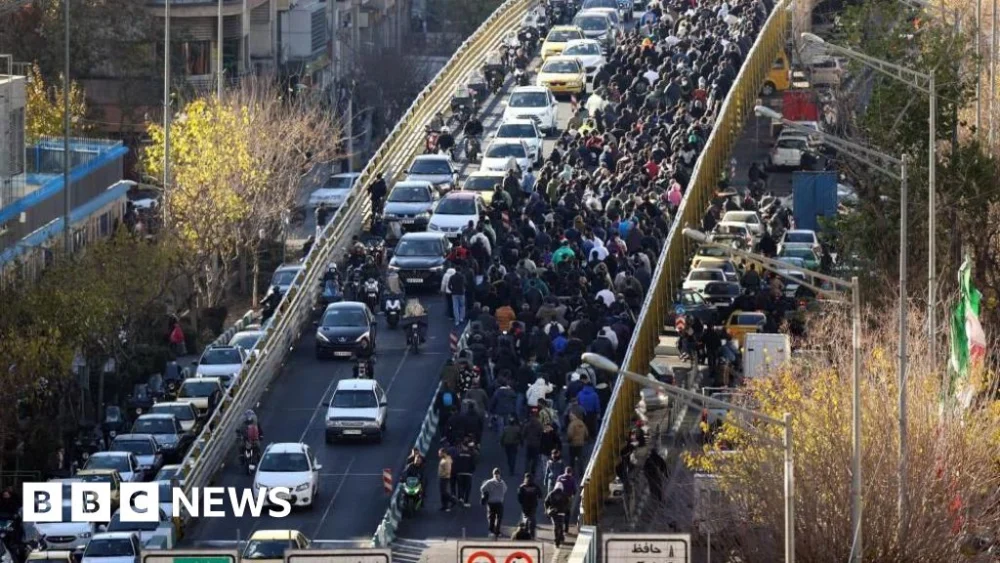
Two people are reported to have been killed during growing unrest in Iran on the fifth day of protests over the soaring cost of living, marking a significant escalation in the ongoing demonstrations that have gripped cities across the nation. Both the semi-official Fars news agency and the human rights group Hengaw reported fatalities during violent clashes between demonstrators and security forces in the city of Lordegan, located in the southwestern province of Chaharmahal and Bakhtiari. The grim toll underscores the volatile nature of the protests, which have been fueled by deep-seated economic grievances and broader political discontent.
Videos circulating on social media platforms on Thursday depicted scenes of chaos and confrontation, with cars set ablaze amidst running battles between enraged citizens and the state’s security apparatus. The intensity of these clashes suggests a palpable level of frustration and anger among the populace, pushing many to take to the streets despite the risks. The slogans and demands emanating from the protests have also taken a decidedly political turn, with many participants explicitly calling for an end to the rule of the country’s Supreme Leader, Ayatollah Ali Khamenei. In a striking display of historical nostalgia and opposition to the current Islamic Republic, some protesters have even voiced calls for a return to a monarchical system of governance, harkening back to the pre-revolutionary era.
Thursday’s reported deaths mark the fifth consecutive day of protests that have spread to numerous cities throughout Iran, ignited by a severe currency collapse that has dramatically devalued the national income and eroded purchasing power. The economic hardship, exacerbated by international sanctions and domestic mismanagement, has pushed many Iranians to the brink, transforming simmering discontent into widespread public demonstrations.
Verified footage shared by BBC Persian offers a visual testament to the breadth of the unrest, showcasing protests unfolding in the central city of Lordegan, the capital Tehran, and Marvdasht in the southern Fars province on Thursday. The sheer geographical spread of these demonstrations highlights the pervasive nature of the economic and political grievances that have galvanized the population.
The Fars news agency, citing an unnamed "informed official," reported that two individuals lost their lives in Lordegan. However, the report was ambiguous regarding the identities of the deceased, not specifying whether they were protesters or members of the security forces. This lack of clarity is often characteristic of official statements in Iran during times of unrest, raising questions about transparency and accountability.
In contrast, the human rights group Hengaw provided more specific details, asserting that the two individuals killed were protesters. Hengaw identified them as 21-year-old Ahmad Jalil and a 28-year-old man identified by his surname, Khaledi. While BBC Persian has not been able to independently verify these deaths, the detailed information provided by Hengaw lends credence to their account, as the organization has a track record of monitoring human rights abuses in Iran.
Adding to the casualties, state media separately reported the death of a member of the security forces on Wednesday night in the city of Kudasht, located in the western Lorestan province. This individual was reportedly affiliated with Iran’s elite Revolutionary Guards (IRGC), a powerful entity within the Iranian state apparatus. However, this claim has been contested by protesters, who allege that the deceased was, in fact, one of their own, shot and killed by the security forces. This conflicting narrative underscores the deep mistrust between the public and the authorities, and the difficulty in obtaining objective information from the ground.
According to the state media report, an additional 13 police officers and members of the Basij militia, a paramilitary force often used to suppress dissent, sustained injuries from stone-throwing incidents in the Kudasht area. This detail suggests that the confrontations were not one-sided and that protesters, driven by desperation, resorted to aggressive tactics.
In an apparent attempt to defuse the escalating situation and prevent further mobilization, authorities declared a bank holiday across the country on Wednesday, leading to the closure of schools, universities, and public institutions. While the official justification for this measure was to conserve energy due to cold weather, many Iranians perceived it as a strategic move to disrupt and contain the ongoing protests. The government’s actions reflect a dual approach: outwardly acknowledging the need for calm while simultaneously employing measures to control the narrative and limit public assembly.
The current wave of protests initially erupted in Tehran, primarily among shopkeepers who were incensed by another significant depreciation of the Iranian currency against the US dollar in the open market. The relentless decline of the rial has had a devastating impact on the daily lives of ordinary citizens, making essential goods increasingly unaffordable and eroding their savings.
By Tuesday, the demonstrations had broadened to include university students, signifying a growing convergence of grievances across different segments of society. The protests quickly spread to several other cities, with participants openly chanting slogans against the country’s clerical leadership. This expansion demonstrates that the economic crisis is not an isolated issue but rather a symptom of deeper systemic problems that have fueled widespread dissatisfaction.
These protests, while significant, have not yet reached the same scale as the nationwide uprising in 2022, which was sparked by the death of Mahsa Amini in the custody of the morality police. The 2022 protests, fueled by anger over the mandatory hijab laws and the broader repression of women’s rights, were characterized by their intensity and widespread participation. The current demonstrations, though perhaps less widespread in sheer numbers, represent a persistent and growing challenge to the government’s authority, driven by a combination of economic desperation and a desire for fundamental political change.
In an effort to prevent any further escalation, tight security measures have reportedly been implemented in the areas of Tehran where the demonstrations began. This visible display of force aims to deter potential protesters and signal the government’s resolve to maintain order, even at the cost of suppressing dissent.
President Masoud Pezeshkian has publicly stated that his government is willing to listen to the "legitimate demands" of the protesters, suggesting a potential opening for dialogue. However, this conciliatory tone is juxtaposed with a stark warning from the prosecutor general, Mohammad Movahedi-Azad, who has vowed that any attempt to create instability will be met with what he described as a "decisive response." This dual messaging highlights the complex and often contradictory approach of the Iranian government in dealing with public unrest, oscillating between acknowledging grievances and resorting to forceful suppression. The future trajectory of these protests will likely depend on the government’s ability to address the underlying economic issues and the extent to which it chooses to engage with or repress the growing discontent among its citizens. The reported deaths in Lordegan serve as a grim reminder of the high stakes involved in this unfolding crisis.

 Roy Suryo