Nana Banana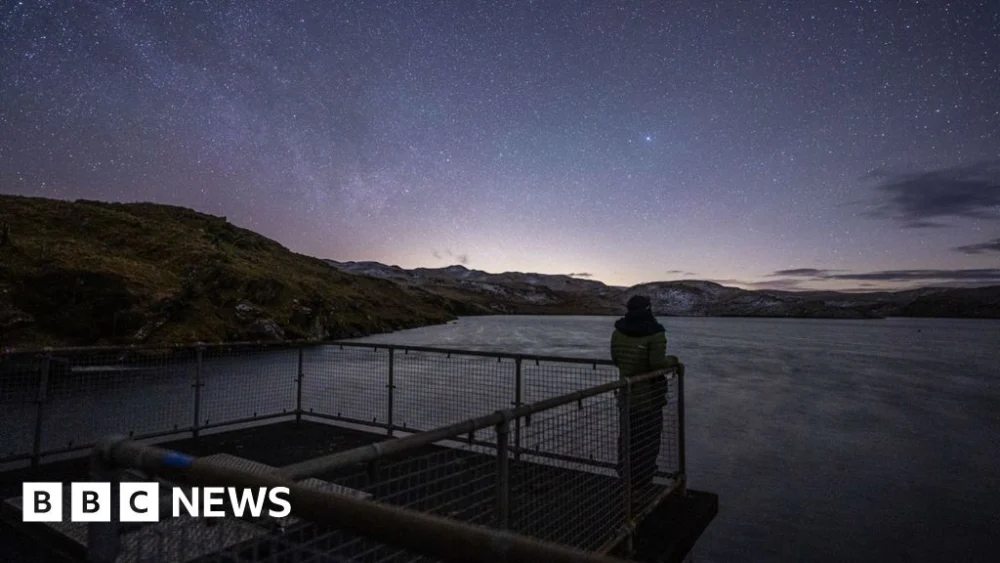
However, hope, like the faintest glimmer of a distant galaxy, persists. Four-and-a-half hours later, at a patient 22:30, the sky begins its slow, magnificent transformation. The clouds, as if by some cosmic command, gradually part, revealing an increasingly dense tapestry of light. When the last vestiges of cloud finally dissipate, what unfolds above is nothing short of breathtaking. Millions upon millions of stars, previously hidden, burst forth in a dazzling display, extending as far as the eye can see, in every conceivable direction. It is an overwhelming, humbling spectacle, a stark contrast to the light-polluted skies I am accustomed to.
I am not alone in witnessing this celestial rebirth. Alongside me are Siân and James Harrison, two enthusiastic star-gazers who have made the pilgrimage from Cardiff to the remote village of Llanddewi-Brefi, nestled within the sweeping, unspoiled Ceredigion countryside. Our shared mission is to immerse ourselves in the wonders of the night sky, guided by an expert who understands not just the science, but the soul of stargazing.
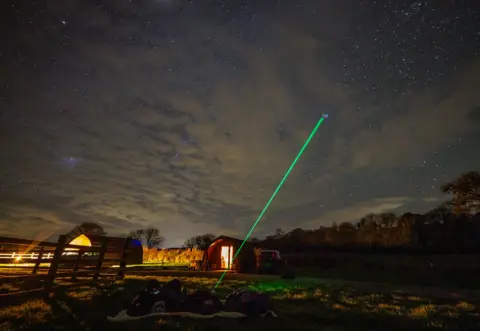
Lying comfortably on a thick blanket spread out on the cool, damp ground, we turn our gaze upwards. The initial focus is on Jupiter, its brilliant light dominating a section of the sky, a beacon in the cosmic ocean. Our guide, Dafydd Wyn Morgan, owner of the astrotourism company Serydda, uses a powerful green laser pointer, its beam stretching impossibly into the blackness, to highlight specific celestial features. He gestures towards three prominent stars aligned in a row, his voice filled with genuine affection as he declares his love for Orion’s Belt.
James, equally captivated, chimes in, confirming Orion’s Belt as his personal favourite constellation. He explains the deeper significance of the region surrounding it – a vibrant stellar nursery where new stars are constantly being born from colossal clouds of gas and dust. His words underscore the immense scale of what we are witnessing. "I’ll focus on something and it’ll be 150 million light years away," James marvels, a sense of profound wonder in his voice. "I can’t quantify that." His reflection echoes a universal human struggle to comprehend such vastness, reducing our earthly concerns to fleeting insignificance.
As I absorb the dazzling panorama above, an extraordinary sense of calm washes over me. The sheer multitude of stars, unobscured by artificial light, feels deeply ancient. I am struck by the profound realization that I am gazing upon a sky that my ancestors, millennia ago, would have seen – a timeless connection to humanity’s past, before the advent of urban glow. It’s a primal, visceral experience that grounds me while simultaneously expanding my perception of the universe.
Wyn Morgan’s "star bathing" sessions are designed to cultivate this very emotional and spiritual connection. Much like "forest bathing" (Shinrin-yoku), a practice originating in Japan in the 1980s that involves immersing oneself in the atmosphere of the forest for therapeutic benefits, star bathing encourages a mindful engagement with the night sky. It has become a growing component of astrotourism and a wider range of wellness practices. His sessions involve setting up a smart telescope, then lying on the ground, sharing insights into the celestial sights on display, and recounting the rich tapestry of myths and legends connected to them.
"It’s about the feeling at that precise moment," Wyn Morgan explains, emphasizing the emotional impact over rigorous scientific identification. "How it makes you feel emotionally, rather than something more scientific which requires you to know about everything you see." Yet, he believes this initial emotional spark can often ignite a deeper interest, empowering participants with the confidence and curiosity to delve further into stargazing on their own.
Wyn Morgan launched Serydda in January 2025, building on years of experience organizing events with his friend, the world-renowned astrophotographer Alyn Wallace, who sadly passed away in 2024. Since its inception, Serydda has welcomed 107 participants, with many returning two or three times to explore different dark sky locations across Wales. This rising interest in star bathing is not isolated; a Booking.com survey of 27,000 travellers revealed that 72% expressed interest in visiting darker sky destinations for such experiences.
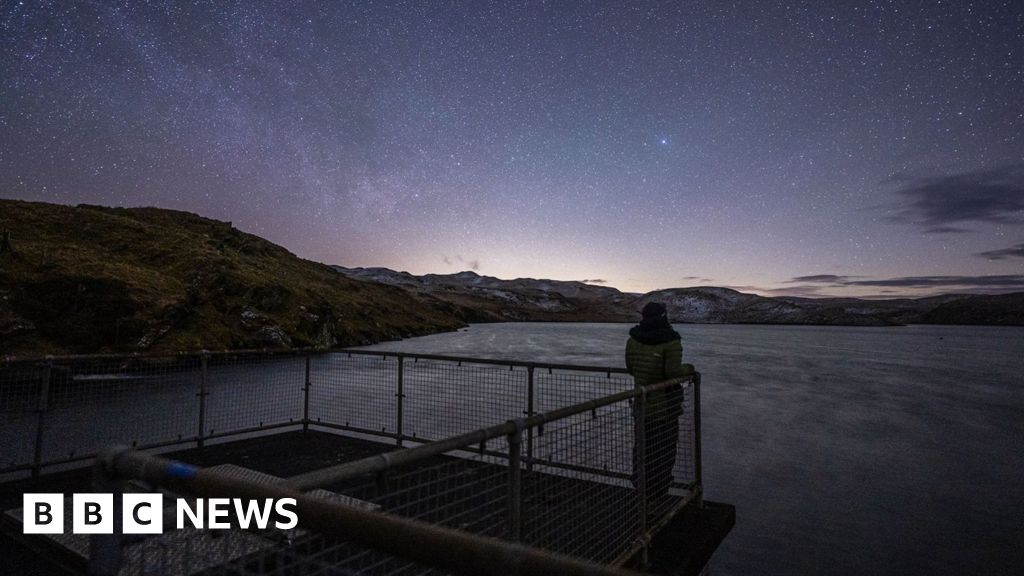
Our celestial journey continues as we drive further into the wilderness, ascending to Llyn Teifi in the rugged Cambrian mountains. Here, surrounded by stark rocky outcrops and sprawling marshland, we stand on a bridge, the silence broken only by the gentle whisper of the wind. "Can you smell that?" Wyn Morgan asks, inviting us to engage another sense. "Breathing in the night sky is something totally different: cool, cold, fresh, and pure – like drinking water from a well." The air is crisp, invigorating, adding another layer to the sensory richness of the experience. It is here, under this expansive canopy, that I experience a moment of pure, child-like joy as I spot fleeting shooting stars, their brief, fiery arcs a reminder of the dynamic, ever-changing universe above.
Humanity’s fascination with the night sky is ancient, ingrained in our very core. "It goes back to the very core of humanity," explains Dani Robertson, a dedicated dark skies officer for Snowdonia National Park (now Eryri National Park). She highlights a concerning reality: 98% of the UK population lives under a light-polluted sky, meaning many are the third or fourth generation to see very few stars – if any – from their homes. This profound disconnect from the natural night environment has significant implications.
Wales is at the forefront of preserving these precious celestial havens, boasting two of the UK’s six national parks with International Dark Sky Reserve status (Eryri National Park and Bannau Brycheiniog National Park). People travel from bustling metropolises like London, often enduring journeys of many hours, to attend Robertson’s events. For them, it’s often their only opportunity to witness the true majesty of the stars and experience genuine darkness.
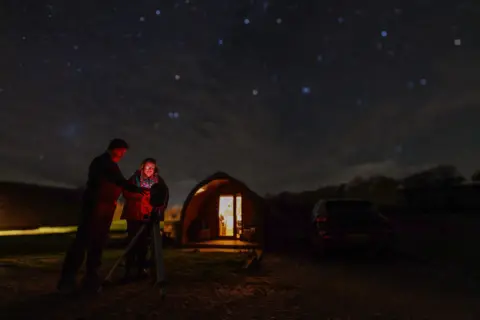
Robertson orchestrates a diverse array of dark sky experiences, including mobile observatory sessions, immersive night hikes, invigorating night swims, and lively meteor watch parties. She recounts a particularly poignant story of a man who, celebrating his 50th birthday, had always yearned to see shooting stars. When they finally streaked across the inky blackness, he was overcome with emotion, sobbing tears of pure wonder. For those living in urban environments, she emphasizes, such an experience is "hugely moving, it’s a once-in-a-lifetime opportunity." The demand is immense; Robertson admits, "I can’t run enough events to keep up with demand. Every event has a huge waiting list."
The therapeutic benefits of nature exposure are well-documented. Annalisa Setti, a senior lecturer of applied psychology and sustainability at University College Cork, explains that engaging with nature has a positive effect on regulating our brain and body. "When we ‘get lost’ observing nature, we experience an optimal level of arousal. We are not bored, nor too excited – and that gives us the feeling of ‘positive relaxation’," she says. Furthermore, Setti’s research indicates that areas of the brain linked with "ruminating on negative thoughts" become less active when people are observing or immersed in nature. The profound quiet and expansive views offered by a dark sky environment amplify these benefits, fostering a deep sense of peace and perspective. If children cannot see stars, Robertson reminds us, they cannot be inspired by them, losing a crucial connection to science, wonder, and their place in the universe.
However, these invaluable benefits and the very existence of truly dark skies face a growing threat. While the cosmos itself is eternal, our view of it is increasingly at risk. Robertson warns that light pollution is steadily increasing, disrupting not only human circadian rhythms but also profoundly affecting the lives of countless other species, from nocturnal animals to migrating birds. The good news, she notes, is that the solution is remarkably simple. Adopting dark-sky friendly bulbs, turning off lights when they are not actively needed, and the simple act of closing curtains at night can collectively make a significant difference. It is a call to action, reminding us that preserving the night sky is a shared responsibility.
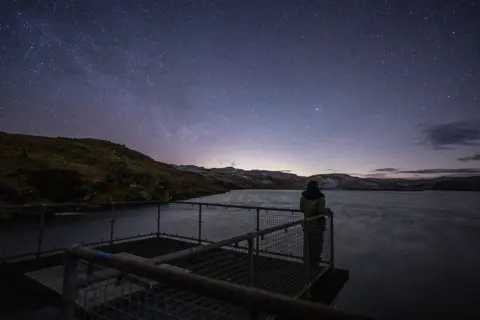
Standing in the hushed mountains at about 02:00, the cold air invigorating, a subtle, ethereal cloud-like formation becomes visible in the vast expanse above. It’s initially indistinct, a faint smear across the heavens. It’s only the excited, hushed whispers of Siân and James that make me fully grasp the incredible reality of what I am witnessing – it is the Milky Way itself, our home galaxy, stretching across the sky like a luminous river of stars.
We stand in profound silence, utterly captivated, staring at this colossal collection of gas, dust, dark matter, and billions upon billions of stars. It is a moment of pure, unadulterated awe. "To be able to look at these things and appreciate the beauty," James says, his voice barely a whisper, "the majesty and the scale of it – it’s just amazing." His words perfectly encapsulate the overwhelming power of the experience. In that moment, under the radiant embrace of the Milky Way in rural Wales, I feel both incredibly small and profoundly connected to something infinitely larger than myself. It is an experience that transcends mere sightseeing, a deep immersion in the cosmos that leaves an indelible mark on the soul.


 George Anjay
 Nakalama John
 atisusanti
 Ramos Leo