Nakalama John
Leading industrialised nations, comprising the Group of Seven (G7), are poised to convene an urgent meeting on Monday to address the alarming surge in global oil prices. This critical gathering comes as crude oil benchmarks soared past $100 a barrel, with some touching nearly $120, triggering a sharp downturn across international stock markets. The escalating US-Israeli war with Iran, now over a week old, has plunged the global economy into a state of heightened uncertainty, prompting finance ministers from these economic powerhouses to deliberate on coordinated responses to mitigate the widespread economic fallout.
The conflict, which has seen fierce exchanges between the US and Israel on one side, and Iran and its proxies on the other, has directly threatened the stability of global energy supplies. Fears of a prolonged disruption to the crucial Strait of Hormuz shipping route, through which approximately a fifth of the world’s oil supply typically transits, have driven prices to levels not seen in years. This narrow, strategic passage, bordering Iran and Oman, has witnessed a near-complete halt in traffic since hostilities intensified, amplifying concerns about an impending energy crisis.
Among the high-profile attendees at the G7 emergency meeting is UK Chancellor Rachel Reeves, who will join her counterparts from the United States, Canada, France, Germany, Italy, and Japan. Their agenda is expected to focus heavily on the economic implications of the conflict, particularly the skyrocketing energy costs. A key discussion point, as reported by The Financial Times, will be the potential for a joint release of petroleum from strategic reserves, a measure that would be coordinated by the International Energy Agency (IEA). Such an action would mark the first time since 2022 that IEA members have collectively tapped into their reserves, a response then to the market instability caused by Russia’s full-scale invasion of Ukraine. The IEA, an autonomous intergovernmental organisation established in the wake of the 1973 oil crisis, plays a vital role in ensuring global energy security, and its intervention underscores the severity of the current situation.
The decision to consider a coordinated release from strategic petroleum reserves highlights the gravity of the G7’s concerns. These reserves, maintained by various countries as a buffer against supply shocks, are intended for precisely such emergency situations. While a release could provide a temporary calming effect on markets and potentially bring down prices, its long-term efficacy depends heavily on the duration and intensity of the conflict. Analysts suggest that while it might alleviate immediate pressures, it would not resolve the fundamental geopolitical risks driving the price hikes. The symbolism of such a coordinated action, however, would be powerful, signaling global unity and determination to stabilize energy markets.
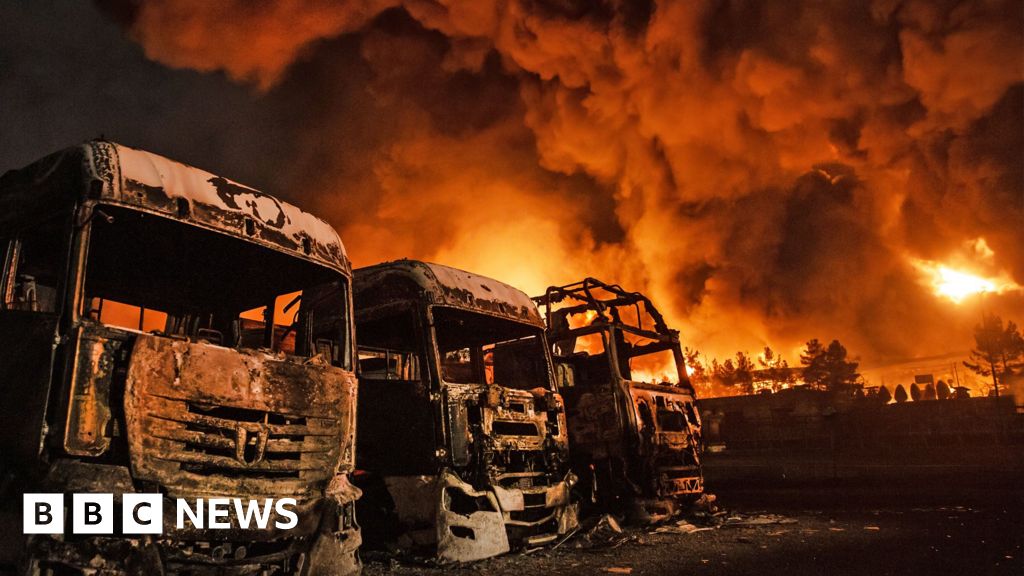
The geopolitical landscape further complicated by the conflict adds layers of concern. On Sunday, Iran’s announcement of Mojtaba Khamenei succeeding his father, Ali Khamenei, as Supreme Leader signaled a hardening of political lines within the Islamic Republic. This move suggests that hardliners remain firmly in control, potentially indicating a prolonged and uncompromising stance in the ongoing conflict. The US and Israel intensified their aerial campaigns over the weekend, launching fresh waves of airstrikes across Iran, targeting multiple sites including critical oil depots. In retaliation, Iran has aimed at energy infrastructure in neighboring Gulf states. Saudi Arabia reported successfully intercepting and destroying two waves of drones targeting a major oilfield overnight, underscoring the regional contagion of the conflict and the direct threat to major oil producers.
These developments sent shockwaves through global financial markets. On Monday morning in Asia, the price of Brent crude, the international benchmark, initially surged by over 25%, touching an intra-day high of $119.50 a barrel before retreating slightly to around $107. Similarly, US West Texas Intermediate (WTI) crude experienced significant volatility, trading at approximately $104 a barrel. The ripple effect extended to natural gas markets, with UK gas prices for month-ahead delivery spiking by nearly 25% to 171p a therm at the start of trading, before settling back to about 156p a therm.
European stock markets mirrored the downturn seen in Asia. Germany’s Dax and France’s Cac 40 indexes both opened significantly lower, shedding around 2.5% of their value. In London, the FTSE 100 index experienced a broad decline, falling 1.5%, with almost all constituent shares registering losses. Notably, oil giants BP and Shell were among the few companies to see their share prices increase, benefiting from the surge in crude oil prices, illustrating the complex and often counter-intuitive dynamics of market reactions during crises.
Earlier in Asia, the impact was even more pronounced. Japan’s Nikkei 225 index plummeted by 5.2%, while South Korea’s Kospi index closed down a staggering 6%. Trading on the Kospi was even temporarily halted for 20 minutes by a "circuit breaker," a mechanism designed to curb panic selling and excessive volatility. These sharp declines across major indices reflect a profound loss of investor confidence and a scramble for safer assets amid the escalating geopolitical risks and the specter of a global economic slowdown fueled by expensive energy.
Adnan Mazarei, an expert from the Peterson Institute for International Economics, underscored the predictability of the oil price jump, given the halt in production in some Gulf countries and the clear signals of a protracted conflict. "People are realising that this won’t end quickly," Mazarei stated, adding a note of caution that "the promises of insurances and objectives laid out by the US are becoming more unrealistic." This sentiment suggests a growing recognition that the conflict’s resolution will be complex and potentially prolonged, making short-term market corrections unlikely without significant policy interventions or a de-escalation of hostilities.
The situation also presents a domestic political challenge for US President Donald Trump, who campaigned on a platform of bringing down the cost of living. Despite the rising oil prices, Trump has consistently dismissed concerns, reiterating his focus on national security. On Sunday, he posted on his Truth Social platform, stating: "Short term oil prices, which will drop rapidly when the destruction of the Iran nuclear threat is over, is a very small price to pay for U.S.A., and World, Safety and Peace. ONLY FOOLS WOULD THINK DIFFERENTLY!" His Energy Secretary, Chris Wright, further attempted to distance the US from the immediate economic pain, telling broadcasters that Israel, not the US, was primarily targeting Iran’s energy infrastructure. However, the impact on American consumers is undeniable. Data from motorists group AAA revealed that the average price for regular gasoline in the US rose by 11% last week, reaching $3.32 a gallon, sparking concerns about inflationary pressures and their potential effect on consumer spending and the broader economy.
The G7 meeting thus carries immense weight, not only for its potential policy outcomes but also for its signal to global markets. The world watches to see if these leading economies can forge a unified and effective strategy to navigate the twin crises of escalating geopolitical conflict and surging energy prices, preventing what many fear could become a significant drag on global economic growth. The delicate balance between ensuring energy security and managing the broader economic fallout will test the resolve and coordination of the international community in unprecedented ways.
Additional reporting by Osmond Chia.




 Roy Suryo
 George Anjay
 Ramos Leo