
 George Anjay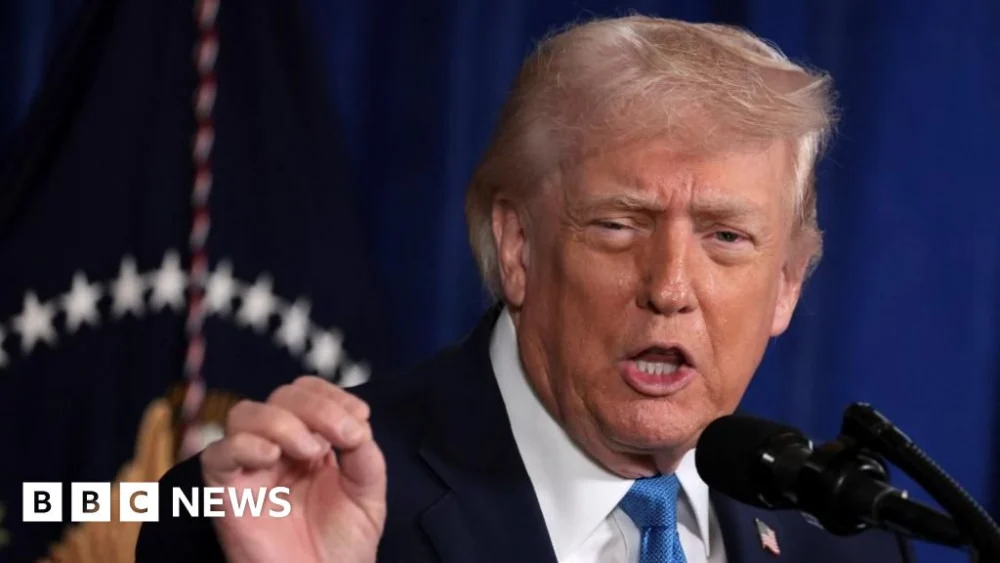
The United States will "run" Venezuela until a "safe, proper and judicious transition" can be ensured, President Donald Trump declared, following a swift and decisive US military operation that led to the capture of Venezuelan President Nicolas Maduro. In a significant pronouncement that signals a new era of American influence in the South American nation, Trump also stated that US oil companies would be instrumental in revitalizing Venezuela’s "broken infrastructure" and "start making money for the country."
The dramatic turn of events unfolded early Saturday morning when US forces launched a targeted operation, resulting in the capture of President Maduro and his wife, First Lady Cilia Flores. Venezuela’s government immediately announced a state of national emergency, denouncing the "military aggression" and reaffirming Maduro as its sole legitimate leader.
Maduro and Flores were reportedly flown out of the capital, Caracas, in the pre-dawn hours aboard a US helicopter. They were subsequently transferred to the USS Iwo Jima, a naval vessel operating in an undisclosed location in the Caribbean Sea. Their journey continued to the Guantanamo Bay US Naval Base in Cuba, before they were placed on another aircraft destined for New York. Upon arrival in the metropolitan area, they were transported by helicopter to the Metropolitan Detention Center in Brooklyn, New York City.
US Attorney General Pam Bondi confirmed that Maduro and Flores had been indicted in the Southern District of New York. The charges include conspiracy to commit narco-terrorism, import cocaine, possession of machine guns and destructive devices, and conspiracy to possess machine guns and destructive devices against the United States. "They will soon face the full wrath of American justice on American soil in American courts," Bondi stated on social media platform X, underscoring the gravity of the legal proceedings.
This development comes after years of Maduro vehemently denying accusations of cartel leadership and consistently framing US actions as a pretext to depose him and seize control of Venezuela’s abundant oil reserves.
Addressing a press conference shortly before Maduro’s arrival in New York, President Trump articulated his vision for Venezuela’s economic future. "The oil business in Venezuela has been a bust, a total bust for a long period of time," he stated. "We’re going to have our very large United States oil companies, the biggest anywhere in the world, go in, spend billions of dollars, fix the badly broken infrastructure, the oil infrastructure, and start making money for the country." This intervention is particularly significant given Venezuela’s status as holding approximately 303 billion barrels of crude oil reserves, representing about 20% of the world’s known oil resources, according to data from the US Energy Information Administration.
The precise mechanisms by which the US intends to "run" Venezuela remain somewhat opaque, though President Trump indicated it would be overseen by a designated "group" of individuals. "We’re going to be running it with a group, and we’re going to make sure it’s run properly," Trump elaborated. When pressed by reporters on the composition of this transitional leadership, Trump revealed that US Secretary of State Marco Rubio had been in discussions with Delcy Rodríguez, Venezuela’s vice-president. Trump characterized Rodríguez – who has since been named interim president by Venezuela’s Supreme Court – as having expressed her willingness to comply with US directives.
However, in a direct contradiction to Trump’s claims, Rodríguez appeared on state television shortly after his remarks, firmly stating that Maduro was the "only one president in Venezuela" and asserting the government’s readiness to defend itself.
President Trump also noted that he had not directly engaged with Venezuela’s prominent opposition leader, María Corina Machado. Machado, who was previously barred from participating in the 2024 presidential election but played a crucial role in galvanizing support for a rival candidate to Maduro who was believed to have won the poll, was deemed by Trump as lacking the necessary "support within or the respect within the country" to effectively govern Venezuela.
The military action itself was swift and comprehensive. Explosions were reported across Caracas in the early hours of Saturday as US forces targeted military installations. For over two hours, numerous US aircraft were observed in the skies, and special forces successfully infiltrated Maduro’s secure location to apprehend him.
The international reaction to the US operation has been sharply divided. Venezuela’s longstanding allies have strongly condemned the US actions. Russia characterized the intervention as "an act of armed aggression" that was "deeply concerning and condemnable." China’s foreign ministry expressed being "deeply shocked and strongly condemns" the use of force against a sovereign nation and its president.
Many Latin American countries also voiced their disapproval. Colombia and Brazil, neighbors of Venezuela, were among those condemning the actions. Cuban President Miguel Díaz-Canel decried the events as a "criminal attack." Conversely, President Trump’s ally in Argentina, Javier Milei, posted a message of support on social media, stating, "freedom moves forward."
US allies, while more measured in their responses, generally urged a peaceful transition of power. Sir Keir Starmer of the UK stated that his government "regarded Maduro as an illegitimate president" and "shed no tears about the end of his regime," but emphasized the need for a "safe and peaceful transition to a legitimate government." The EU’s top diplomat, Kaja Kallas, and French President Emmanuel Macron offered similar sentiments, calling for peace and stressing that any new government must be "respectful of the will of the Venezuelan people." German Chancellor Friedrich Merz described the legality of the US operation as "complex" and cautioned against allowing "political instability to arise in Venezuela."
The capture of Maduro marks the culmination of an intensified pressure campaign waged by the Trump administration against his government over the past year. This campaign has included extensive sanctions and a significant naval deployment in the region. Since September, the US has conducted over 30 strikes targeting vessels it claims were involved in drug trafficking in the Pacific and Caribbean, resulting in more than 100 fatalities. The Trump administration has framed these strikes as actions against terrorists attempting to smuggle fentanyl and cocaine into the US, though concrete evidence supporting these claims has not been publicly presented. With the exception of two survivors – a Colombian and an Ecuadorean national – the identities of those on board the targeted vessels have not been disclosed. Earlier this week, the conflict saw an escalation with a US strike on a "dock area" associated with alleged Venezuelan drug boats. Counter-narcotic experts have also noted that Venezuela plays a relatively minor role in global drug trafficking, primarily serving as a transit country for drugs produced elsewhere. Fentanyl, a potent synthetic opioid, is largely produced in Mexico and reaches the US almost exclusively via land routes from its southern border.



 Roy Suryo

 Nakalama John
 atisusanti
 Ramos Leo
