
 Ramos Leo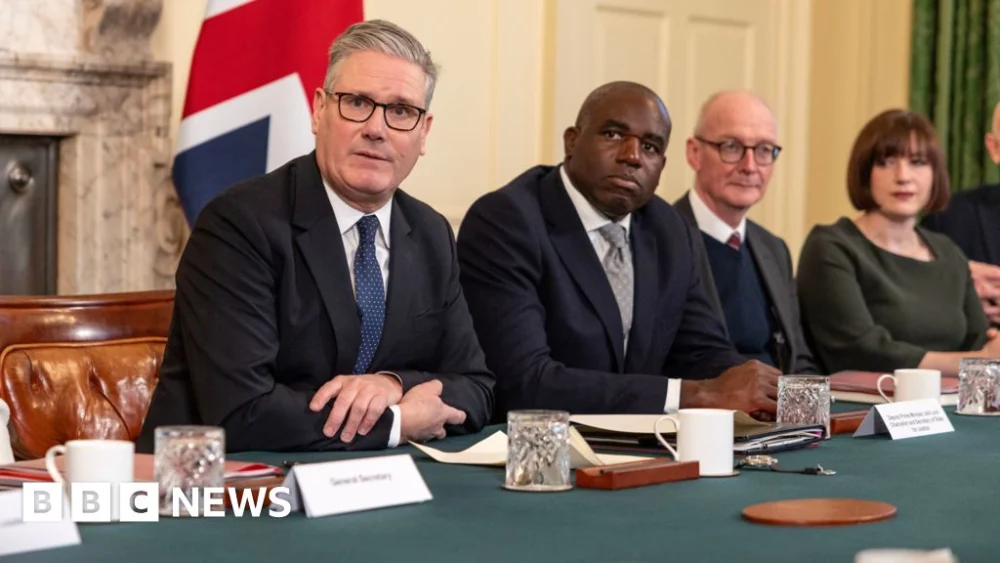
Prime Minister Sir Keir Starmer has emphatically drawn a series of stark dividing lines with Nigel Farage’s burgeoning Reform UK party, signaling a pivotal strategic shift intended to resuscitate Labour’s and his own flagging political fortunes as the new year commences. In a direct and fiery address to his political cabinet, Sir Keir articulated a clear choice for the electorate: between a Labour government committed to "renewing the country" and a Reform movement he accused of cynically feeding on "grievance, decline and division." This aggressive pivot marks a critical juncture for Labour, which finds itself battling unprecedented post-landslide struggles.
Since securing a historic landslide victory in the 2024 general election, both Labour’s collective approval ratings and Sir Keir’s personal popularity have experienced a precipitous decline in opinion polls. This dramatic reversal of fortunes has been mirrored by the meteoric rise of Reform UK, which has not only consistently led the polls but is also poised to capitalize on its momentum in the forthcoming May council elections across England, as well as crucial parliamentary contests in Scotland and Wales. The electoral landscape, once firmly in Labour’s grasp, now appears fractured and highly volatile, forcing the Prime Minister to confront a formidable and increasingly popular challenger head-on.
Addressing a meeting of his political cabinet, notably held without the presence of civil servants and including Deputy Labour Leader Lucy Powell, Sir Keir urged his government to adopt a "relentless" focus. This focus, he stressed, must be two-fold: tackling the persistent cost-of-living crisis gripping households nationwide, and delivering "change people can feel" – tangible improvements that resonate directly with the everyday experiences of citizens. He framed the upcoming political battles as an existential choice for the nation’s future, reiterating his assertion that the choice was between "a Labour government renewing the country or a Reform movement that feeds on grievance, decline and division."
Sir Keir did not mince words when detailing his accusations against Reform UK. He asserted that their agenda sought "a weaker state," aiming to "inject bile into our communities," and, most controversially, that they desired to "appease [Russian President Vladimir] Putin." This latter accusation suggests a profound philosophical and geopolitical chasm between the parties, implying Reform’s foreign policy stance could undermine international alliances and stability. "This is the fight of our political lives and one that we must relish," Sir Keir declared, rallying his ministers to embrace the ideological confrontation with unwavering determination.
The accusations, predictably, elicited a swift and indignant response from Reform UK. A spokesperson for the party dismissed the Prime Minister’s offensive as further evidence of his "obsession" with Reform, an obsession they attributed to his acute awareness of the existential threat their party posed to his "failing government." The spokesperson launched a blistering counter-attack, reminding the public that "Two years ago Labour promised to get the cost of living under control. Since then they have failed on nearly every count as household bills have soared, taxes have skyrocketed, and economic growth has flatlined." They concluded with a scathing indictment: "They simply cannot be trusted." This exchange highlights the deep ideological chivergence and the high stakes involved in the unfolding political battle.
Acknowledging the daunting challenge ahead, Sir Keir sought to instill confidence and resilience within his team. "I do not underestimate the scale of the task. But I have no doubt about this team," he assured his ministers. He drew a crucial distinction between fluctuating public opinion and fundamental political will: "Governments do not lose because polls go down. They lose when they lose belief or nerve. We will do neither." This statement served as both a rallying cry and a pre-emptive defence against the growing internal and external pressures.
The Prime Minister’s resolve comes amidst widespread speculation regarding his own political longevity. With a challenging set of local elections looming in May, where Labour is expected to face significant headwinds, numerous reports suggest that Sir Keir could face a leadership challenge if the party performs poorly. This latest strategic pronouncement can be seen as a concerted effort to consolidate his authority, galvanize his party, and redefine the political narrative ahead of these crucial electoral tests. Adding to the chorus of criticism, Conservative leader Kemi Badenoch seized the opportunity to lambast Labour, claiming the government had "no plan, no agenda" and was led by a "weak prime minister who doesn’t know if he is going to be in the job for much longer." She insisted the country urgently needed a government focused on economic security, dramatically asserting, "Right now, our economy is in freefall."
The political meeting at Downing Street, where Sir Keir delivered his impassioned address, followed a remarkably brief official cabinet meeting. This initial gathering, attended by civil servants, lasted less than ten minutes, underscoring the government’s immediate priority: the subsequent political strategy session. During the brief official meeting, Sir Keir had earlier tasked his senior ministers with demonstrating "hard work, focus and determination" throughout 2026, emphasizing their collective responsibility in alleviating the financial burden on households. His renewed and intensified focus on the cost-of-living crisis also coincided with his preparations to join world leaders in Paris for a critical meeting of Ukraine’s allies, highlighting the dual domestic and international pressures on his premiership.
Compounding the challenges, Sir Keir’s latest strategic "reset" has been notably overshadowed by extraordinary global events. President Trump’s audacious capture of Venezuelan leader Nicolas Maduro has sent shockwaves across the international community, while the US president’s continued, and widely documented, ambitions to annex Greenland have further destabilized global geopolitics. These significant international developments have undeniably diverted media attention and public discourse away from domestic policy announcements, adding another layer of complexity to Sir Keir’s efforts to regain control of the narrative.
Reflecting on past frustrations, Sir Keir had previously expressed his impatience with the slow pace of governmental change during a Parliament’s Liaison Committee hearing at the end of 2025. He articulated his experience as prime minister as one of profound frustration, noting that "every time I go to pull a lever, there are a whole bunch of regulations, consultations and arm’s length bodies that mean the action from pulling the lever to delivery is longer than I think it ought to be." This sentiment, he explained, was among his core motivations for desiring to "cut down on regulation generally and within government."
Reiterating his unwavering commitment to domestic issues, Sir Keir told the cabinet meeting on Tuesday, "There’s a world of uncertainty and upheaval, but tackling the cost of living remains and must remain our focus." He underscored that the electorate would ultimately judge his government at the next election not on poll numbers, but on its tangible delivery of improvements to public services and the beleaguered National Health Service. The Prime Minister confidently asserted that the government’s policies were already yielding positive results, citing recent increases in the minimum wage, the Bank of England’s strategic reductions in interest rates – which he framed as a testament to economic stability – and crucial governmental assistance aimed at easing household energy bills. This robust defense of his administration’s achievements forms the bedrock of his strategy to counter the Reform challenge and revive Labour’s electoral prospects.



 Roy Suryo

 Nakalama John
 atisusanti
