Nana Banana
NASA’s ambitious journey to re-establish a human presence on the Moon is taking a monumental leap forward with the Artemis II mission. This mission, poised to be the first crewed lunar voyage in over half a century, is tentatively scheduled for launch as early as the first week of February, with a window extending into spring. The 10-day journey will not only take its four-person crew further into deep space than any human has traveled before, but it will also serve as a crucial precursor to an eventual human landing on the lunar surface, a feat not accomplished since the Apollo era of the 1960s and 70s. The Artemis program marks a new chapter in space exploration, moving beyond the Cold War-era space race to establish a sustained human presence and prepare for future missions to Mars.
When does Artemis II launch?
The highly anticipated launch window for Artemis II is set to open on February 6th, extending through the end of April. NASA is targeting a liftoff from the historic Kennedy Space Center in Florida, a site synonymous with human spaceflight. However, a precise launch date remains fluid and will only be solidified after extensive, rigorous final checks on its colossal Space Launch System (SLS) rocket, the Orion crew capsule, and the intricate ground systems supporting the mission. These meticulous evaluations are paramount to ensuring the safety of the astronauts and the success of the mission, given the unprecedented nature of deep-space human travel in modern times.
The SLS rocket, standing at an imposing 98 meters (320 feet) tall, is the most powerful rocket ever built by NASA. Its design incorporates elements from the Space Shuttle program, including its core stage engines and solid rocket boosters, but on an even grander scale, capable of launching the Orion spacecraft and heavy cargo payloads towards the Moon. The Orion capsule, which will house the crew, is a marvel of engineering, designed to withstand the harsh environment of deep space, provide life support for its occupants, and perform a high-speed re-entry into Earth’s atmosphere.
The successful, uncrewed Artemis I mission, launched in November 2022, played a vital role in paving the way for Artemis II. Artemis I sent an Orion capsule on a 25-day journey around the Moon and back, validating the performance of the SLS rocket, the Orion spacecraft’s heat shield, and its critical systems in a deep-space environment. The data gathered from Artemis I has been instrumental in refining the plans and procedures for this upcoming crewed flight.
Who are the Artemis II crew and what will they be doing?
The Artemis II mission will carry a pioneering crew of four astronauts, representing a blend of seasoned space veterans and a historic international participant. The team comprises NASA’s commander Reid Wiseman, pilot Victor Glover, and mission specialist Christina Koch, alongside a second mission specialist, Jeremy Hansen from the Canadian Space Agency (CSA). This crew embodies the international collaborative spirit of the Artemis program, with Canada being the first international partner to have an astronaut assigned to a lunar mission.
Commander Reid Wiseman: A former Navy test pilot, Wiseman previously spent 165 days aboard the International Space Station (ISS) in 2014 as part of Expedition 41. His experience in orbital operations and command will be crucial in leading the complex Artemis II mission.
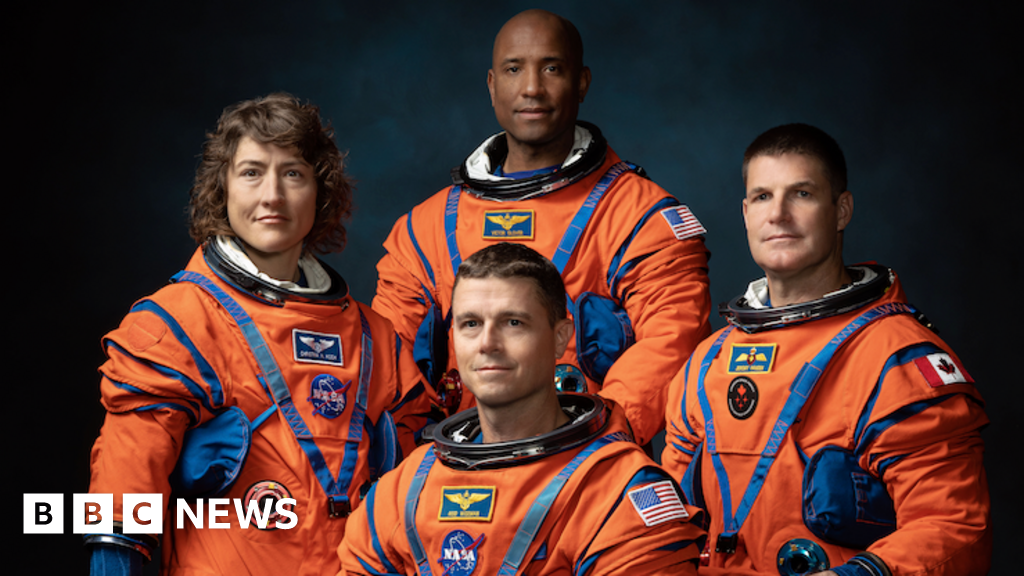
Pilot Victor Glover: Another accomplished Navy pilot, Glover made history as the first African American to fly a long-duration mission on the ISS as part of SpaceX Crew-1/Expedition 64 in 2020-2021. His expertise in spacecraft piloting and systems will be vital for managing the Orion capsule.
Mission Specialist Christina Koch: Koch is renowned for holding the record for the longest single spaceflight by a woman, having spent 328 days on the ISS from 2019-2020. She also participated in the first all-female spacewalk. Her extensive experience in microgravity and complex space operations makes her an invaluable member of the crew. She will also be the first woman to embark on a lunar mission.
Mission Specialist Jeremy Hansen: Representing the Canadian Space Agency, Hansen is a former fighter pilot and the first Canadian astronaut assigned to a lunar mission. While he has yet to fly to space, his rigorous training and expertise will be critical for the mission’s success, highlighting the growing international partnership in space exploration.
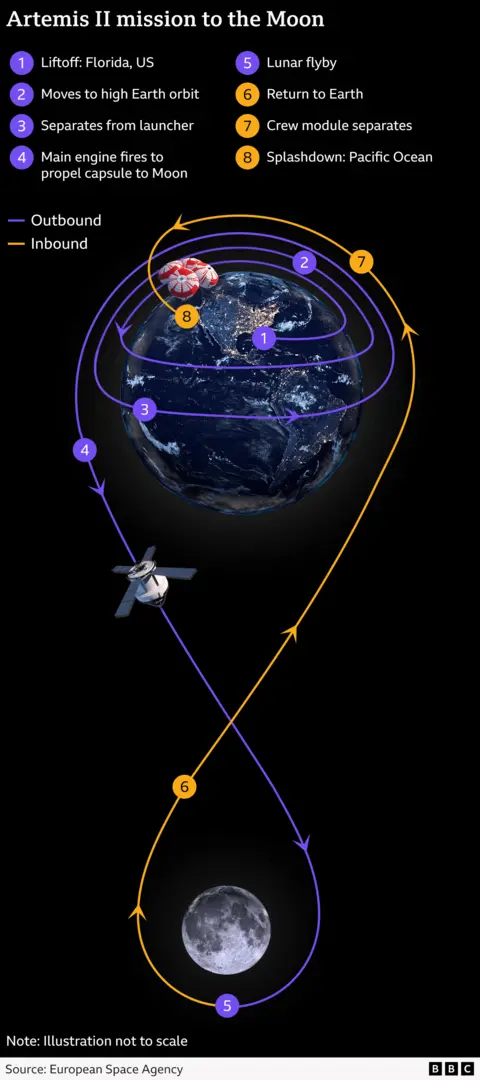
The primary objective of Artemis II is to perform the first crewed flight test of the SLS rocket and the Orion spacecraft. Once safely in Earth orbit, the astronauts will embark on a series of critical tests. A key task will involve manually flying the Orion capsule in Earth orbit to practice steering and aligning the spacecraft, skills that will be essential for future lunar landings and rendezvous operations. This manual control test is crucial for validating the human interface with the spacecraft’s automated systems.
Following these initial tests, the crew will propel themselves towards a point thousands of kilometers beyond the Moon. This figure-eight trajectory around the Moon will take them to a distance of approximately 4,600 miles (7,400 km) beyond the lunar far side, setting a new record for human travel into deep space. During this phase, they will meticulously check Orion’s life-support, propulsion, power, and navigation systems under the conditions of deep space. These systems are the spacecraft’s lifeblood, ensuring the crew’s survival and the mission’s ability to execute its maneuvers.
Beyond the technical tests, the crew will also serve as medical test subjects. They will continuously send back invaluable data and imagery from deep space, allowing scientists to study the effects of prolonged exposure to a higher-radiation environment than that experienced on the International Space Station, which is protected by Earth’s magnetosphere in low-Earth orbit. While radiation levels will be higher, the mission profile is designed to remain within safe limits for the crew. They will operate in a confined, weightless cabin of approximately nine cubic meters of living space, testing their ability to live and work efficiently in such conditions.
The mission will culminate in a dramatic return to Earth, where the astronauts will experience a high-speed, bumpy re-entry through the atmosphere, followed by a precision splashdown off the west coast of the US, typically in the Pacific Ocean. Recovery teams will be on standby to retrieve the crew and the capsule.
Will Artemis II land on the Moon?
No, Artemis II is explicitly a test flight designed to orbit the Moon, not to land on its surface. This mission is a vital stepping stone, laying the critical groundwork for the Artemis III mission, which aims to return humans to the lunar surface.
The launch of Artemis III is currently projected for "no earlier than" 2027 by NASA. However, many experts in the space community believe that 2028 is a more realistic target, primarily due to the significant developmental hurdles that remain. These include the final selection and readiness of the Human Landing System (HLS) and the completion of new, advanced spacesuits.
The competition for the lunar lander is fierce, with SpaceX’s Starship lander and a craft designed by Jeff Bezos’s Blue Origin vying for the prestigious role. SpaceX’s Starship, a revolutionary fully reusable launch and landing system, is still undergoing extensive testing and development. Its sheer size and complexity represent a significant engineering challenge, but its potential to deliver large payloads and a substantial crew to the lunar surface is unmatched.
New spacesuits, specifically designed for lunar surface exploration by the US company Axiom Space, are also in development. These suits must offer greater flexibility, durability, and life support capabilities than the Apollo-era suits, tailored for the unique challenges of the Moon’s south pole environment.
When Artemis III finally takes flight, its astronauts will be heading to the Moon’s south pole. This region is of immense scientific interest due to the potential presence of significant quantities of water ice in permanently shadowed craters. Access to water ice would be transformative for future lunar exploration, providing a resource for drinking water, breathable air, and even rocket fuel.
Beyond Artemis III, the overarching goal of the Artemis program is to establish a sustained human presence on the Moon. This vision includes the construction of Gateway, a small space station that will orbit the Moon. Artemis IV and V missions are planned to begin assembling Gateway, which will serve as a staging point for lunar surface missions, a science outpost, and a proving ground for technologies destined for Mars. Future missions will involve more Moon landings, the addition of further sections to Gateway, and the deployment of new robotic rovers on the lunar surface. The program emphasizes increasing international collaboration, with more countries expected to participate in keeping people living and working on and around the Moon for extended periods.
When was the last Moon mission?
The last time humans walked on the Moon was during the Apollo 17 mission in December 1972. Apollo 17, commanded by Gene Cernan, was the final mission of NASA’s Apollo program. Cernan was the last human to step off the lunar surface, marking the end of an extraordinary era of lunar exploration. In total, 24 astronauts traveled to the Moon during the Apollo program, and 12 of them had the privilege of walking on its surface.
America’s initial push to the Moon in the 1960s was primarily driven by the geopolitical imperative of the Cold War. The space race with the Soviet Union became a potent symbol of technological and ideological dominance. Once the United States achieved its goal of landing a man on the Moon and safely returning him to Earth, political enthusiasm and public interest gradually waned, leading to a significant reduction in funding for future lunar missions.
The Artemis program, however, grew out of a renewed desire to return humans to the Moon, but with a different philosophy. This time, the focus is on a longer-term, sustainable presence built around advanced new technology, robust commercial partnerships, and broad international collaboration. It’s not just about planting a flag, but about learning to live and work on another celestial body, preparing humanity for even more ambitious journeys, such as sending astronauts to Mars.
Do other countries plan to send astronauts to the Moon?
The ambition to send humans to the Moon is not exclusive to the United States. Several other nations and space agencies have outlined plans to put their own astronauts on the lunar surface, primarily targeting the 2030s. This burgeoning interest underscores a new era of global space exploration, characterized by both competition and collaboration.
European astronauts, through the European Space Agency (ESA), are already slated to join later Artemis missions, contributing to the Gateway station and potentially participating in lunar surface expeditions. Japan, through its aerospace agency JAXA, has also secured seats on future Artemis missions, signifying its growing role in deep-space exploration.
China, with its rapidly advancing space program, is pursuing an independent and highly ambitious lunar exploration agenda. The China National Space Administration (CNSA) is developing its own powerful rockets and spacecraft with the explicit goal of a first crewed landing near the Moon’s south pole by 2030. China has already successfully landed robotic probes on the lunar far side and returned lunar samples, demonstrating its capabilities.
Russia, a historical powerhouse in space exploration, continues to articulate plans for flying cosmonauts to the lunar surface and establishing a small base sometime between 2030 and 2035. However, due to ongoing international sanctions, significant funding pressures, and technical setbacks in its space program, many experts view Russia’s timetable as highly optimistic and subject to considerable delay.
India, following the remarkable success of its Chandrayaan 3 mission, which achieved a soft landing near the lunar south pole in 2023, has also expressed strong ambitions for human lunar exploration. The Indian Space Research Organisation (ISRO) has set a goal of sending its own astronauts to the Moon by approximately 2040. This bold objective is part of a broader push to expand India’s human spaceflight program beyond low Earth orbit, building on the success of its Gaganyaan mission, which aims to send Indian astronauts into Earth orbit.
This global surge in lunar interest is further shaped by initiatives like the Artemis Accords, a set of non-binding principles to guide civil space exploration and foster cooperation in lunar and deep-space missions. These accords, led by the US, provide a framework for responsible, transparent, and peaceful exploration, inviting nations to collaborate on humanity’s return to the Moon and beyond.
Additional reporting by Kevin Church.




 Roy Suryo

 Nakalama John
 atisusanti
 Ramos Leo