Ramos Leo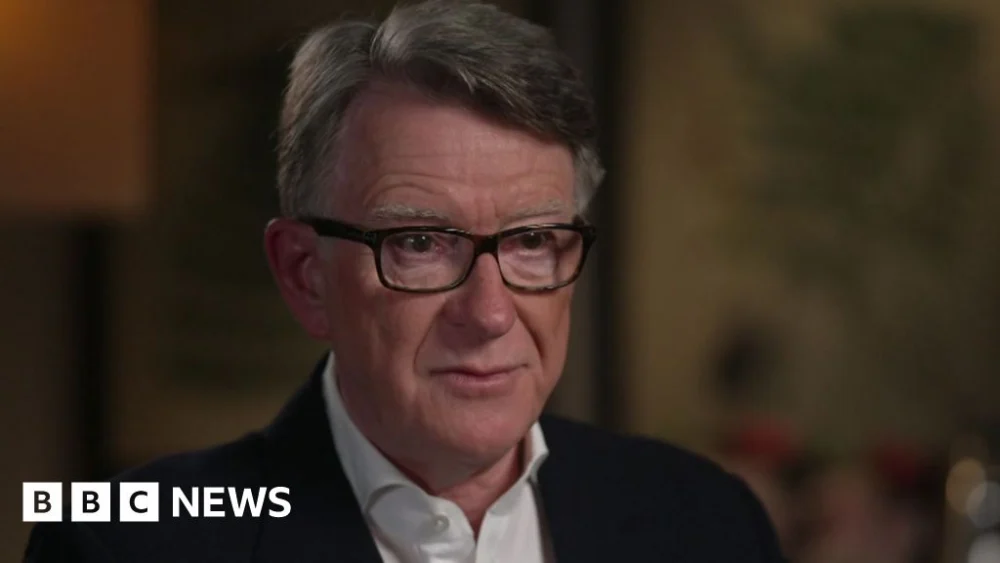
Mandelson’s interview marked his first public statement since his swift dismissal from his ambassadorial role, a termination directly linked to the revelation of supportive emails he had sent to Epstein following the American’s 2008 conviction for soliciting prostitution from a minor. During the conversation, Mandelson stated unequivocally that the only individuals he encountered at Epstein’s luxurious properties were "middle-aged housekeepers." He declined to offer a personal apology to Epstein’s numerous victims for maintaining his friendship, instead directing his regret towards "a system that refused to hear their voices and did not give them the protection they were entitled to expect."
The seasoned politician, a key architect of New Labour, stressed his non-culpability, explaining, "If I had known, if I was in any way complicit or culpable, of course I would apologise for it. But I was not culpable, I was not knowledgeable of what he was doing." He reiterated his profound regret for "powerless women, women who were denied a voice, were not given the protection they were entitled to expect," framing the issue as a systemic failure rather than a personal oversight on his part. This stance is likely to provoke further debate and scrutiny, particularly from victims’ advocates and the wider public who have demanded accountability from those associated with Epstein.
Jeffrey Epstein, a well-connected financier with a vast network spanning elite social, political, and scientific circles, died by suicide in a New York prison cell in August 2019 while awaiting trial on federal sex trafficking charges. His earlier conviction in 2008 for soliciting prostitution from a minor had led to his registration as a sex offender, yet he continued to move freely within influential circles, raising persistent questions about how his crimes were enabled and overlooked for so long. The revelations about his extensive abuse network have since brought intense focus on all individuals who maintained close ties with him.
Mandelson’s explanation for his lack of awareness hinged on his sexuality. He posited that because he is a gay man, he was "kept separate" from Epstein’s sexual exploits. "Possibly some people will think because I am a gay man… I wasn’t attuned to what was going on. I don’t really accept that," he said, before adding, "I think the issue is that because I was a gay man in his circle I was kept separate from what he was doing in the sexual side of his life." He recounted visits to Epstein’s notorious private island, as well as his residences in New York and New Mexico. During these visits, Mandelson insisted, "The only people that were there were the housekeepers, never were there any young women or girls, or people that he was preying on or engaging with in that sort of ghastly predatory way that we subsequently found out he was doing." He also made the notable claim that Epstein himself "was never there" on his visits to the infamous private island, often dubbed "Pedophile Island" by the media.
Lord Mandelson’s tenure as the UK’s ambassador to the US was abruptly cut short after only a few months. The catalyst for his dismissal was the emergence of emails, first reported by Bloomberg and The Sun, which revealed his continued contact and expressions of support for Epstein even after the financier’s 2008 conviction. In these messages, Mandelson was reported to have encouraged Epstein to "fight for early release" and, on the eve of Epstein beginning his prison sentence, conveyed sentiments such as "I think the world of you." These revelations starkly contradicted the government’s understanding of the depth and nature of their relationship when Mandelson was appointed.
Sources within No 10 Downing Street indicated that Mandelson had been "economical with the truth" during his vetting process, and the government had been unaware of the true extent of his friendship with Epstein. Mandelson, however, contested this, stating on Sunday that the government "knew everything" pertinent to his relationship when offering him the job, with the exception of the specific emails. He claimed not to remember sending them and that they "no longer existed on my server." Despite his denial of prior knowledge by the government regarding the emails, Mandelson acknowledged the prime minister’s difficult position, likening the situation to a "thermonuclear explosion." He expressed understanding for the decision to sack him, stating, "I wish I’d had the opportunity to remind him of the circumstances of my relationship, my friendship with Jeffrey Epstein and how I came to write the emails in the first place… I didn’t, so I understand why he took the decision he did, but one thing I’m very clear about is that I’m not going to seek to reopen or relitigate this issue. I’m moving on."
The interview also touched upon other geopolitical matters, including Mandelson’s perspective on then-US President Donald Trump’s contentious comments about the US potentially "owning" Greenland. While expressing admiration for Trump’s "directness" in his political approach, Mandelson dismissed the idea that the US president would "land on Greenland and take it by force." He offered his "best judgement as somebody who’s observed him at fairly close quarters," asserting that Trump is "not a fool" and would be guided by a close circle of advisers who would remind him of the "completely counterproductive" and "real danger for America’s national interest" such an intervention would entail. Mandelson contextualized this within a broader strategic imperative, highlighting the need for the Arctic to be "securing against China and Russia," an effort he believes the United States is uniquely positioned to lead.
Reactions to Mandelson’s interview were swift and critical. Labour’s Transport Secretary Heidi Alexander, also appearing on the program, characterized Mandelson’s remarks as demonstrating "at best, deep naivety." Alexander suggested that a direct apology from Mandelson "would have gone a long way for the women who were subjected to the most appalling treatment at the hands of Jeffrey Epstein." She further remarked on the due diligence process for high-profile appointments, noting that while "detailed information" about the relationship might not have been available initially, she personally would not "touch them with a barge pole" if someone she was associated with found themselves in Epstein’s situation.
Downing Street’s official statement reinforced its position, asserting that the published emails showed the "depth and extent" of Mandelson’s relationship with Epstein was "materially different" from what had been known prior to his appointment. Specifically, Mandelson’s "suggestion that Jeffrey Epstein’s first conviction was wrongful and should be challenged was new information." Consequently, "in light of that, and mindful of the victims of Epstein’s crimes, he was withdrawn as ambassador with immediate effect."
Lord Mandelson, who has been a prominent figure in British politics for four decades, played a pivotal role in shaping the New Labour era. He held numerous ministerial portfolios during Tony Blair’s premiership, famously having to resign from government posts on two separate occasions before Labour’s electoral defeat in 2010. His long and often controversial career has consistently placed him at the heart of political discourse, and his recent interview ensures that the scrutiny of his past associations and present justifications will continue.


 George Anjay
 Nakalama John
 Nana Banana