
 Ramos Leo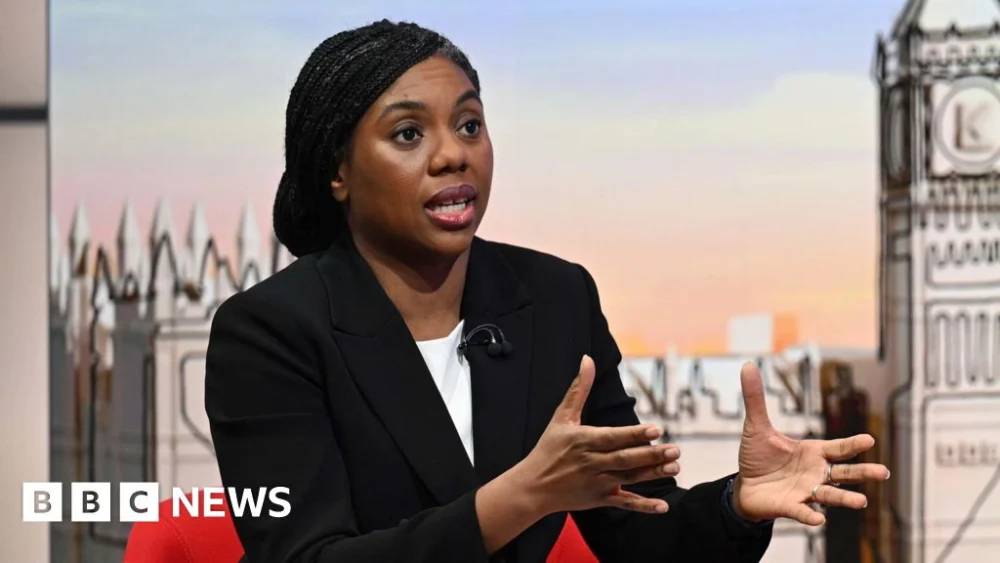
In a pivotal interview marking the turn of the new political year, Conservative leader Kemi Badenoch articulated a clear and combative strategy for her party, asserting that the Conservatives would serve as the conduit for the public’s widespread "anger" towards the Labour government. Speaking to the BBC’s Sunday with Laura Kuenssberg, Badenoch sought to firmly position the Conservatives as the sole political force capable of confronting the profound and "tough decisions" she believes are indispensable for the United Kingdom’s future stability and prosperity. Her remarks underscored a renewed vigour within the opposition, determined to capitalise on any perceived missteps by the incumbent administration.
The former Secretary of State launched a trenchant critique of Prime Minister Sir Keir Starmer’s Labour government, specifically accusing them of a fundamental misallocation of public funds. Badenoch alleged that Labour had demonstrably failed to adequately finance the nation’s armed forces, a critical pillar of national security, even while simultaneously "spending too much" in other, less essential areas. This dual accusation aimed to paint Labour as fiscally irresponsible and strategically myopic, a narrative the Conservatives intend to hammer home as they seek to rebuild their own economic credibility following their electoral defeat in 2024. The implicit message was one of a government losing sight of core priorities, neglecting defence in favour of other, unspecified expenditures that Badenoch believes are not delivering value for taxpayer money.
Beyond her frontal assault on Labour, Badenoch also turned her fire on Reform UK, the ascendant populist party led by Nigel Farage, characterising their policy agenda as driven by an "authoritarian" desire to "control" industry. She cited Reform’s proposals concerning the oil sector and the iconic British engineering firm Rolls-Royce as prime examples of this interventionist tendency. According to Badenoch, the perceived "draconian" nature of Labour’s governance had become increasingly apparent to the electorate after eighteen months in office, providing a fertile ground for Conservative opposition. However, Labour swiftly countered, reminding the public that they were still "paying the price" for the Conservatives’ own fourteen years in power, a period marked by austerity and economic challenges.
During her extensive interview, Badenoch reiterated her conviction that "It’s clearer what they [Labour] are doing, so it is clearer what we are opposing." This statement highlights a strategic shift, where the Conservatives aim to define themselves explicitly against Labour’s policies and governance style. Her declaration, "I’m trying to channel the anger that a lot of people out there feel about the way the country is being run," was a direct appeal to disaffected voters, suggesting that the Conservative party, under her leadership, is attuned to public sentiment and prepared to articulate it. She acknowledged that the Conservatives had "learned a lot of lessons" since their removal from power in the 2024 general election, a period of introspection and recalibration for the party. These lessons, she implied, have forged a party more resilient and realistic about the challenges ahead. "We think we’re the only party that’s both competent enough and brave enough to take the tough decisions that will get the country in the right place," she asserted, drawing a stark contrast with both Labour and Reform UK. The Labour Party’s response was sharp, stating that the public was still enduring the consequences of the "failure" of the previous Conservative government and pledging that the current Labour administration "will not return to the Tory austerity that hammered public services and sent NHS waiting lists soaring." This exchange sets the stage for a heated political debate focused on economic management and public services.
Badenoch, who assumed the leadership of the Conservative Party in November 2024, faces an undeniably steep and arduous task in revitalising her party’s fortunes as the new year unfolds. Despite her increasingly lauded performances in Parliament, where she has effectively held the government to account, Tory poll ratings have shown only marginal improvement in recent months. The political landscape is further complicated by the persistent challenge posed by Nigel Farage’s Reform UK, which continues to vie with the Conservatives for the attention and votes of those disaffected with Labour. This three-way dynamic on the right-of-centre presents a significant hurdle for Badenoch as she seeks to consolidate support.
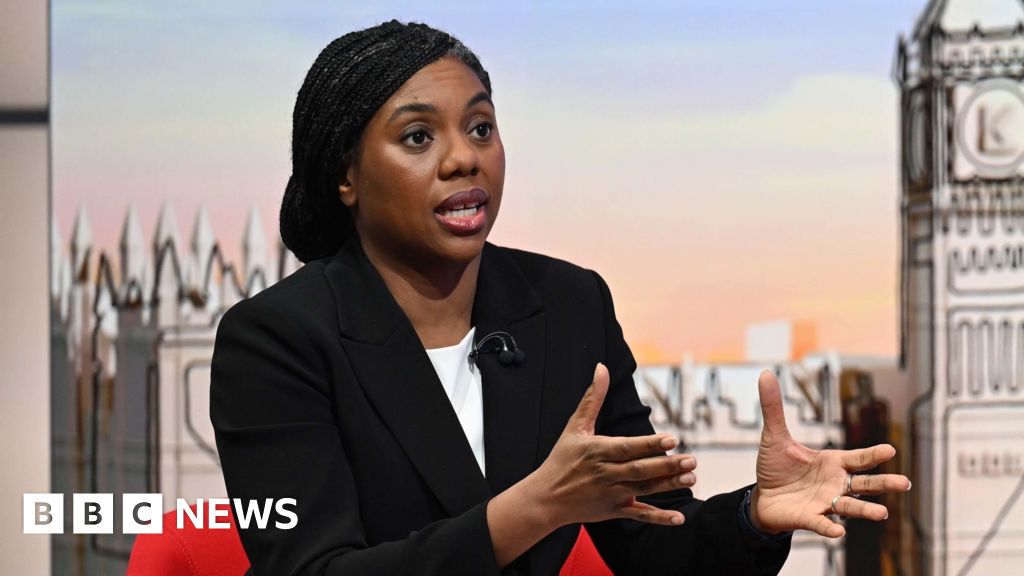
In her appearance on Sunday with Laura Kuenssberg, Badenoch continued her recent strategic attacks on both Labour and Reform’s economic platforms, accusing them of presenting "two different types of authoritarianism" and "two different types of grievance." This framing aims to discredit both rival parties by linking them to undesirable traits and suggesting a fundamental lack of original, sound policy. She categorically dismissed any prospect of forming an electoral pact or deal with Farage’s party, a notion often floated by commentators seeking to prevent a split in the right-wing vote. Her reasoning was explicit: Reform, she claimed, "wants to do the same things that Labour wants to do" in certain key policy areas, making any alliance illogical.
To bolster this argument, Badenoch highlighted Reform UK’s stance on welfare, specifically their stated favour of lifting the two-child benefits cap for working British couples. The existing two-child cap, introduced by the Conservative government in 2017, limits Child Tax Credit and Universal Credit to the first two children for most new claims, a policy designed to encourage smaller families and reduce welfare spending. Reform’s proposal to lift this cap, particularly for working couples, while seemingly divergent from Labour’s overall approach, was used by Badenoch to illustrate a shared propensity for increased state spending. She argued that this move would represent a significant expansion of welfare provision, contrasting sharply with the Conservative vision of fiscal restraint.
She further criticised Reform’s economic proposals, pointing to their policy of offering government investment in oil and gas drilling projects in exchange for a taxpayer stake. This, Badenoch contended, was a clear demonstration of how many within Farage’s party favoured "using the state to control things," a principle she views as antithetical to true Conservative free-market ideals. This interventionist approach, she argued, mirrored aspects of traditional Labour policy and deviated from the Conservative commitment to minimise state interference in the economy. Badenoch also took aim at Reform’s recent suggestion that a Reform government would seek to acquire a partial ownership stake in FTSE 100-listed engineering giant Rolls-Royce. This proposed nationalisation, intended to facilitate contracts for building small modular reactors (SMRs), was presented by Badenoch as another example of Reform’s statist tendencies. "They want to increase welfare spending, they want to nationalise Rolls-Royce, oil and gas," she summarised, adding emphatically: "that’s not where we want to be." This statement underscored a fundamental philosophical difference, with Badenoch asserting that "Right now I believe the government is doing too much," advocating instead for a focus on functions that "only the government can do," implying a leaner, more targeted state.
Shifting her focus to foreign policy, Badenoch articulated a robust and hawkish stance during the interview, particularly regarding Iran. She expressed unequivocal support for the idea that the United Kingdom could and should collaborate with the United States to effect a change in government in Iran. This assertive position comes in the wake of Iran’s escalating crackdown on internal protests, which have persistently called for an end to the current regime, and its continued destabilising actions in the Middle East. "I don’t have an issue with removing a regime that is trying to harm us," Badenoch declared, although she prudently declined to elaborate on whether such an effort should involve the deployment of British military forces. Her language was stark and uncompromising: "Iran would very happily wipe out the UK if it felt it could get away with it. It has tried to kill people on our soil. It is an enemy." This strong condemnation reflects a growing concern within Western political circles about Iran’s nuclear ambitions, its proxy warfare, and its internal repression, signaling a potential shift towards a more confrontational UK foreign policy under her leadership.
When questioned about the hypothetical scenario of the UK sending troops to protect Greenland in the event of a US invasion – a provocative suggestion made by former US President Donald Trump – Badenoch dismissed the query as "getting ahead of ourselves." While acknowledging that Trump’s threats towards Greenland were a "second order issue" when compared to the grave situation in Iran, she admitted to being "completely shocked" by the US president’s comments about wanting to control the vast island territory. Despite her shock, Badenoch offered an interpretation of Trump’s broader strategic thinking, suggesting that he was "looking strategically at the axis of authoritarian states" around the world. She cited Iran, along with Russia, China, and North Korea, as key components of this axis, and stressed the critical importance for the UK to "start thinking on that scale" in its own foreign policy and defence planning. This perspective highlights a desire to engage with global geopolitical realities and to align the UK more closely with allies in confronting perceived threats from authoritarian regimes.
In essence, Kemi Badenoch’s comprehensive interview laid bare a multi-pronged strategy for the Conservatives. She aims to simultaneously attack Labour from both the left on fiscal profligacy and from the right on defence inadequacies, while also robustly fending off the electoral challenge from Reform UK by painting them as economically irresponsible and prone to statist intervention. Concurrently, she seeks to project a strong and decisive stance on international security, particularly against perceived adversaries like Iran. The path ahead for the Conservatives remains undoubtedly steep, but Badenoch’s assertive rhetoric and clear strategic direction indicate a party determined to reclaim its narrative and fight for relevance in a rapidly evolving political landscape.




 Nakalama John
 atisusanti
 Roy Suryo
 Nana Banana
 George Anjay