
 atisusanti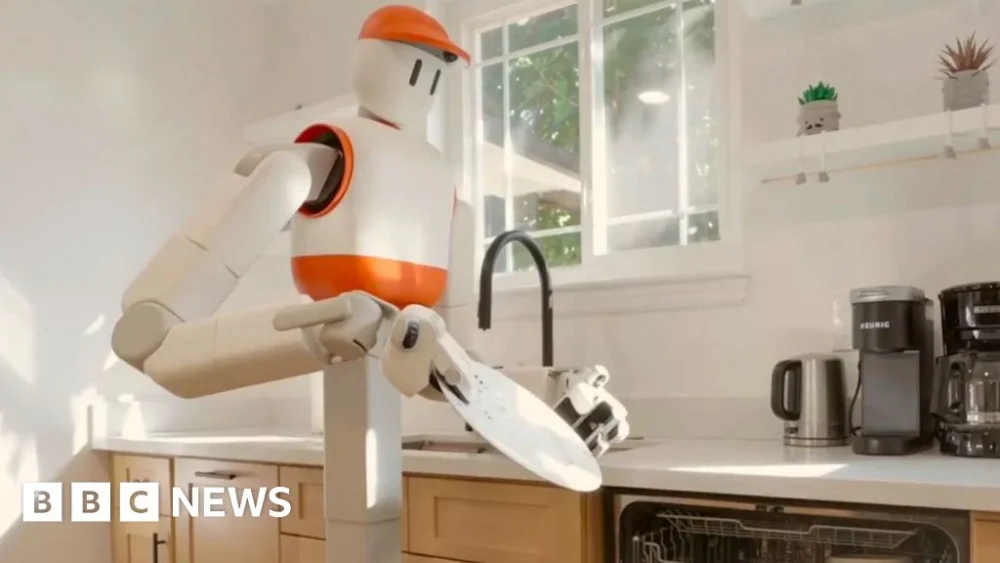
The dream of a tireless, helpful robot butler, capable of banishing household drudgery, has long been a staple of science fiction. For decades, we’ve imagined automated assistants taking on life’s mundane chores. Now, powered by rapid advancements in artificial intelligence (AI), this futuristic vision is on the cusp of becoming a tangible reality. This year marks a significant milestone, with the first truly multi-purpose domestic robots poised to enter our homes. In the heart of Silicon Valley, these sophisticated machines are being meticulously trained at an accelerated pace, learning to perform tasks as varied as folding laundry, loading dishwashers, and tidying up after our busy lives. While their enthusiastic creators are making bold promises about the capabilities of these new domestic helpers, a crucial question remains: how realistic is the prospect of a robot housekeeper truly integrated into our daily routines? To investigate, I had the opportunity to meet and observe some of the leading contenders in this burgeoning field: Eggie, NEO, Isaac, and Memo.
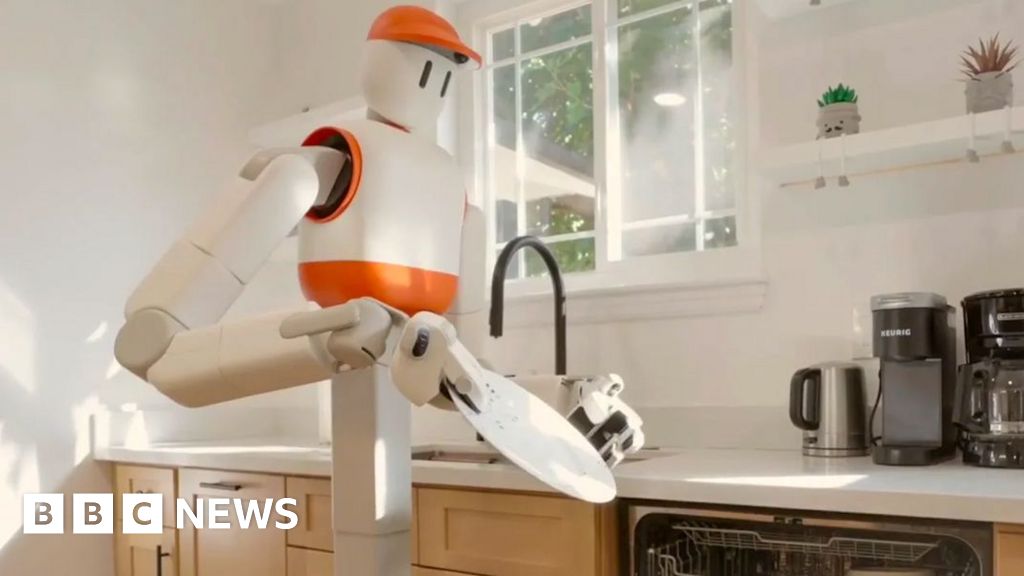
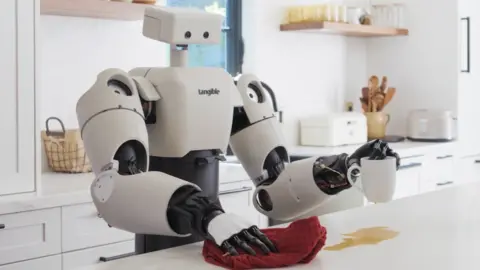
The sight of these robots, whether fully humanoid or cleverly designed with partial anthropomorphic features, is undeniably captivating. It’s difficult not to feel a sense of wonder and anticipation when one of them glides into a room. The current state of domestic robotics suggests that many of these machines are now remarkably agile, sensitive, and dextrous enough to tackle a wide array of important, albeit often tedious, household chores. During my observations, Eggie, a creation from the relatively new startup Tangible AI, demonstrated an impressive ability to perform several tasks. I watched as it carefully hung a jacket on a coat stand, efficiently stripped a bed, and meticulously wiped up a spill on the kitchen counter. However, it’s important to note that these actions, while executed, were performed at a deliberately slow pace, with the robot moving on wheels in a somewhat stuttering, deliberate manner. Similarly, NEO, developed by 1X, a company that has recently generated considerable buzz by opening pre-orders for its robot, also showcased its capabilities. NEO was able to move slowly but effectively around the company’s test kitchen, navigating the space on its soft, padded feet. It demonstrated its ability to water plants, though with a minor spillage, and fetch a drink. It also attempted to tidy away dishes and cups, an endeavor that required a degree of assistance from me as the robot encountered some difficulty gripping the cupboard handles. If time were not a primary constraint, the prospect of having a robot like Eggie or NEO diligently cleaning up after myself and my family could certainly be viewed as immensely helpful.
However, a critical detail that often goes unhighlighted in the promotional material for these robots is their current reliance on human operators. This is a facet that many of the Silicon Valley companies I visited seemed keen to downplay. Bipasha Sen, the founder of Tangible AI, remains resolutely optimistic about the pace of technological advancement. "Today, people have two aspirations – a car and a house," she stated with a broad smile. "In the future, they’ll have three aspirations – a car, a house, and a robot." Across town, 1X stands as a testament to the significant financial backing this sector is attracting, boasting major investments from tech giants such as the renowned microchip manufacturer Nvidia. At their state-of-the-art headquarters, I was granted a tour of a secure area where NEO prototypes are actively being built, rigorously tested, and, when necessary, repaired. Bernt Bornich, the Norwegian CEO of 1X, shared his personal experience with NEO, describing it as a valuable asset in his own home. He explained that the robot assists with tasks like vacuuming and tidying up after his family, characterizing its operation as a "mix" of autonomous action and human-controlled input. "We have a lot of data, so a lot of the stuff in my home can get automated, but periodically someone kind of steps in and helps," he explained.
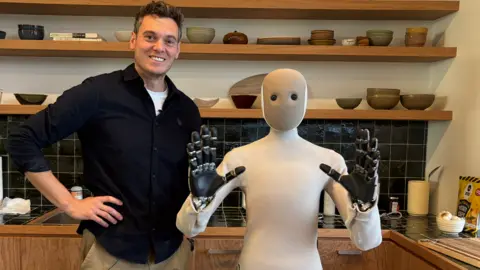
Data is indeed the cornerstone of how these robots are learning to navigate the complex and often unpredictable environments of our homes, a considerably more challenging task than that faced by humanoids designed for structured factory settings. A significant part of 1X’s strategy to enhance NEO’s AI capabilities involves its deployment into homes this year. 1X expresses strong confidence that NEO will exhibit considerably greater autonomy thanks to recent breakthroughs in AI. However, during my visit, no demonstrations were provided showcasing the bot independently thinking or making decisions. The initial wave of customers can likely expect to exercise considerable patience and perhaps exhibit a degree of leniency regarding privacy concerns, as human operators will likely be remotely intervening when the robot encounters situations it cannot autonomously resolve. Furthermore, these early adopters will undoubtedly need to possess substantial financial resources, as NEO is slated to cost approximately $20,000, or a monthly subscription of around $500. "A lot of our early customers are people who will actually have a lot of value from this, but I do think getting the right customers is important. We can use these amazing early adopters to help us make this work," Bornich commented.
Unconventionally for the broader tech industry, a significant portion of the investment and hype surrounding household robots appears to be directed towards innovative startups rather than established tech giants. While Tesla is developing a humanoid robot, its intended market – whether factories or homes – remains somewhat ambiguous. CEO Elon Musk, however, is undeniably convinced of a substantial market for these machines, with his record-breaking $1 trillion pay package reportedly linked in part to the ambitious goal of selling one million bots within the next decade. Nevertheless, it is the agile and rapidly developing Silicon Valley startups that seem best positioned to capture the market first. In Noe Valley, San Francisco, another domestic robot company has already deployed its stationary robot to gather real-world data, albeit focused on the specific task of folding laundry. Weave Robotics has strategically placed seven of its "Isaacs" across the city, autonomously folding clothes for local laundromats. I observed one Isaac meticulously fold T-shirts in approximately 90 seconds, with its creator asserting that the robot’s speed is continuously improving. "Deployment is the strategy," stated co-founder Evan Wineland. The company intends to launch a general-purpose version of Isaac for home use this year, although the extent of its autonomous capabilities remains to be fully clarified.
Elsewhere, at Sunday AI, a clever and effective solution has been devised to address the critical challenge of data collection. I witnessed their robot, Memo, smoothly and deliberately make a cup of coffee, crumple up a pair of socks, and clear a table laden with precariously fragile wine glasses – all entirely on its own, without any human intervention. However, even this highly capable bot experienced a minor setback, breaking a wine glass on its initial attempt, an incident that appears to have been an isolated fluke. The engineers at Sunday AI are confident that any such issues will be ironed out once the bots begin shipping next year, a process facilitated by a specialized robot glove they have developed. "We built these gloves, and people wear them in their homes and collect data for us. That gives us really diverse data because we now see 500 homes and also all the different ways people do chores," explained co-founder Tony Zhao. This highlights the often-overlooked human drudgery that underpins the learning process for AI systems operating in the physical world. Teaching AI chatbots, in contrast, is comparatively straightforward, as they can absorb vast quantities of information from billions of web pages, books, and films to enhance their intelligence.
The final company I visited offers a distinctly different perspective on how to bring the domestic robot into widespread reality. Physical Intelligence is not focused on manufacturing robots themselves; instead, their mission is to develop the advanced "brains" that will imbue otherwise "dumb" robots with intelligence. Their engineers utilize a diverse range of robotic arms, hands, and bodies to develop AI software that can be adapted to virtually any robot hardware. "We want to be able to breathe intelligence into any sort of physical embodiment, whether that’s a humanoid robot or even something that looks closer to an appliance," stated co-founder Chelsea Finn. Their innovative approach is receiving enthusiastic backing from prominent investors, including Amazon founder Jeff Bezos and OpenAI. The sheer volume of investment pouring into this technology is substantial. While Silicon Valley remains a primary hub for this innovation, it is facing formidable competition from its Chinese counterparts. The humanoid robot industry in China, in fact, is experiencing such a surge that the government recently issued a warning about the potential risk of a speculative bubble forming, should the robots not achieve the anticipated levels of success and popularity.

The International Federation of Robotics offers a more tempered outlook, suggesting that it could take as long as 20 years before domestic bots become truly useful and widely accepted. Questions also linger regarding the ultimate demand for these machines. Will they remain the exclusive playthings of the affluent, or will they eventually become affordable enough for mainstream adoption, mirroring the trajectory of robot vacuums? However, for the engineers at the vanguard of this technological revolution, there appears to be an unwavering confidence that they are indeed building a future that we will all ultimately welcome into our homes.


 George Anjay
 Nakalama John
 Ramos Leo
 Roy Suryo
 Nana Banana