
 Nakalama John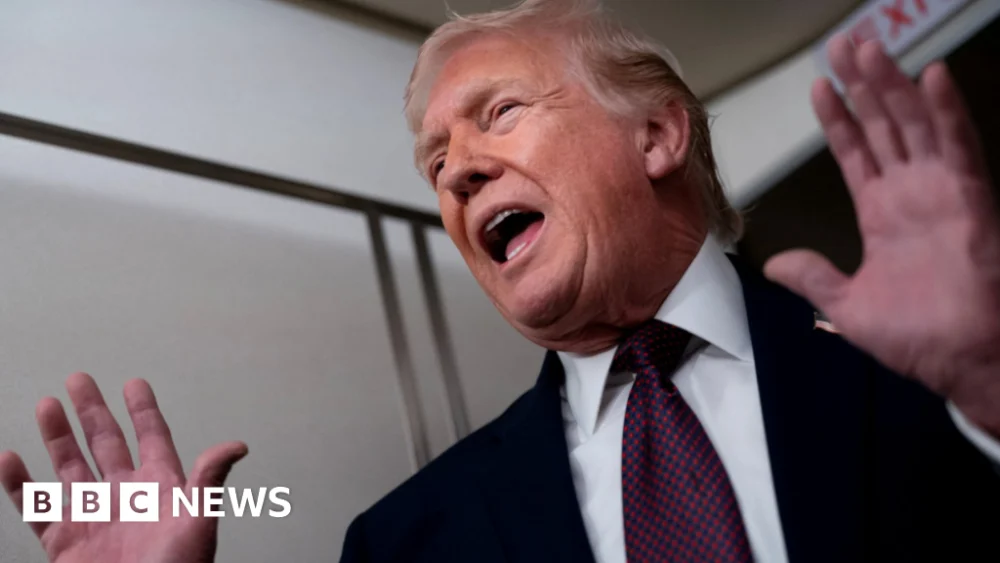
Shares in major banks and credit card firms experienced a notable downturn following an unexpected declaration from former US President Donald Trump, who called for a dramatic cap on credit card interest rates. On Friday, through a post on his social media platform, Truth Social, Trump outlined his vision for a one-year limit, effective January 20, 2026, setting the maximum interest rate on credit cards at 10%. This proposal, which he had previously floated during his 2024 presidential campaign, immediately sent ripples through the financial markets, sparking concerns over potential profit erosion and a fundamental disruption to the credit card industry’s established business model.
The former president’s statement lacked specific details on how such a cap would be implemented or, critically, whether it would possess legal enforceability. Despite this ambiguity, investors reacted swiftly. Early trading saw significant drops in the share prices of prominent US credit card firms. American Express initially fell by 4%, while Visa and Mastercard, two giants in payment processing, each saw their stock drop by more than 2%. The impact wasn’t limited to dedicated credit card companies; major US lenders with substantial credit card portfolios, such as JPMorgan Chase and Bank of America, also witnessed their shares open more than 1% lower. The tremors extended across the Atlantic, with UK-based Barclays, which operates a sizeable US credit card business, closing down 1.9% in London trading, underscoring the global reach of investor anxiety regarding the proposal.
Trump’s rhetoric on Truth Social was unequivocal. "Effective January 20, 2026, I, as President of the United States, am calling for a one year cap on Credit Card Interest Rates of 10%," he wrote. He added a stark warning: "Please be informed that we will no longer let the American Public be ‘ripped off’ by Credit Card Companies." Further solidifying his stance, on Sunday, while speaking to reporters aboard Air Force One, Trump asserted that credit card companies would be deemed "in violation of the law" if they failed to comply with his demands, escalating the confrontational tone of his proposal.
The average interest rate for credit cards in the US currently hovers around 20%, a figure that has climbed in recent years amidst rising inflation and the Federal Reserve’s efforts to cool the economy through rate hikes. This 20% average translates into substantial financial burdens for millions of Americans carrying balances. According to the most recent survey of consumer finances by the Federal Reserve in 2022, nearly half of US households held credit card debt. For those with a balance, the average amount owed exceeded $6,000, which, at an approximate 20% interest rate, amounted to roughly $100 in monthly interest charges alone. This substantial debt burden has made the idea of interest rate caps a politically appealing concept, particularly to those struggling with personal finances.
However, the banking and credit card industry vehemently opposes such a cap, arguing it would have catastrophic consequences for both consumers and the financial system. US banking associations quickly issued warnings, stating that capping rates would severely restrict access to credit and prove "devastating" for millions of families and small businesses. Matt Britzman, a senior equity analyst at Hargreaves Lansdown, echoed these concerns, explaining that forcing companies to drastically lower their lending rates would "upend the basic economics of the industry." He elaborated that "Most banks would respond by cutting credit limits, closing riskier accounts, and scaling back rewards programmes, because they simply couldn’t cover losses at that price point." The industry’s argument rests on the principle that interest rates reflect the risk associated with lending. Lowering rates artificially would make it uneconomical for lenders to extend credit to higher-risk borrowers, who often rely on credit cards as a crucial financial lifeline. This could push vulnerable consumers towards less regulated, and potentially more predatory, lending alternatives, such as payday loans or loan sharks.
A joint statement from five prominent US banking bodies acknowledged sharing the president’s stated goal "of helping Americans access more affordable credit." However, they unequivocally warned that the proposed 10% cap would "reduce credit availability and be devastating for millions of American families and small businesses who rely on and value their credit cards, the very consumers this proposal intends to help." They concluded with a stark prediction: "If enacted, this cap would only drive consumers toward less regulated, more costly alternatives," thereby exacerbating the very problems it aims to solve.
The political landscape surrounding credit card interest rate caps is complex and has garnered support from an unlikely bipartisan coalition. On one end, figures from the far-left, such as Senator Bernie Sanders, have long advocated for stricter consumer protections and limits on interest rates. On the other, populists aligned with Trump’s "Make America Great Again" (MAGA) agenda see such a cap as a way to challenge corporate power and support the working class. Despite this broad appeal, the practical path to bringing such a proposal into force remains fraught with uncertainty and significant legal hurdles.
Similar plans have previously languished in Congress, failing to gain sufficient traction for passage into law. For instance, early last year, Senator Sanders, alongside Republican Senator Josh Hawley, introduced bipartisan legislation aimed at capping credit card interest rates at 10% for five years. That bill, despite its bipartisan backing, has yet to advance. The question of how Trump, if re-elected, would implement such a cap without congressional approval is central to the debate. Analysts widely predict that executive action by the White House would almost certainly be met with immediate and robust legal challenges from the financial industry, which has a track record of successfully fighting regulatory efforts in the courts.
The role of regulatory agencies, particularly the Consumer Financial Protection Bureau (CFPB), also comes into focus. Critics of Trump’s approach, such as Democratic Senator Elizabeth Warren, highlighted the inconsistency in his stance. Warren, a staunch advocate for consumer protection and the architect of the CFPB, remarked on X (formerly Twitter): "Begging credit card companies to play nice is a joke." She added, "I said a year ago if Trump was serious I’d work to pass a bill to cap rates. Since then, he’s done nothing but try to shut down the CFPB." This points to a deeper ideological conflict regarding the role of government in regulating financial markets. The Trump administration has historically sought to reduce the power and scope of such regulatory bodies. Indeed, in a move that contrasts sharply with his latest proposal, the Trump administration in April 2025 moved to repeal a regulation that capped credit card late fees at $8. This rule had been a key component of President Joe Biden’s administration’s broader crackdown on "junk fees," underscoring the divergent approaches of the two political camps on consumer financial protection.
Beyond the immediate market reaction and political rhetoric, the proposed cap raises fundamental questions about the American financial system. Credit cards are deeply embedded in the US economy, facilitating consumer spending, providing emergency funds, and helping individuals build credit scores. A sudden, drastic reduction in interest rates, without addressing the underlying risks and costs of lending, could lead to a significant contraction of credit availability, potentially hindering economic activity and disproportionately affecting those with lower credit scores who rely most heavily on access to credit. The debate over capping credit card interest rates therefore extends beyond a simple matter of consumer cost; it touches upon the intricate balance between consumer protection, financial stability, and the fundamental economics of the lending industry.




 Roy Suryo

 atisusanti
 Ramos Leo
