
 George Anjay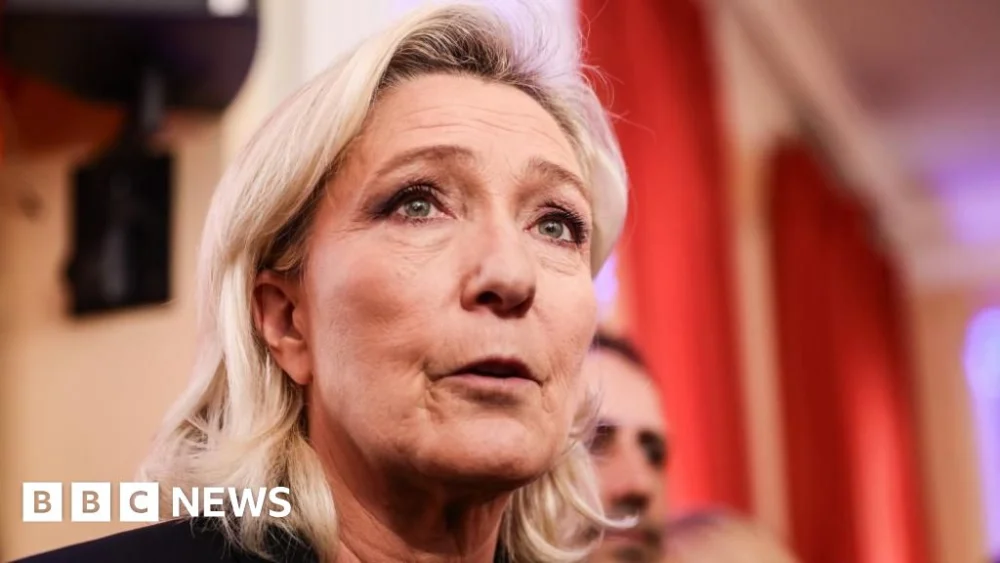
A pivotal appeal trial commenced on Tuesday in Paris, where far-right French politician Marine Le Pen is challenging a five-year ban from public office, a ruling that could decisively shape her political future and the landscape of French democracy. Le Pen, a prominent figure in French politics for over a decade, faces the possibility of being barred from contesting the 2027 presidential election should the appeals court uphold the initial verdict. The 57-year-old leader, who has twice reached the presidential run-off, vehemently denies any wrongdoing in the case concerning the alleged embezzlement of European Union funds. As the proceedings began, a visibly determined Le Pen expressed her "hopeful" outlook to reporters, underscoring the immense personal and political stakes involved.
The gravity of the situation was amplified by statements from Jordan Bardella, the current president of Le Pen’s National Rally (RN) party. Bardella asserted that barring Le Pen from the election would be "deeply worrying for democracy," framing the legal challenge as an existential threat to the democratic process in France. He further indicated that while he himself would not seek the presidency in 2027, he would instead aim for the position of Prime Minister, suggesting a potential shift in the party’s leadership strategy should Le Pen be incapacitated from running.
The case, heard at the Paris Court of Appeal, is scheduled to continue until February 12th, with a definitive ruling anticipated in the summer. This timeline is crucial, as it will precede the official presidential election campaigns, leaving ample time for potential further legal avenues to be explored or for the political ramifications to fully unfold. The original charges, levied last year, centered on allegations that Le Pen, alongside more than 20 other senior figures within the RN, employed assistants who were purportedly paid by the European Parliament but primarily worked on party affairs.
Presiding over the initial trial, Judge Bénédicte de Perthuis concluded that Le Pen was at the "heart of the system" responsible for the misappropriation of approximately €2.9 million (equivalent to roughly £2.5 million) in European funds. The consequences for Le Pen were severe: a four-year prison sentence, with two years suspended and the remaining two to be served under electronic surveillance rather than in detention. In addition to this, she was fined €100,000 (approximately £82,635) and immediately disqualified from holding public office. The implications of the appeal are stark; if unsuccessful, Le Pen could potentially face an even more substantial jail term.
The repercussions of the initial verdict extended beyond Le Pen. Over 20 other RN officials were also found guilty, and the party itself was ordered to pay a €2 million fine, with half of that amount suspended. Within the framework of the current appeal, eleven of Le Pen’s former colleagues have chosen to challenge the verdicts, while twelve, including her sister Yann Le Pen – who received a one-year suspended prison sentence – have opted not to appeal.
Speaking on the eve of the trial, in a press conference attended by Le Pen, Bardella reiterated his strong defense of the RN leader. He emphasized her potential to prove her innocence and voiced concerns about the impact on French democracy if a candidate with her electoral track record were to be excluded. "It would be deeply worrying for democracy if the justice system were to deprive the French people of a presidential candidate, already qualified twice for the second round and now considered the undisputed favourite in the election," he stated, highlighting Le Pen’s previous electoral successes and her perceived strength in the upcoming contest.
The French legal system provides for a comprehensive review of lower court decisions during an appeal. This means the Paris Court of Appeal will re-examine both the factual evidence and the legal arguments presented in the original trial. Le Pen’s primary objective is for the court to overturn the previous verdict, thereby clearing her name and restoring her eligibility to run for the presidency for a fourth time.
However, the appeal process offers several potential outcomes, each with distinct consequences for Le Pen’s political aspirations. A second scenario would involve the appeals court affirming the guilty verdict but potentially removing the "immediate effect" clause of the ban. This crucial distinction could allow Le Pen to register her candidacy for the 2027 election, even if she were to pursue a further appeal to the Court of Cassation, France’s highest court, to overturn the conviction itself.
A third possibility is that the appeals judges might reduce the five-year ban to a period that still allows Le Pen to meet the candidacy registration deadline in March 2027. This would represent a partial victory, enabling her to participate in the election despite the conviction.
The fourth outcome would be the affirmation of all decisions made by the lower court. This would render it virtually impossible for Le Pen to run, even though she would likely still have the option to appeal to the Court of Cassation. This path would leave her political future hanging by a thread.
The fifth and most definitive outcome, which would unequivocally rule Le Pen out of the race, is the upholding of the original conviction with a potentially harsher sentence. The offense itself carries a maximum penalty of up to ten years in prison, meaning the appeals court has the power to significantly increase her jail time and the length of her ban.
The timing of these judicial decisions will be as critical as their substance, particularly given that the presidential election is projected to take place around April 2027. The legal process could extend for months, potentially leaving the political landscape in a state of uncertainty for an extended period.
Marine Le Pen’s political career has been marked by a consistent surge in support for the far-right in France. Her ability to reach the presidential run-off on two previous occasions – in 2017 and 2022 – has solidified her position as a formidable contender. Many of her ardent supporters believe that her chances of winning the presidency are high, provided she is cleared to run.
However, recent polling data suggests a potentially complex internal dynamic within the RN. An opinion poll published by the newspaper Le Monde on the eve of the appeal indicated that Jordan Bardella, her protégé, might possess a stronger electoral appeal than Le Pen herself. The poll suggested Bardella could garner 49% of the vote, compared to 18% for Le Pen, raising questions about the party’s leadership trajectory regardless of the appeal’s outcome. This data point adds another layer of complexity to the already high-stakes legal battle, hinting at a potential succession plan being considered by the National Rally, or at least an acknowledgment of Bardella’s growing influence. The coming months will undoubtedly be a period of intense scrutiny and anticipation, as the legal fate of Marine Le Pen intertwines with the future direction of French politics.



 Roy Suryo

 Nakalama John
 atisusanti
 Ramos Leo
