
 George Anjay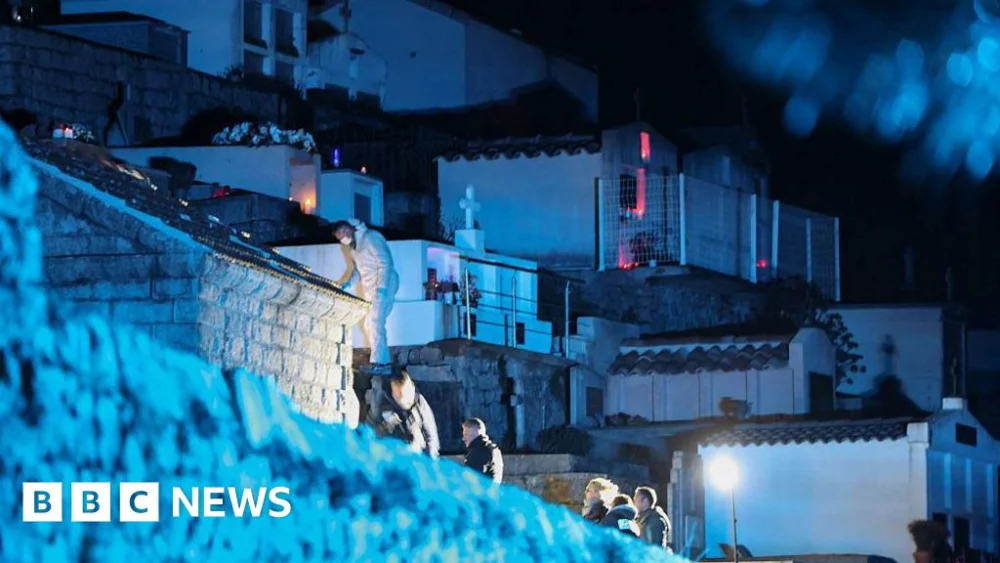
Organised crime prosecutors on the French island of Corsica are intensely pursuing a gunman following the brazen assassination of former separatist leader Alain Orsoni, who was shot dead while attending his mother’s funeral. Orsoni, 71, a figure deeply entwined with Corsica’s tumultuous history and who had spent years living in exile in Nicaragua, was a prominent, and often controversial, personality on the island. The chilling attack is believed to have occurred on Monday afternoon as the funeral ceremony concluded in the serene village of Vero. He is thought to have been struck by a single, long-range bullet fired by an assailant lying in wait, succumbing to his injuries swiftly. "It would appear he was hit by a long-range shot. He died pretty quickly from his injuries," confirmed Corsican prosecutor Nicolas Septe, underscoring the calculated nature of the hit.
The tragedy cast a dark shadow over a moment of profound grief. Father Roger-Dominique Polge, who had led the funeral service for Orsoni’s mother, recounted the horrific scene with palpable anguish. "We’d just finished burying Alain’s mother – it was a moment of pain and grief," he stated, his voice heavy with emotion. "Suddenly we hear a gunshot and Alain falls down dead. In the middle of a cemetery, after a religious ceremony, I ask where are we, what kind of home are we living in? It’s as if Corsica is worse than Sicily – it’s unimaginable." The brutal act, occurring in such a sacred and somber setting, has sent shockwaves through the community, amplifying fears about the pervasive influence of criminal elements.
While no definitive motive has yet been established, Orsoni’s decades-long presence as a high-profile figure in Corsican society, coupled with his violent end in his native village cemetery, starkly illuminates the enduring grip of criminal clans that have plagued the island for generations. The investigation into his murder has been entrusted to a newly established national anti-organised crime prosecutor, working in tandem with the specialised regional crime office based in Marseille, a testament to the gravity and potential national implications of the case.
A police source, speaking to the influential Le Monde newspaper, revealed that striking similarities exist between this assassination and recent gangland killings that have targeted individuals connected to Orsoni’s son, Guy. In 2023 alone, two of Guy Orsoni’s associates met similar fates, both victims of distant gunfire. Guy Orsoni himself is currently serving a substantial 13-year prison sentence for the attempted murder of a member of the notorious Petit Bar gang, a crime committed in 2018. This familial connection to ongoing criminal feuds strongly suggests that Alain Orsoni’s murder is deeply rooted in these long-standing rivalries.
Alain Orsoni’s life was a complex tapestry woven with threads of Corsican nationalism, political activism, and undeniable entanglement with the island’s criminal underworld. Renowned for his striking good looks and a rich singing voice, he found himself drawn to the burgeoning Corsican nationalist movement in the 1970s. His early involvement included participation in a gun attack targeting the Iranian embassy in 1980. The violence that seemed to shadow his life intensified three years later when his brother was kidnapped and presumed murdered, a loss that undoubtedly left an indelible mark. Criminologist Alain Bauer, speaking to the Ouest-France newspaper, provided a somber assessment of the Orsoni family’s trajectory: "Father, brother and son all found themselves thrust over time into the heart of politics and criminal cases."
Later, Alain Orsoni co-founded the separatist Movement for Self-Determination (MPA), a political force that managed to secure four seats in the 1992 elections. However, he was disqualified from taking his seat due to campaign irregularities, and subsequently spent time in prison for a series of offenses. Amidst the volatile and often violent schisms that fractured the leadership of Corsican nationalist movements, Orsoni made the significant decision to leave the island for Central America in 1996. His return to Corsica in 2008 saw him assume the presidency of the local football club, AC Ajaccio, a move that brought him back into the public eye, albeit in a different arena.
Remarkably, just weeks after his return to Corsica, police intercepted a plot to assassinate him, a plot attributed to the Petit Bar gang. His tenure at AC Ajaccio concluded in 2015, but he returned to lead the club once more in 2022. This period was again marked by his decision to return to exile in Nicaragua, eventually resigning from his presidential post in September of the previous year, a move that now appears prescient given the circumstances of his death.
Throughout his life, Alain Orsoni was acutely aware of the persistent threat to his safety. Following the murders of four of his associates over a two-year period, he spoke candidly to Le Figaro newspaper in 2012, revealing that he had purchased an armoured car under duress from his family after he himself had been targeted in 2008. Despite the evident dangers, he projected an image of defiance and resilience. "I’m not afraid of dying," he stated at the time. "I don’t wake up every morning thinking I’m going to be killed. I live a normal life, without a squad of bodyguards." He also addressed the public perception of him, lamenting the portrayal of his persona. "I’m portrayed as a godfather, even though I don’t even own a business on Corsica. As former head of a nationalist movement for 15 years I wasn’t exactly a saint. But to depict me as a dangerous wheeler-dealer? That’s a joke." His assassination, however, has once again thrust him into the shadowy narrative of Corsican organised crime, leaving authorities to piece together the motives behind a life lived on the edge and a death that occurred in the most tragic of circumstances. The hunt for the gunman continues, with investigators delving deep into the complex web of rivalries and resentments that have long defined Corsica’s violent underbelly.



 Roy Suryo

 Nakalama John
 atisusanti
 Ramos Leo
