
 Nana Banana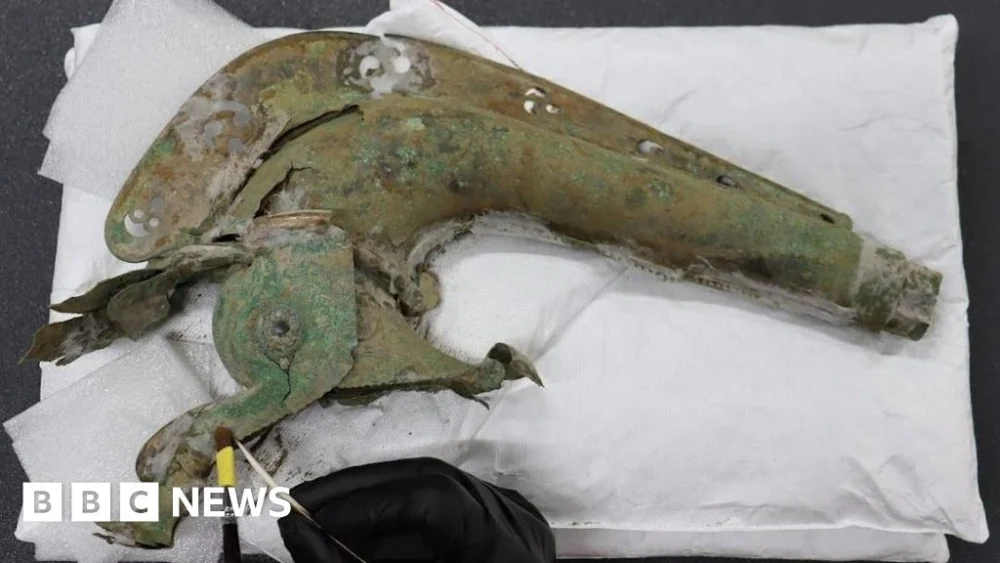
A truly astonishing discovery near Thetford, Norfolk, has electrified the archaeological world, bringing to light two of the most exceptionally rare Iron Age artefacts ever found in Europe. A team from Pre-Construct Archaeology, working diligently on a building site just a few miles from the historic market town last year, unearthed a hoard that promises to redefine our understanding of Iron Age Britain. At the heart of this remarkable collection lay the most complete battle trumpet, known as a carnyx, ever recovered across the continent, alongside the first-ever boar’s head flag standard to be found on British soil. This dual discovery has been hailed by experts as "a discovery of a lifetime," offering an unprecedented window into the martial culture, artistry, and ritual practices of ancient Celtic societies.
Gary Trimble, Senior Project Officer, conveyed the profound significance of the find to BBC Two’s Digging for Britain, stating with evident awe that carnyces "are extraordinarily rare… a boar standard, that’s even rarer." The sheer unlikeliness of finding both these unique objects in a single hoard has left archaeologists speechless. Peter Crawley, the dig leader, admitted to having a profound premonition about the site, a "gut feeling" that it was special even before the excavation began. His intuition proved prescient, leading to what is now considered a landmark archaeological event. "We have our fair share of hoards in Norfolk," Trimble added, referencing the county’s rich archaeological heritage, "but this is so, so different – it is really, really special."
The carnyx itself is a masterpiece of Iron Age craftsmanship and a potent symbol of power. Fashioned from extremely thin sheets of bronze, it features an animalistic bell, often depicting a boar or dragon with a gaping mouth and an elaborate crest. The Thetford carnyx is particularly notable for its exceptional state of preservation, including its pipe, mouthpiece, and the animal-headed bell – a completeness unparalleled in other European finds. Conservator Jonathan Carr, who meticulously worked on the fragile artefacts, described the carnyx as possessing "a wonderful little eye, which is a remarkable survivor and you can’t help but be impressed and charmed by it." This delicate eye, likely inlaid, hints at the sophisticated aesthetic sensibilities of its creators.
In Iron Age warfare, the carnyx was more than just a musical instrument; it was a psychological weapon and a vital communication tool. Used by Celtic tribes across Europe, its piercing, guttural sound was designed to strike terror into the hearts of enemies, inspiring fear and disarray before battle. Simultaneously, its powerful notes would have rallied Celtic warriors, boosting morale and directing their movements amidst the chaos of combat. The sound, amplified and distorted by the metal bell, would have been an auditory spectacle, a primal roar echoing across ancient battlefields. This instrument held a particular fascination for the Romans, who frequently depicted captured carnyces as war trophies on their monuments, acknowledging their symbolic and practical importance to their Celtic adversaries. The Thetford carnyx is one of only three known to have been found in Britain, making its intact nature all the more extraordinary.
Equally compelling is the boar’s head flag standard, crafted from sheet bronze. This artefact, like the carnyx, speaks volumes about Iron Age martial culture and symbolism. Such standards would have been held aloft on poles, serving as powerful rallying points for troops in the thick of battle. The boar, a ferocious and formidable animal in the wild, was a deeply significant motif in Celtic art and ideology, embodying strength, courage, ferocity, and untamed power. Dr Fraser Hunter, Iron Age and Roman curator at National Museums Scotland, elaborated on this symbolism: "They were very fierce animals to face in the hunt, so the symbolism of the boar is a lot about the strength of it – a very appropriate adversary in battle." To fight under the banner of a boar was to invoke these very qualities, instilling pride and a sense of shared identity among the warriors. The discovery of this standard, the first of its kind in Britain, provides invaluable insights into the visual culture and military organisation of Iron Age societies in the region.
The hoard, which archaeologists date to approximately 50BC to AD50, represents a crucial period in British history, spanning the decades immediately preceding and following the Roman invasion of 43 AD. It sheds light on the world of the Iceni tribe of East Anglia, famed for their fierce resistance against Roman occupation, notably under the legendary Queen Boudica in her failed uprising of AD60-61. The presence of such powerful military and ritual objects within Iceni territory offers a tangible link to their storied past and their formidable warrior traditions. Beyond the carnyx and boar standard, the hoard also contained five shield bosses – the central protective dome of a shield – and a mysterious iron object whose original purpose is still being investigated. The collective nature of these finds suggests a deliberate deposition, possibly a ritual offering, a burial of sacred war items, or an emergency concealment in times of conflict.
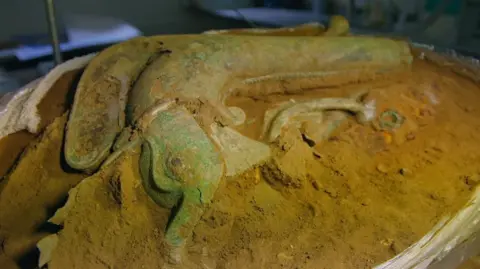
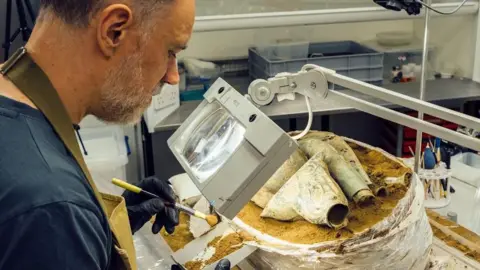
The excavation and subsequent conservation of these fragile artefacts have been a monumental undertaking. Upon discovery, the entire hoard was carefully extracted from the earth as a single soil block. This method is critical for preserving delicate items made of "extremely thin sheets of metal which have become extremely brittle after 2,000 years in the ground," as Jonathan Carr explained. Once in the lab, advanced scanning techniques, such as X-rays and CT scans, were employed to map the precise location and condition of each item within the soil matrix, allowing conservators to plan their intricate removal and preservation with utmost precision. The painstaking work of cleaning and stabilising these ancient objects, particularly the intricate details of the carnyx’s eye or the boar’s features, requires immense skill and patience.
This monumental archaeological project is a testament to collaborative effort. Pre-Construct Archaeology led the initial excavation, with the Norfolk Museums Service playing a central role in the ongoing research and conservation. National Museums Scotland, with its expertise in Iron Age and Roman artefacts, is also deeply involved, alongside the overarching support and coordination from Historic England. Dr Fraser Hunter remarked, "I’ve looked at carnyces from around Europe, and the full research and conservation of these incredibly fragile remains will reshape our view of sound and music in the Iron Age." This inter-institutional cooperation ensures that the finds receive the highest level of academic scrutiny and conservation care.
The legal process surrounding such a significant find involves reporting it to the coroner, who will hold an inquest to determine if it meets the criteria for "treasure" under the Treasure Act. If declared treasure, its ownership will be legally transferred, likely to a museum, ensuring its long-term preservation and public access. Its eventual long-term future, including where it will be displayed, has yet to be formally decided, but it is certain to become a star attraction wherever it ultimately resides.
Dr Tim Pestell, a senior curator of archaeology for Norfolk Museums Service, underscored the enduring appeal and historical weight of the discovery: "This find is a powerful reminder of Norfolk’s Iron Age past which, through the story of Boudica and the Iceni people, still retains its capacity to fascinate the British public." He emphasised that "The Norfolk Carnyx Hoard will provide archaeologists with an unparalleled opportunity to investigate a number of rare objects and ultimately, to tell the story of how these came to be buried in the county 2,000 years ago." Claudia Kenyatta CBE and Emma Squire CBE, co-CEOs of Historic England, echoed this sentiment, calling it a "remarkable discovery" and expressing their anticipation "to uncovering and sharing the story of the Norfolk community that owned and used these items."
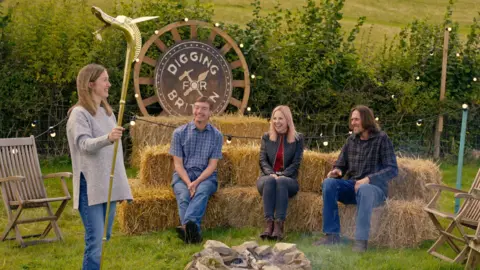
The public will have the opportunity to delve deeper into this extraordinary discovery through BBC Two’s popular series Digging for Britain. The story of the excavation, the initial shock of the find, and the meticulous conservation efforts will be featured on 14 January at 21:00 GMT, also available on BBC iPlayer. The programme, presented by anatomist, author, and broadcaster Professor Alice Roberts, who has fronted Digging for Britain since its inception, will undoubtedly bring this captivating slice of Iron Age history to a wide audience, sparking renewed interest in Britain’s ancient past and the remarkable people who once inhabited it. This unparalleled hoard not only illuminates the martial prowess and artistic sophistication of the Iron Age Iceni but also stands as a testament to the ongoing revelations hidden beneath the landscape of Britain.



 Nakalama John
 atisusanti
 Ramos Leo
 Roy Suryo
 George Anjay