
 Nana Banana
The prospect of humanity’s return to the lunar vicinity is drawing ever closer, with NASA preparing for the Artemis II mission, the first crewed journey to the Moon in over half a century. This pivotal mission, designed to pave the way for an eventual human landing, is tentatively slated for launch as soon as the first week of February. Preparations are already in full swing at the Kennedy Space Center in Florida, where the colossal Space Launch System (SLS) Moon rocket and its Orion Space Capsule are set for a critical rollout.
When does Artemis II launch?
The journey of the SLS rocket and Orion capsule from the immense Vehicle Assembly Building (VAB) to Launch Pad 39B is a spectacle in itself, a four-mile traverse undertaken by the crawler-transporter-2. This monumental move, expected to take up to 12 hours, is not merely a transport but a crucial step in the pre-launch sequence. Once at the pad, a dedicated team of engineers will commence an exhaustive series of preparations. This involves meticulously connecting a vast array of ground support equipment, including critical electrical lines, environmental control system ducts to manage temperature and humidity within the capsule, and cryogenic propellant feeds essential for fueling the rocket. The VAB itself is a historic landmark, a facility originally built for the Apollo program and later modified for the Space Shuttle, now serving as the assembly point for the next generation of lunar exploration.
A major milestone following the rollout will be the "wet dress rehearsal" scheduled for the end of January. This comprehensive prelaunch test is an exhaustive simulation of the countdown sequence, culminating in the fueling of the rocket with super-chilled liquid hydrogen and liquid oxygen propellants. This rehearsal is vital for verifying all systems, procedures, and personnel readiness without actually igniting the engines. Should any technical anomalies or operational issues arise during this critical test, NASA retains the option to roll back the SLS and Orion stack to the Vehicle Assembly Building for further inspections, repairs, or modifications, potentially impacting the launch schedule.
Assuming all systems perform as expected and the wet dress rehearsal is successful, the earliest possible launch date for Artemis II would be Friday, February 6th. However, space launches are not solely dependent on rocket readiness; the celestial mechanics of the Moon’s position relative to Earth and the desired orbital trajectory play an equally critical role. This dictates specific "launch windows" – periods during which the rocket can be precisely aimed to achieve the mission’s objectives. In practice, this typically translates to approximately one week at the beginning of each month when these favorable conditions align, followed by roughly three weeks without suitable launch opportunities. This delicate balance of engineering readiness and astronomical alignment underscores the complexity of lunar missions. It is important to note that launch dates for such ambitious space endeavors are often subject to change due as unforeseen technical challenges, weather conditions, or other factors can necessitate delays, a common reality in the history of spaceflight.
Who are the Artemis II crew and what will they be doing?
The Artemis II mission marks a historic moment as it will carry four exceptional astronauts further into space than any human has traveled in over half a century. The crew comprises NASA’s commander Reid Wiseman, pilot Victor Glover, and mission specialist Christina Koch, alongside a second mission specialist, Jeremy Hansen of the Canadian Space Agency (CSA). Their diverse backgrounds and extensive experience prepare them for this unprecedented journey.
Reid Wiseman, the mission commander, is a seasoned Navy test pilot and veteran of a 165-day mission aboard the International Space Station (ISS) in 2014. His leadership will be crucial in overseeing the mission’s complex operations and ensuring the safety and success of the crew.
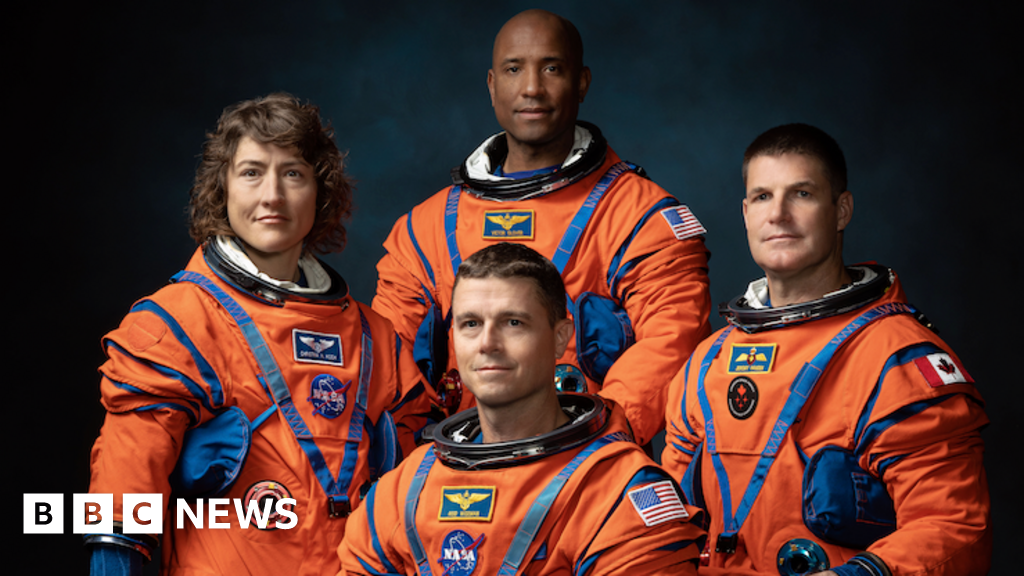
Victor Glover, the pilot, is also a distinguished Navy pilot and a veteran of a long-duration mission on the ISS, having served as part of the Crew-1 mission. His role will involve manually flying the Orion spacecraft, a critical skill test for future deep-space operations. Glover will make history as the first African American astronaut to venture on a lunar mission.
Christina Koch, a mission specialist, is an electrical engineer and holds the record for the longest single spaceflight by a woman, having spent 328 days aboard the ISS. Her expertise will be invaluable in testing the Orion’s systems and conducting scientific observations. Koch will be the first woman to travel around the Moon.
Jeremy Hansen, the other mission specialist, is a Canadian Armed Forces fighter pilot and the first Canadian astronaut selected for a lunar mission. His inclusion highlights the growing international collaboration in space exploration and Canada’s significant contribution to the Artemis program.
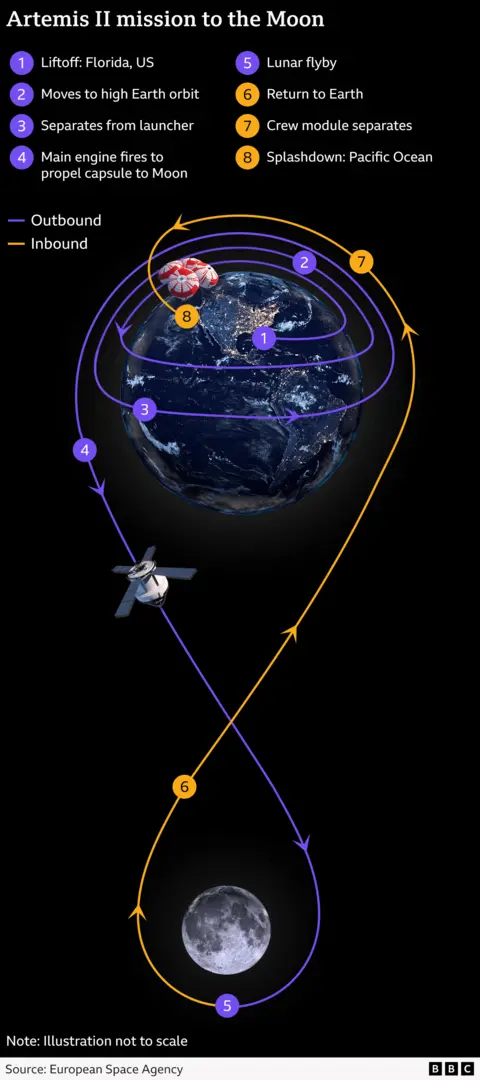
The Artemis II mission is the inaugural crewed flight of the powerful Space Launch System (SLS) and the Orion spacecraft. Once the crew is safely in Earth orbit, their initial tasks will focus on thoroughly testing the Orion spacecraft’s capabilities with human input. This involves manually flying the capsule, a crucial exercise to practice steering, maneuvering, and aligning the spacecraft – skills that will be vital for future lunar landings and rendezvous operations.
Following these initial checks, the crew will embark on a trajectory that will take them thousands of kilometers beyond the Moon, on a free-return trajectory. This path uses the Moon’s gravity to sling the spacecraft back towards Earth, providing a safe return path even if propulsion systems were to fail. During this deep space transit, they will meticulously check the Orion’s life-support systems, ensuring they can sustain the crew for extended periods, as well as its propulsion, power, and navigation systems under the extreme conditions of deep space. This rigorous testing in a true deep-space environment, where radiation levels are higher and communication delays are more pronounced than in low-Earth orbit, is paramount before attempting a lunar landing.
Beyond their operational duties, the astronauts themselves will serve as crucial medical test subjects. They will continuously transmit physiological data and imagery from deep space, providing invaluable insights into the human body’s response to the unique challenges of lunar transit, including exposure to higher radiation levels than those experienced on the International Space Station. While these radiation levels are elevated, they are still within safe limits for the mission’s duration. The crew will live and work in the relatively confined space of the Orion capsule’s nine-cubic-meter cabin, experiencing weightlessness for approximately 10 days, a testament to their endurance and adaptability.
The mission will culminate in a dramatic return to Earth. The Orion capsule will execute a high-speed, fiery re-entry through the atmosphere, designed to be "bumpy" but controlled, testing the spacecraft’s advanced heat shield and aerodynamic stability. This will be followed by a precision splashdown off the west coast of the United States, in the Pacific Ocean, where recovery teams will be standing by to retrieve the crew and the capsule.
Will Artemis II land on the Moon?
It is important to clarify that Artemis II is not a lunar landing mission. Its primary purpose is to serve as a critical test flight and dress rehearsal, laying the essential groundwork for the subsequent Artemis III mission, which aims to return humans to the lunar surface.
The launch of Artemis III is currently projected for "no earlier than" 2027. However, many experts within the space industry believe that 2028 is a more realistic timeframe. This projected delay stems from several complex factors, including the intricate development of the necessary technologies and systems. A significant component still under development is the Human Landing System (HLS) that will transport astronauts from lunar orbit to the surface. NASA has contracted SpaceX for its Starship lander, but an alternative option from Jeff Bezos’s Blue Origin is also in the pipeline. Both designs represent ambitious engineering challenges that require extensive testing and validation. Furthermore, new spacesuits, specially designed for lunar surface operations and being developed by US company Axiom Space, are still undergoing development and certification processes.
When Artemis III finally flies, its astronauts will be targeting the Moon’s south pole. This region is of immense scientific interest due to the suspected presence of significant quantities of water ice in permanently shadowed craters. This water ice could be a game-changer for future lunar exploration, potentially providing resources for drinking water, breathable air, and even rocket fuel, making a sustained human presence more feasible.
Beyond Artemis III, the overarching goal of the Artemis program is to establish a sustained human presence on and around the Moon. This ambitious vision includes the development of the Gateway, a small space station that will orbit the Moon, serving as an outpost for scientific research, a staging point for lunar surface missions, and a proving ground for technologies needed for missions to Mars. Artemis IV and V will be instrumental in assembling key modules of the Gateway. Subsequent missions will involve more frequent Moon landings, the expansion of Gateway, the deployment of advanced robotic rovers on the lunar surface, and an increasing level of international collaboration. The future of lunar exploration under Artemis envisions a truly global effort, with multiple nations contributing to long-term human habitation and scientific endeavors on and around Earth’s closest celestial neighbor.
When was the last Moon mission?
The last time humans walked on the Moon was during the Apollo 17 mission in December 1972. This mission, commanded by Gene Cernan, marked the conclusion of NASA’s historic Apollo program. In total, 24 astronauts traveled to the Moon between 1968 and 1972, and 12 of them had the extraordinary experience of stepping onto its dusty surface.
America’s initial push to reach the Moon in the 1960s was primarily driven by the Cold War "Space Race" – a geopolitical and technological competition with the Soviet Union. The successful moon landings firmly asserted American dominance in space. However, once this monumental goal was achieved, political enthusiasm and public interest in lunar missions gradually waned. This decline in interest, coupled with significant budget pressures, ultimately led to the cessation of the Apollo program.
The Artemis program represents a renewed commitment to lunar exploration, but with a fundamentally different approach and long-term objectives. Unlike the Apollo missions, which were largely "flags and footprints" endeavors focused on short scientific forays, Artemis aims to establish a sustainable human presence on the Moon. This new era leverages advanced technology, fosters extensive commercial partnerships with private companies, and emphasizes broad international collaboration, moving towards a future where living and working on the Moon becomes a reality.
Do other countries plan to send astronauts to the Moon?
The ambition to send humans to the Moon is no longer exclusive to the United States; several other nations are actively developing plans to place their astronauts on the lunar surface, primarily targeting the 2030s.
European astronauts, through the European Space Agency (ESA), are slated to participate in later Artemis missions, underscoring the international collaborative spirit of the program. Japan has also secured seats for its astronauts on future Artemis flights, further broadening the scope of this global endeavor.
China is rapidly advancing its independent lunar exploration program, with ambitious goals to land its own astronauts near the Moon’s south pole by 2030. This follows a series of successful robotic Chang’e missions, including lunar orbiters, landers, and sample return missions, demonstrating their growing capabilities in deep space.
Russia, through its Roscosmos space agency, continues to articulate plans for flying cosmonauts to the lunar surface and establishing a small lunar base sometime between 2030 and 2035. However, these timelines are widely considered highly optimistic by international observers, given the significant challenges faced by the Russian space program, including international sanctions, persistent funding pressures, and technical setbacks.
India has also emerged as a significant player in lunar exploration. Following the triumphant landing of its Chandrayaan-3 mission near the lunar south pole in August 2023 – making India the fourth nation to successfully soft-land on the Moon – the Indian Space Research Organisation (ISRO) has set an ambitious goal of sending its own astronauts to the Moon by approximately 2040. This aspiration is part of a broader strategic push to expand India’s human spaceflight program beyond low Earth orbit and establish its presence in deep space exploration.
The landscape of lunar exploration is evolving into a truly multi-polar endeavor, characterized by both collaboration and healthy competition, as nations vie for scientific discovery, technological advancement, and strategic advantage in the new era of space exploration.
Additional reporting by Kevin Church.




 Roy Suryo

 Nakalama John
 atisusanti
 Ramos Leo
