Nana Banana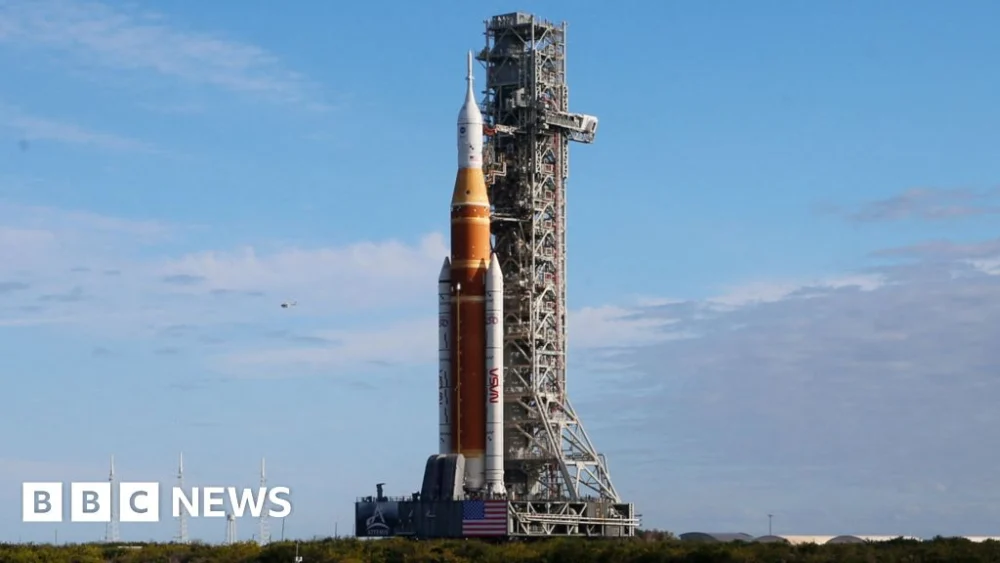
NASA’s monumental Space Launch System (SLS) rocket, poised to carry humanity closer to the Moon than ever in half a century, has completed its arduous journey to Launch Pad 39B at the Kennedy Space Center in Cape Canaveral, Florida. This critical manoeuvre signals the commencement of final preparations for the Artemis II mission, which will see four astronauts embark on a historic circumlunar voyage, marking the first crewed mission to the Moon in more than 50 years.
The colossal 98-meter-tall SLS, standing majestically vertical, was slowly transported from the Vehicle Assembly Building (VAB) – one of the largest buildings in the world – across a purpose-built 4-mile (6.5km) pathway to the launch pad. The intricate operation, executed by the colossal crawler-transporter, spanned almost 12 hours, a testament to the meticulous planning and precision required for such a gargantuan undertaking. Beginning its deliberate crawl at 07:04 local time (12:04 GMT), the rocket arrived at its destination, Launch Pad 39B, at 18:41 local time (23:42 GMT). The journey, though slow, reaching a top speed of just 0.82 mph (1.3 km/h), was a spectacle of engineering prowess, broadcast live to an eagerly watching world.

With the rocket now securely in position, a series of rigorous final tests, comprehensive checks, and a crucial "wet dress rehearsal" are scheduled. This rehearsal is a full-scale simulation of launch day, encompassing fueling operations, countdown procedures, and emergency response drills, all designed to ensure every system and protocol is perfectly calibrated for the actual liftoff. Only after these exhaustive preparations are successfully completed will NASA grant the ultimate "go-ahead" for the 10-day Artemis II mission. The earliest window for the rocket to blast off is currently projected for February 6th, with additional launch opportunities identified later that month, as well as in March and April, offering flexibility in the face of the complex technical and weather-dependent factors inherent in spaceflight.
Artemis II represents a pivotal moment in human space exploration, serving as the proving ground for the Orion spacecraft and the SLS rocket with a human crew onboard, paving the way for future lunar landings. The mission’s four intrepid astronauts – NASA’s Reid Wiseman, Victor Glover, and Christina Koch, alongside Canadian Space Agency (CSA) astronaut Jeremy Hansen – were present at the Kennedy Space Center, witnessing firsthand the awe-inspiring transfer of their future ride to the Moon. This crew is especially significant, as it includes the first woman (Christina Koch), the first person of colour (Victor Glover), and the first Canadian (Jeremy Hansen) to undertake a lunar mission, embodying the diverse and international spirit of modern space exploration. In just a few weeks, these pioneers will be strapped into the Orion spacecraft, perched atop the most powerful rocket ever built, ready to embark on a journey that will take them further into space than any humans have travelled before.
This mission harks back to the golden age of Apollo, specifically Apollo 17 in December 1972, which marked the last time humans walked on the lunar surface. For over five decades, humanity’s direct presence on the Moon has been absent, with focus shifting to Earth orbit and the International Space Station. Artemis II is designed not to land on the Moon but to perform a precise circumlunar trajectory, testing the spacecraft’s systems, life support, and heat shield capabilities under deep-space conditions. This critical test flight will lay the foundational groundwork for the subsequent Artemis III mission, which aims to return humans to the lunar surface, specifically targeting the Moon’s South Pole, a region believed to hold significant water ice resources. While NASA has stated Artemis III will launch "no earlier than" 2027, experts in the field suggest 2028 is a more realistic timeframe, underscoring the formidable challenges and timelines associated with such ambitious endeavours.
The astronauts themselves conveyed a mix of excitement and profound purpose. Christina Koch, reflecting on the calm professionalism of her colleagues, noted, "Astronauts are the calmest people on launch day. And I think… it feels that way because we’re just so ready to fulfil the mission that we came here to do, that we’ve trained to do." Jeremy Hansen articulated a broader, more philosophical sentiment, expressing his hope that the mission would inspire the entire world. "The Moon is something that I’ve taken for granted. I’ve looked at it my whole life, but then you just glance at it and glance away," he mused. "But now I’ve been staring at it a lot more, and I think others will be joining us and staring at the Moon a lot more as there will be humans flying around the far side and that is just good for humanity." His words capture the essence of space exploration: to ignite wonder, push boundaries, and foster a collective sense of achievement.
Before venturing into deep space, the Artemis II crew will spend the initial two days of their mission in a high Earth orbit, a crucial phase for system checks and crew acclimatization. "We’re going to be going into an orbit almost right away that is 40,000 miles out – like a fifth of the way of the Moon," Koch elaborated to BBC News. "We will have the Earth out the window as a single ball, something none of us have seen in that perspective." Following this, the Orion spacecraft will perform a Trans-Lunar Injection burn, propelling them a quarter of a million miles away towards the Moon. Throughout their journey, the crew will conduct a multitude of scientific experiments and operational procedures. During their three hours dedicated to lunar observation as they fly around the far side of the Moon, they will meticulously gaze, capture images, and study its geological features. This data will be invaluable for planning and preparing for the Artemis III landing at the Moon’s South Pole, where detailed knowledge of the terrain and potential resources will be critical.
A vital component of the Orion spacecraft, indispensable for the mission’s success, is the European Service Module (ESM). This sophisticated cylindrical module, sitting directly behind the crew capsule, is the European Space Agency’s (ESA) substantial contribution to the Artemis program, built by Airbus in Bremen, Germany. Sian Cleaver, a spacecraft engineer at Airbus, highlighted its critical role: "The European Service Module is so important – we basically can’t get to the Moon without it." She explained that the ESM provides the essential propulsion necessary to guide Orion to the Moon and ensures the spacecraft’s manoeuvrability. Furthermore, its expansive solar arrays are responsible for generating all the electrical power required for the craft’s systems, while large tanks storing oxygen, nitrogen, and water are meticulously mixed to create breathable air and provide the life support systems crucial for sustaining the astronauts throughout their arduous journey.

Inside the sterile confines of their cleanroom facilities, the dedicated team at Airbus is continuously engaged in constructing additional ESMs for future Artemis missions. Each module demands approximately 18 months to assemble, but its design represents thousands of painstaking engineering hours. The uncompromising philosophy underpinning their work is that every single component on board must perform flawlessly. "We’ve got to get those astronauts to the Moon and then back again, completely safely," Cleaver stressed, emphasizing that the safety of the crew is the paramount concern guiding every decision and every weld. This international collaboration between NASA and ESA, leveraging the expertise of companies like Airbus, exemplifies the global effort required to push the boundaries of human exploration.
With the magnificent SLS rocket now firmly established on Launch Pad 39B, the Artemis team is working tirelessly, around the clock, to ensure its readiness for the impending lift-off. While the mission has faced several years of delays, a common occurrence in complex space development programs due to technical hurdles, budget constraints, and the sheer scale of innovation required, NASA is acutely aware of the pressure to launch. However, the agency has consistently reiterated its unwavering commitment to safety above all else. John Honeycutt, chair of the Artemis mission management team, articulated this steadfast principle: "I’ve got one job, and it’s the safe return of Reid and Victor and Christina and Jeremy. We’re going to fly when we’re ready… crew safety is going to be our number one priority." This assurance underscores NASA’s methodical approach, prioritizing human life and mission success over arbitrary deadlines.
The arrival of the Artemis II rocket at the launch pad is more than just a logistical milestone; it’s a powerful visual declaration of humanity’s renewed ambition to return to the Moon and establish a sustainable presence there. This mission is not merely a revisit but a stepping stone, laying the groundwork for Artemis III and the eventual establishment of a long-term lunar habitat, paving the way for future human expeditions to Mars. As the world watches, the upcoming weeks will be filled with anticipation, marking the final stretch before a new chapter in lunar exploration begins, inspiring generations to look up and dream of the stars once more.




 Roy Suryo

 Nakalama John
 atisusanti
 Ramos Leo