Nakalama John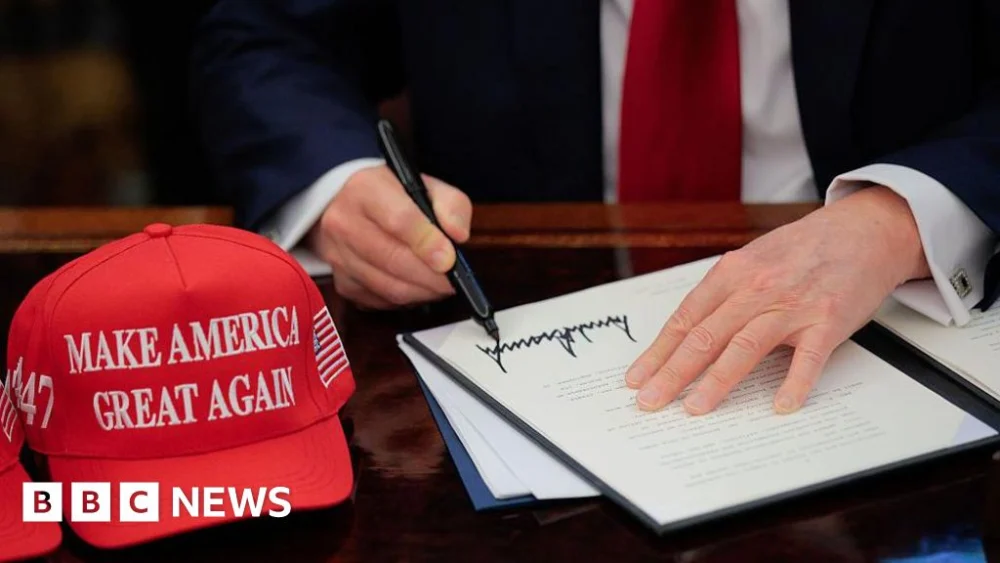
US President Donald Trump has implemented a sweeping range of tariffs on goods imported from numerous countries across the globe, a move he champions as a vital step to rejuvenate American manufacturing and create jobs. However, these aggressive trade policies have drawn significant criticism, with many economists and international bodies warning of the potential for higher consumer prices, damaged global supply chains, and a general slowdown in the world economy. Beyond their stated economic goals, Trump has also strategically deployed these taxes as leverage for broader political objectives, notably threatening tariffs on eight nations—including the United Kingdom—that have voiced opposition to his controversial proposed acquisition of Greenland. The legality of some of these measures is currently under intense scrutiny, with the US Supreme Court poised to deliver a landmark ruling in the coming weeks that could have profound implications for future presidential trade authority.
Tariffs are essentially taxes levied by a government on imported goods or services. They serve as a border tax, making foreign products more expensive in the domestic market. Typically, this charge is calculated as a percentage of the imported good’s value. For instance, a 10% tariff on a product valued at $10 would add a $1 tax, increasing its total cost to $11 (approximately £8.17). The responsibility for paying this tax falls on the companies that import these foreign products into the United States. These importing firms then face a choice: absorb the additional cost, thereby reducing their profit margins, or pass some or all of this extra expense onto their customers, which ultimately means higher prices for American consumers and businesses. Faced with increased costs, importers may also opt to reduce their orders of foreign goods, potentially shifting demand towards domestically produced alternatives. Historically, tariffs have been used for various purposes, including raising revenue for the government, protecting domestic industries from foreign competition (a policy known as protectionism), or as a bargaining chip in international trade negotiations.
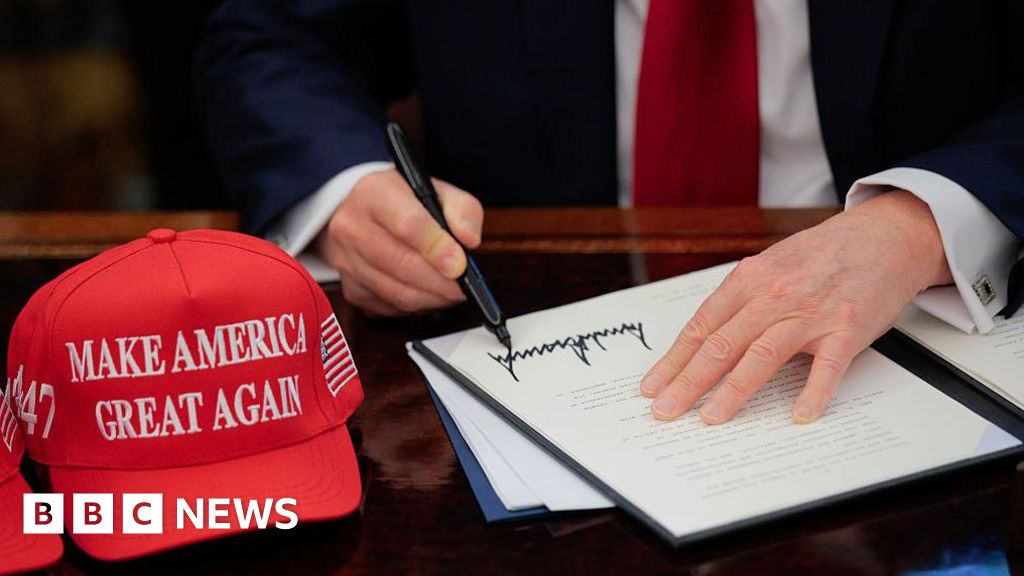
President Trump’s rationale for employing tariffs is multi-faceted, rooted deeply in his "America First" economic philosophy. He argues that tariffs serve several crucial functions: first, they increase government revenue, adding to the national coffers. Second, and more importantly from his perspective, they make imported goods more expensive, thereby encouraging American consumers to opt for domestically manufactured products. This shift in consumer behavior, he believes, will stimulate investment in US industries, leading to the creation of new factories and jobs across the country. A central pillar of his trade agenda is the desire to drastically reduce the US trade deficit—the persistent imbalance where the value of goods and services the US imports significantly exceeds the value of what it exports. Trump views this deficit not as a natural outcome of global trade dynamics but as evidence that the US has been systematically "exploited" and "pillaged" by other nations engaged in what he labels as unfair trade practices, such as currency manipulation, intellectual property theft, and excessive state subsidies.
Beyond these economic objectives, Trump has also demonstrated a willingness to weaponize tariffs for non-trade-related political demands. A notable example occurred when announcing tariffs against China, Mexico, and Canada. In these instances, he explicitly linked trade penalties to demands that these countries enhance their efforts to curb illegal migration and prevent the illicit flow of the potent opioid fentanyl into the US. More recently, in a highly unconventional move, Trump escalated this approach by threatening to impose fresh tariffs starting from early February on eight specific countries—Denmark, Norway, Sweden, France, Germany, the UK, the Netherlands, and Finland—all of whom have publicly expressed opposition to his proposed takeover of Greenland. This clearly signals a strategy where trade policy is directly intertwined with broader geopolitical ambitions and domestic policy concerns. It’s also worth noting that many of the announced tariffs have been subject to subsequent amendments or delays, reflecting the dynamic and often unpredictable nature of his administration’s trade strategy.
The legal standing of many of Trump’s tariffs has been a contentious issue, leading to numerous challenges in US courts due to the unconventional method of their implementation. Rather than seeking traditional Congressional approval for imposing these widespread tariffs, the Trump administration controversially invoked the 1977 International Emergency Economic Powers Act (IEEPA). This act grants the President broad authority to regulate international commerce during a declared national emergency. By declaring such an emergency, Trump was able to issue immediate executive orders, effectively bypassing the established legislative process for trade policy. This sidestepping of Congress sparked outrage among legal scholars and trade experts, who argued it was an overreach of executive power and an abuse of the IEEPA’s intent. In August 2025, a US appeals court delivered a significant blow to the administration, ruling that most of Trump’s tariffs were indeed illegal, though the court opted to leave them in place pending further review. The White House subsequently appealed this decision, pushing the matter to the highest court in the land. The US Supreme Court began hearing arguments in the pivotal case in November 2025, and a ruling that could redefine presidential trade authority is widely anticipated in the coming weeks. On January 12th, Trump took to social media to express his strong concern, stating it would be a "complete mess" if the Supreme Court were to strike down his tariffs. He warned of immense logistical difficulties if businesses were then entitled to claim refunds for taxes already paid. "It would take many years to figure out what number we are talking about and even, who, when, and where, to pay," Trump posted. He concluded his warning with a stark declaration: if the Supreme Court does not uphold his tariffs, "WE’RE SCREWED."
Negotiations regarding tariff rates are ongoing with a multitude of countries, particularly America’s largest trading partners. China, Canada, and Mexico, in particular, were singled out with warnings of exceptionally high tariffs, reflecting their significant trade volumes and the specific grievances Trump held against each. For China, initial tariffs on steel and aluminum quickly expanded to include a vast array of goods, from technology components to consumer electronics, totaling hundreds of billions of dollars. These were primarily justified by allegations of intellectual property theft, forced technology transfers, and state-backed subsidies that distorted global markets. Tariffs against Canada and Mexico were often intertwined with the renegotiation of the North American Free Trade Agreement (NAFTA), which was ultimately replaced by the US-Mexico-Canada Agreement (USMCA), as well as concerns over border security and the flow of illegal drugs.
Beyond these major players, a complex "patchwork" of different tariff rates has been applied to other nations. This largely stems from Trump’s April 2025 announcement that a "baseline" 10% tariff would be applied to imports from all countries. Nations deemed "worst offenders" for unfair trade practices would then face even higher rates as a punitive measure. Following delays to allow for bilateral trade talks, new tariff rates for dozens of countries were subsequently introduced in August. Illustrating the political dimension of his trade policy, on January 13th, Trump announced that the US would apply a 25% tariff on countries continuing to trade with Iran, a direct response to Tehran’s violent crackdown on anti-government protests, where thousands of lives are feared to have been lost. Just four days later, on January 17th, the US president declared he would impose a 10% tariff on the eight aforementioned countries (Denmark, Norway, Sweden, France, Germany, the UK, the Netherlands, and Finland) that had expressed opposition to his proposed takeover of Greenland. This additional tariff was set to come into force on February 1st, with a clear warning that it could escalate to 25% and would remain in place until a deal regarding Greenland was reached.
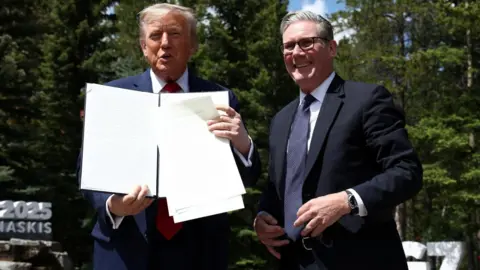
The United Kingdom managed to negotiate a relatively favorable tariff deal in June 2025, securing a 10% US tariff rate, which was the lowest of any country to strike a specific agreement with the Trump administration at that point. This agreement is particularly significant given that the UK exported approximately £58 billion worth of goods to the US in 2024, primarily comprising high-value items such as cars, sophisticated machinery, and pharmaceuticals. Under the terms of the deal, the 10% rate applies to the first 100,000 UK vehicles exported to the US each year, a figure roughly commensurate with the number of cars sold in 2024. Any additional vehicles beyond this quota would face the standard 25% tariff. The agreement also facilitated reciprocal beef trade between the two nations and granted a 0% tariff on some US ethanol, down from a previous 19%. While Trump enthusiastically declared "the deal was done" in June, a key point of contention remained the expected removal of all charges on steel imports from the UK. While the UK is uniquely positioned as the only country not facing 50% tariffs on steel and aluminum, instead paying 25%, reports indicate that the plan to entirely eliminate tariffs on UK steel exports has now been put on hold. Despite this setback, speaking to reporters ahead of his second state visit to the UK in September, Trump indicated his willingness to "help" Britain fine-tune the existing deal, suggesting an openness to further adjustments.
Beyond the specific country deals, Trump’s tariffs have impacted a wide array of goods. A primary target has been steel and aluminum, with initial tariffs of 25% on steel and 10% on aluminum, justified under a national security clause (Section 232 of the Trade Expansion Act of 1962) to protect domestic industries vital for defense. The US is the world’s second-largest importer of steel after the EU, with significant volumes coming from Canada, Brazil, Mexico, and South Korea, all of whom faced these new levies. A major policy change also saw Trump end an exemption for imports valued at $800 (£592) or less. Previously, these low-cost goods were duty-free, a rule that facilitated millions of daily packages, especially from booming online retailers like Shein and Temu. Now, companies shipping these parcels must either pay duties based on the tariff rate applicable to the country of origin or, for a transitional six-month period, opt to pay a fixed fee ranging from $80 to $200 per package. In early January, the White House confirmed a significant reduction in proposed tariffs on certain imported pasta, which had been set at almost 92%. The government had alleged that specific Italian-made goods were being "dumped" in the US at "less than normal value," thereby undercutting local producers. However, the tariffs were substantially lowered after what the administration described as constructive engagement with the Italian firms involved. Conversely, in November, Trump signed an executive order granting exemptions from tariffs for a range of other food products, including avocados, bananas, beef, and coffee. The administration explained this decision by stating that these specified goods could not be produced in sufficient quantities domestically to meet consumer demand.
The most direct consequence for ordinary Americans has been an increase in consumer prices for various products. Shoppers have experienced price hikes on a broad spectrum of goods, from toys and household appliances to furniture and certain foodstuffs. US inflation, which stood at 2.4% in April, rose to 3% in the 12 months to September. While it subsequently eased to 2.7% in November and remained at that level in December—a figure lower than many analysts had predicted—the upward pressure from tariffs has been undeniable. Numerous major retailers and manufacturers, including Target, Walmart, and Adidas, have publicly stated their intention to pass on the increased costs resulting from tariffs to US customers. Furthermore, the cost of goods manufactured within the US that rely on imported components is also expected to rise, creating a ripple effect throughout the economy. For example, complex supply chains often see car parts cross the US, Mexican, and Canadian borders multiple times before a vehicle is fully assembled, meaning tariffs at various stages can accumulate into a significant final cost.
Trump’s initial announcement of tariffs during his second presidential term sent shockwaves through the global economy, prompting accusations that he was deliberately fostering instability. While financial markets have largely regained their footing since the initial turmoil, the International Monetary Fund (IMF) stated in October 2025 that the overall economic picture remained volatile, directly attributing a negative impact to US tariffs. The IMF’s forecasts for global growth stood at 3.2% for 2025 and 3.1% for 2026. While a slight increase from its July predictions, these figures still represented a reduction from the 3.3% growth projected for both years before the introduction of Trump’s measures, highlighting the drag on international trade. For the US economy specifically, the IMF projected growth of 2% in 2025 and 2.1% in 2026. This marks a deceleration from the robust 2.8% growth recorded in 2024, yet it still positions the US economy as the fastest-growing among the world’s most advanced nations. The most recent US economic figures, covering the three months to September 2025, showed a significant pickup in speed, driven by a surge in consumer spending and increased exports. The economy expanded at an impressive annual rate of 4.3%, up from 3.8% in the preceding quarter, marking the strongest growth in two years and exceeding expectations. Notably, imports—which are subtracted when calculating Gross Domestic Product (GDP)—continued their decline during this period, a trend that aligns with Trump’s stated goal of reducing the trade deficit, even if it might technically reduce the headline GDP growth figure. However, the broader economic consequences of tariffs remain a subject of intense debate, with concerns persisting about potential long-term effects such as disrupted global supply chains, retaliatory tariffs from other countries, a reduction in overall global trade volumes, and increased investment uncertainty, all contributing to the spectre of a protracted "trade war."




 George Anjay
 Ramos Leo
 Nana Banana