
 Ramos Leo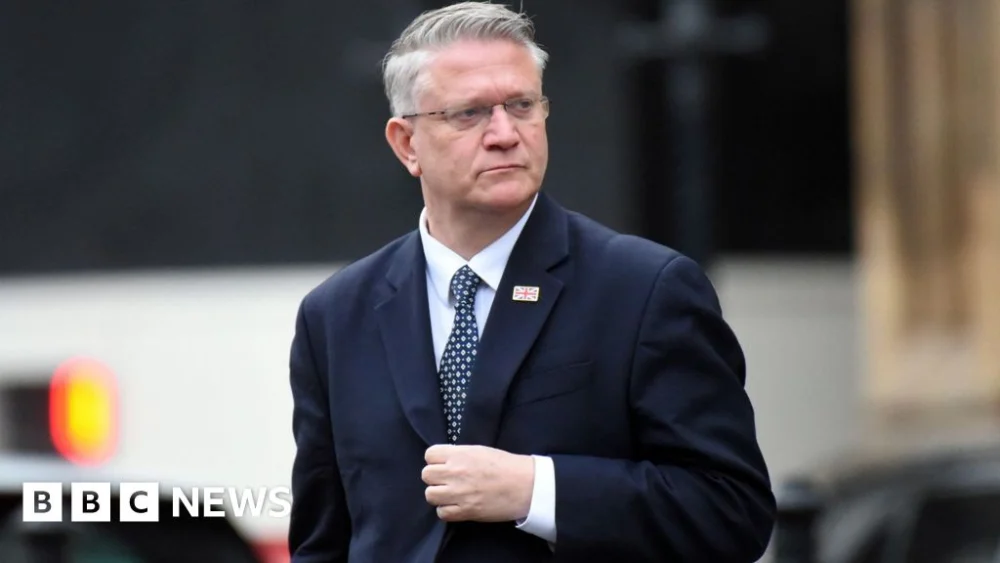
Rosindell, who has represented the Romford constituency in east London since 2001, stated that the Conservative Party was "irreparably bound to the mistakes of previous governments" and had consistently demonstrated an unwillingness to take "meaningful accountability" for its poor decisions. His defection is not merely a change of party but, in his own words, a principled stand born from deep-seated frustration over the direction of the country and the perceived abandonment of core conservative values by his former party.
The decision came after Rosindell spoke directly with Reform UK leader Nigel Farage on Sunday evening, a conversation that culminated in his agreement to join the party. Farage, never one to shy away from grand pronouncements, hailed Rosindell as "a great patriot" and expressed his delight, affirming that the Romford MP "will be a great addition to our team." This endorsement underscores Reform UK’s strategy of attracting disillusioned figures from the Conservative ranks, aiming to position itself as the true voice of traditional British conservatism and patriotism.
Predictably, the Conservative Party’s reaction was one of dismissal, laced with a hint of relief. An anonymous Conservative source quipped that Rosindell’s departure was a prime example of Farage doing Kemi Badenoch’s "spring cleaning," adding flippantly that Reform was "welcome" to him. This attempt to downplay the significance of a long-standing MP leaving highlights the deep ideological chasm that has opened up within the broader right-wing political spectrum in the UK.
Rosindell’s move marks a dramatic week for the Conservative Party, coming just days after Robert Jenrick, another former minister, also joined Reform UK. Jenrick’s defection on Thursday followed swiftly after his sacking from the shadow cabinet by Conservative leader Kemi Badenoch, who had openly accused him of plotting to defect. This sequence of events paints a picture of a Conservative Party in turmoil, battling internal dissent and the increasing gravitational pull of Reform UK.
The 59-year-old Rosindell, who had served as Shadow Minister for Foreign Affairs, articulated his disillusionment in a statement on X (formerly Twitter), asserting that the "views and concerns of constituents such as mine in Romford have been consistently ignored for far too long." He lamented that "Our country has endured a generation of managed decline," a phrase that resonates with many voters who feel neglected by the political establishment. He concluded that "Radical action is now required to reverse the damaging decisions of the past and to forge a new course for Britain."
With Rosindell’s switch, Reform UK now boasts seven Members of Parliament, making him the third sitting Conservative MP to join the party, following Robert Jenrick and Danny Kruger. This growing contingent significantly boosts Reform UK’s parliamentary presence and its ability to amplify its message from within Westminster. The numerical strength means that – when considering active voting blocs and setting aside independent MPs – Reform UK now holds the joint fifth biggest party grouping in the House of Commons, level with Sinn Fein, which, notably, does not send its seven MPs to Westminster. This places Reform UK just two MPs behind the fourth biggest party, the Scottish National Party (SNP), a remarkable rise for a party that, until recently, had no parliamentary representation.
Beyond sitting MPs, about 20 former Tory MPs have also switched their allegiance to Reform UK, a testament to the party’s increasing appeal among disaffected Conservatives. Among these high-profile figures is former Chancellor Nadhim Zahawi, who made his defection public just a week prior. This exodus of both current and former Conservative figures signals a profound shift in loyalty and a growing crisis for the mainstream Conservative Party.
Speaking to BBC Breakfast, Robert Jenrick welcomed his new colleague, stating it was "great news" Rosindell had joined Reform. He went on to issue a thinly veiled invitation to other disgruntled Conservative MPs, adding: "If there are other members of Parliament who are in the same situation, then I’m sure Nigel [Farage] and the party would welcome them in." However, Jenrick also added a caveat, reflecting Farage’s own strategic positioning: "But he has said very clearly, that you need to make up your mind quickly because Reform is growing fast."
The defections have naturally drawn criticism from within the Conservative Party. Shadow Welsh Secretary Mims Davies, speaking on BBC Radio 4’s Westminster Hour, condemned the defectors as "self-serving and completely wrong." Davies also expressed confusion regarding Reform UK’s ideological stance, stating: "I do find this very confusing that these people who are saying they want to put things right, want to be right-wing, but ultimately there’s a lot in Reform which is very left-wing and obviously populist." She argued that a narrative of national failure was unhelpful, urging politicians to focus on solutions rather than self-interest.
Andrew Rosindell’s tenure as MP for Romford has been a long one, having held the seat since 2001. However, his once substantial majority of 17,893 was significantly reduced to just 1,463 at the last general election, indicating a growing vulnerability and perhaps influencing his decision to seek a new political home.
A key driver behind Rosindell’s defection, as he elaborated after switching to Reform, was the Labour government’s contentious decision to hand the Chagos Islands to Mauritius. He also cited the "failure of the Conservative Party both when in government and more recently in opposition to actively hold the government to account on the issue" as a primary reason for his move. Rosindell, a staunch defender of British sovereignty, highlighted the profound implications of the decision to relinquish the strategic archipelago. "Both the government and the opposition have been complicit in the surrender of this sovereign British territory to a foreign power," he declared, framing it as a betrayal of national interest. The Chagos Islands, a British Indian Ocean Territory, are home to the strategically vital US military base on Diego Garcia. The UK’s recent move to negotiate a settlement with Mauritius over the islands’ sovereignty has been a point of contention for many traditionalists, including Rosindell, who view it as an unacceptable concession of British territory.
Nigel Farage, seizing on Rosindell’s specific grievance, reinforced this point, stating: "The Tories’ lies and hypocrisy over the Chagos Islands betrayal has tipped him over the edge, and we are delighted to welcome him to our ranks." This statement not only validates Rosindell’s reasoning but also aligns Reform UK with a strong stance on national sovereignty, a popular theme among their target electorate.
The timing of Rosindell’s defection is particularly notable, coming hours after the Reform leader had publicly insisted his party was "not a rescue charity for every panicky Tory MP" and would not become the "Conservative Party 2.0." In an article published in the Daily Telegraph, Farage had also stipulated that Reform would not accept any more defectors after local elections are held on 7 May. This calculated move by Farage aims to manage expectations, project an image of selectivity, and prevent Reform UK from being perceived as a mere repository for disgruntled Conservative politicians without a clear ideological identity of its own.
A Conservative source, clearly exasperated by the ongoing defections, suggested that Rosindell had been "threatening to defect for months, denying it was happening as recently as Saturday." The source concluded with a dismissive tone: "We’re not going to be distracted from holding this disastrous Labour government to account."
The Labour Party, naturally, has sought to capitalize on the Conservative disarray. Labour Party chair Anna Turley remarked: "The stench of a failed and dying Tory Party now engulfs Reform." She added, with a clear political jab, "Nigel Farage is now unconditionally trying to rehabilitate their disastrous record. The public won’t be fooled: the Tories failed Britain and Reform want to do it all over again." This narrative aims to paint Reform UK as merely an extension of Conservative failures rather than a genuine new force.
The Liberal Democrats also weighed in, with a source commenting that the defection was "a change of rosette for a career politician worried about getting a P45," implying opportunism rather than principle. They added: "The public are fed up hearing about how Britain is broken from the very same people who broke it."
Robert Jenrick, in his earlier news conference announcing his own defection to Reform, had been scathing in his assessment of his former party, stating that the Tories "broke" the country and had "betrayed its voters," leading to the UK’s current state of "decline." He later told the BBC’s Laura Kuenssberg that the country needed a "new and exciting" leader "who hasn’t been part of that failed consensus."
Kemi Badenoch, in her response to Jenrick’s departure, called it a "good day" for the Conservatives and declared Jenrick was "now Nigel Farage’s problem." She further elaborated on her disdain for Reform UK in an article for the Telegraph, asserting that the party was destined to fail as it welcomed "toxic people" who "destroy organisations." Badenoch’s strong words underscored the deep ideological battle now raging on the right, as she predicted: "A movement built on grievance and serial disloyalty is doomed to fail, and they will be at each other’s throats soon enough." The escalating rhetoric from both sides signals an intense and increasingly bitter fight for the soul of the British right-wing electorate ahead of the next general election.



 Roy Suryo

 Nakalama John
 atisusanti
