
 Nana Banana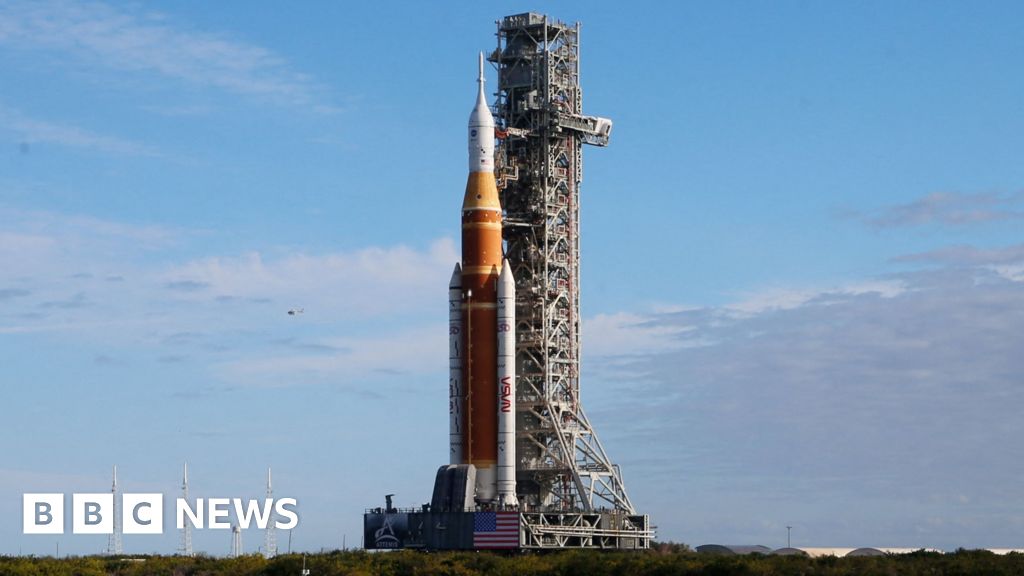
Nasa’s colossal Space Launch System (SLS) rocket, poised to launch the Artemis II mission, has completed its monumental journey to Launch Pad 39B at the Kennedy Space Center in Cape Canaveral, Florida. This pivotal milestone marks the final stages of preparation for the first crewed mission to orbit the Moon in over half a century, igniting anticipation for humanity’s renewed exploration of deep space.
The 98-meter (322-foot) tall SLS, crowned with the Orion spacecraft, embarked on its deliberate, almost stately procession from the iconic Vehicle Assembly Building (VAB) at 07:04 local time (12:04 GMT). Over nearly 12 painstaking hours, the integrated stack was carefully trundled along the 4-mile (6.5km) crawlerway, arriving at its launch position at 18:41 local time (23:42 GMT). This slow-moving spectacle, captured by live feeds and witnessed by thousands, underscored the immense scale and complexity of modern spaceflight.

Propelling the behemoth was the crawler-transporter, a legendary machine weighing over six million pounds (2.7 million kg) and standing as tall as a multi-story building. Travelling at a glacial top speed of just 0.82 mph (1.3 km/h), these colossal vehicles have been instrumental in moving rockets from the Apollo era to the Space Shuttle program, and now, the Artemis missions. The journey itself is a testament to meticulous engineering and operational precision, ensuring the delicate cargo remains perfectly vertical and stable.
With the SLS now firmly in place on the launch pad, an intense series of final tests and checks will commence. Paramount among these is the "wet dress rehearsal," a critical simulation that will see the rocket fully loaded with over 700,000 gallons of super-chilled liquid hydrogen and liquid oxygen propellant. This comprehensive test will exercise all countdown procedures, ensuring every system and team is ready for launch day, right up to the final seconds before ignition. It’s a full-scale dry run that has proven essential in identifying and resolving any potential issues before the crew is on board.
The Artemis II mission is designed as a 10-day journey that will carry four astronauts around the Moon. While it won’t land on the lunar surface, its ambitious trajectory is set to take the crew further into space than any human has ever traveled before, pushing the boundaries of human endurance and spacecraft capabilities. Nasa has indicated that the earliest launch window could be 6 February, with subsequent opportunities available later in February, and extending into March and April, allowing for flexibility as final preparations unfold.
The four trailblazing astronauts for Artemis II — Nasa’s Reid Wiseman (mission commander), Victor Glover (pilot), and Christina Koch (mission specialist), alongside Canadian Space Agency (CSA) astronaut Jeremy Hansen (mission specialist) — were present at the Kennedy Space Center, witnessing their ride to the Moon being rolled out. Their presence highlighted the very human element at the heart of this technological marvel, as they prepared mentally and physically for the incredible journey ahead.
This mission signifies a profound return to human lunar exploration, marking the first crewed flight to the Moon since Apollo 17’s landing in December 1972. For over five decades, the Moon has remained unvisited by human hands, making Artemis II a symbolic bridge between past achievements and future aspirations. The Artemis program, named after Apollo’s twin sister in Greek mythology, aims not just to return humans to the Moon, but to establish a sustainable presence there, leveraging lunar resources and developing technologies that will ultimately pave the way for human missions to Mars.
Artemis II’s flight path is meticulously planned. The initial two days of the mission will be spent in Earth orbit, allowing the crew to perform critical checks of the Orion spacecraft’s systems and to calibrate its navigation. Christina Koch elaborated on this, telling BBC News, "We’re going to be going into an orbit almost right away that is 40,000 miles out – like a fifth of the way of the Moon. We will have the Earth out the window as a single ball, something none of us have seen in that perspective." Following these initial checks, Orion will execute a Trans-Lunar Injection (TLI) burn, propelling it towards the Moon.

Once en route, the spacecraft will travel approximately a quarter of a million miles, performing a lunar flyby that will take the crew around the far side of the Moon. During this critical phase, the astronauts will have a dedicated three hours for intense lunar observation. This period will be used to gaze at the lunar landscape, capture high-resolution images, and study its geology, gathering vital data that will inform and prepare for the subsequent Artemis III mission, which aims to land astronauts at the Moon’s South Pole. This region is of particular scientific interest due to the potential presence of water ice in permanently shadowed craters, a crucial resource for future long-duration lunar outposts.
A fundamental component of the Orion spacecraft, essential for the mission’s success, is the European Service Module (ESM). Built in Bremen, Germany, by Airbus for the European Space Agency (ESA), the ESM is the powerhouse of Orion. Positioned directly behind the crew capsule, it provides the critical propulsion needed to journey to the Moon, the electrical power through its distinctive four solar arrays, and the life support systems vital for the astronauts’ survival.
Sian Cleaver, a spacecraft engineer at Airbus, emphasized the ESM’s indispensable role: "The European Service Module is so important – we basically can’t get to the Moon without it." She explained its multifaceted functions: "It provides the propulsion that Orion needs to get us to the Moon. We’ve also got these big tanks full of oxygen and nitrogen, which are mixed to make air, and also water, so that we can provide everything that the astronauts need in the crew module to keep them alive on their journey." The meticulous design and construction of each ESM module, taking about 18 months to assemble after thousands of engineering hours, underscores the paramount importance of reliability in deep space. Cleaver reiterated the core principle: "We’ve got to get those astronauts to the Moon and then back again, completely safely."

The Artemis II crew members themselves expressed a mix of awe and resolute determination. Christina Koch articulated the astronaut’s mindset, stating, "Astronauts are the calmest people on launch day. And I think… it feels that way because we’re just so ready to fulfil the mission that we came here to do, that we’ve trained to do." Jeremy Hansen spoke of the mission’s broader impact, hoping it would inspire the world. "The Moon is something that I’ve taken for granted. I’ve looked at it my whole life, but then you just glance at it and glance away," he reflected. "But now I’ve been staring at it a lot more, and I think others will be joining us and staring at the Moon a lot more as there will be humans flying around the far side and that is just good for humanity."
While Artemis II lays the critical groundwork, the ultimate goal of returning humans to the lunar surface rests with the Artemis III mission. Nasa has set a target of "no earlier than" 2027 for Artemis III, though many experts believe 2028 is a more realistic timeframe given the complexities of developing a human landing system and lunar surface operations. This subsequent mission will focus on landing astronauts near the Moon’s South Pole, where they will conduct extensive scientific research and test technologies for sustainable lunar living.
Despite the pressure to launch, given the years of delays the Artemis program has faced, Nasa remains steadfast in its commitment to safety above all else. John Honeycutt, chair of the Artemis mission management team, articulated this unwavering priority: "I’ve got one job, and it’s the safe return of Reid and Victor and Christina and Jeremy. We’re going to fly when we’re ready… crew safety is going to be our number one priority." This assurance underscores the profound responsibility carried by every individual involved in the Artemis program, as they prepare to send humanity’s next pioneers on an unprecedented journey around Earth’s closest celestial neighbor. The arrival of the mega rocket at Launch Pad 39B is not just a logistical step; it is a tangible symbol of humanity’s enduring quest for exploration, discovery, and inspiration beyond our home planet.





 George Anjay
 Ramos Leo
 atisusanti
 Nakalama John