Nana Banana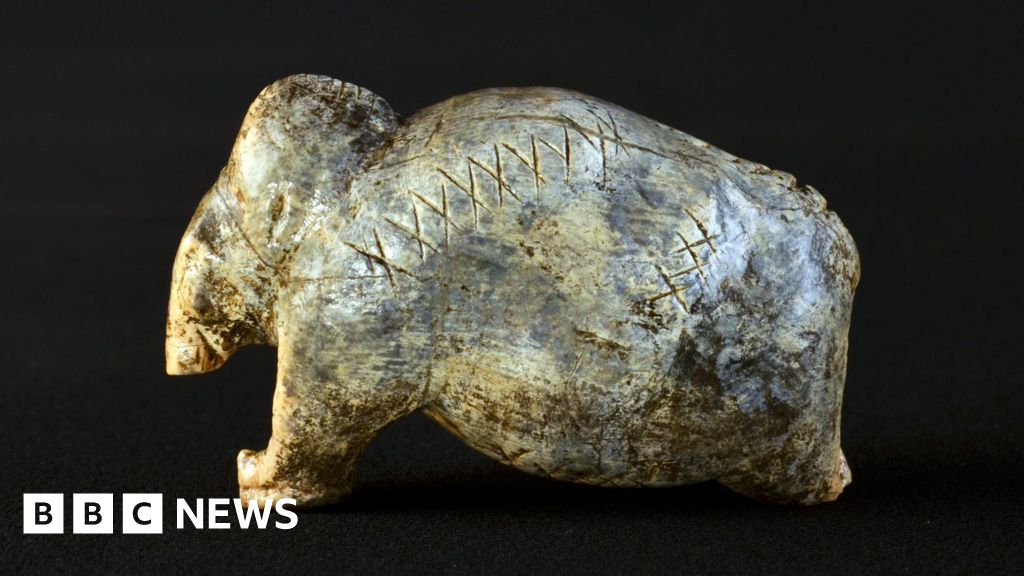
Researchers have meticulously analyzed ancient objects, primarily fragments of mammoth tusks, ivory plaques, and other artifacts, unearthed from prehistoric caves in Germany. These artifacts, some dating back an incredible 45,000 years, bear intricate patterns of lines, notches, dots, and crosses. Far from being random decorative marks, these sequences have been identified as possessing discernible patterns of meaning, hinting at an early, sophisticated form of communication that predates what has traditionally been considered the dawn of writing.
For centuries, historians and linguists have largely agreed that the first true written words emerged in ancient Mesopotamia, present-day Iraq, approximately 5,000 years ago. These early systems, known as proto-cuneiform scripts, were rudimentary but undeniably structured, primarily used for administrative and economic record-keeping. Following Mesopotamia, hieroglyphics developed in ancient Egypt, and later, distinct writing systems arose independently in China and Mesoamerica. The discovery of these much older symbolic sequences in Europe fundamentally challenges this established timeline, suggesting a far deeper and more complex history of human cognitive development and symbolic expression.
While the precise meaning of these newly identified symbols in Germany remains an intriguing mystery, the systematic nature of their arrangement strongly indicates an intentional effort to convey information. These objects date from a critical period in human history, just before Homo sapiens embarked on their significant migration into Europe from Africa, a time when they also interacted with Neanderthal populations. This context adds another layer of intrigue, raising questions about the role such communication systems might have played in the cognitive and social landscapes of these early human communities.
Professor Christian Bentz from Saarland University, a key author of the pioneering research, describes these Stone Age sign sequences as "an early alternative to writing." This classification is crucial, as it distinguishes them from fully developed phonetic or logographic writing systems while simultaneously acknowledging their structured, communicative intent. The study posits that these markings represent a foundational stage in the evolution of writing, a precursor to the more complex systems that would emerge millennia later.
The implications of this discovery are vast, particularly for our understanding of the intelligence and capabilities of Stone Age people. Ewa Dutkiewicz from Berlin’s Museum of Prehistory and Early History, another prominent researcher involved in the project, emphasizes that the work suggests early humans were "as clever as modern-day humans." This finding challenges long-held assumptions about the cognitive limitations of Paleolithic societies, revealing a capacity for abstract thought, symbolic representation, and structured communication that was far more advanced than previously imagined. Dutkiewicz further notes, "So far, we’ve only scratched the surface of what can be found in terms of symbol sequences on a wide variety of artifacts," hinting at the potential for future discoveries that could further illuminate this nascent form of communication.
The research team undertook an extensive analysis, examining more than 3,000 distinct characters distributed across 260 different objects. This meticulous investigation allowed them to uncover what they have termed the "DNA of writing" – the underlying structural principles and recurring patterns that signify intentional communication. Many of these remarkable artifacts were recovered from the Lonetal, a 37-kilometer-long cave system located in Baden-Württemberg, southern Germany, renowned for its significant Paleolithic archaeological sites. Other crucial finds originated from the Achtal valley, specifically the Geißenklösterle cave, another site celebrated for its rich collection of Ice Age art and artifacts.
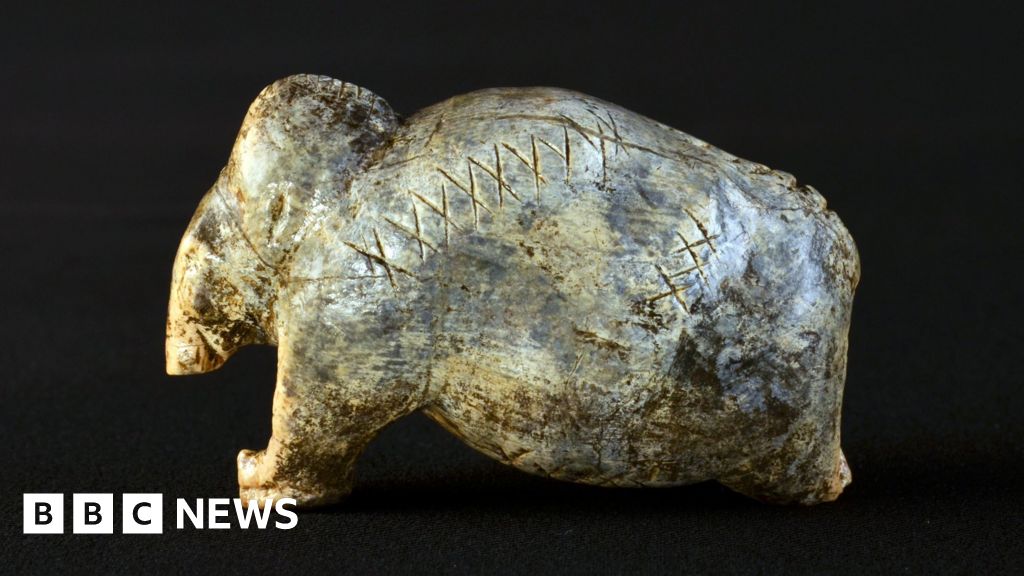
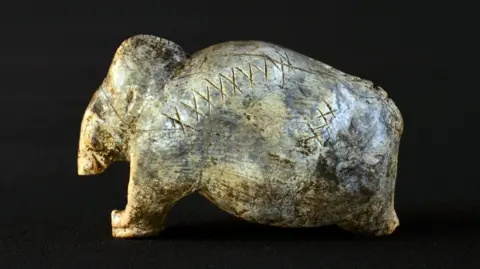
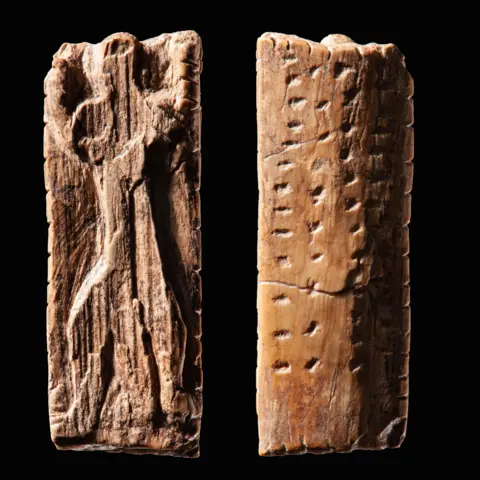
Among the most compelling pieces is a small mammoth figurine, exquisitely carved from tusk, which features carefully engraved rows of crosses and dots. The precise arrangement and repetition of these symbols are what caught the researchers’ attention, suggesting a deliberate pattern rather than mere decoration. Another significant artifact, dubbed the "adorant," originates from the Geißenklösterle cave. This ivory plaque depicts a captivating lion-human creature and is adorned with distinct rows of dots and notches. The researchers observed that the organization of these marks, particularly the dots on the back of the figurine, demonstrated a clear, non-random pattern indicative of communication.
The central tenet of the researchers’ hypothesis is that Stone Age people intentionally carved these symbols to convey messages, impart meaning, and express thoughts. This intent is a crucial differentiator, elevating these marks beyond simple artistic expression or ritualistic markings to a form of proto-writing. Professor Bentz further elaborates on the statistical significance of their findings: "Our results also show that the hunter-gatherers of the Paleolithic era developed a symbol system with a statistically comparable information density to the earliest proto-cuneiform tablets from ancient Mesopotamia – a full 40,000 years later."
The key to deciphering the communicative intent behind these ancient symbols lies in the density and predictability of their patterns. The research team identified a high degree of repetition and a notable predictability in the subsequent symbols within sequences. This characteristic, remarkably, is "comparable to much later proto-cuneiform," according to Bentz. Such statistical consistency suggests a rule-based system, a hallmark of organized communication. Interestingly, they observed denser patterns of symbols on figurines compared to tools, perhaps indicating that figurines held greater symbolic or narrative significance requiring more elaborate messaging.
This observation underscores the profound importance of communicating information for Paleolithic people. While the exact content of these messages remains elusive, it is plausible that they conveyed vital information about their environment, such as animal migration patterns, seasonal changes, territorial boundaries, or even social structures and mythological narratives. The very act of engraving these symbols, often with considerable skill and effort, speaks volumes about their value to these early communities.
Dutkiewicz highlights the craftsmanship involved: "They were skilled craftspeople. You can tell they carried the objects with them. Many of them fit very well in the hand, just the right size to fit in the palm." The portability and ergonomic design of many of these objects suggest they were not merely static art pieces but rather active tools for communication, carried and consulted frequently. This implies a dynamic use of these symbols in daily life, potentially for tracking, teaching, or sharing knowledge within their groups. The discovery opens up exciting new avenues for understanding the cognitive evolution of humanity, demonstrating an innate drive for symbolic expression and systematic communication far earlier than previously thought possible.
The implications extend to how we perceive the "birth" of abstract thought and the fundamental human capacity for externalizing complex ideas. These "early alternatives to writing" represent a crucial step in the long trajectory of human communication, bridging the gap between simple artistic representation and the complex phonetic and logographic systems that would eventually emerge. They signify a period where structured visual information could encode and transmit meaning across time and space, laying the groundwork for all subsequent forms of written language.
This transformative research, published in the esteemed journal PNAS (Proceedings of the National Academy of Sciences), not only rewrites a significant chapter in the history of writing but also profoundly enriches our understanding of the sophisticated intellectual capabilities of our ancient ancestors. It encourages a fresh perspective on what constitutes "writing" and how early humans leveraged symbolic systems to navigate their world and articulate their experiences. As Ewa Dutkiewicz suggested, this may indeed be just the beginning, with untold layers of ancient communication waiting to be unearthed and deciphered.







 Roy Suryo
 George Anjay
 Ramos Leo