Nana Banana
What once belonged solely to the realm of science fiction – a fully operational factory orbiting hundreds of kilometres above Earth, dedicated to producing advanced materials – is rapidly becoming a tangible reality. A pioneering Cardiff-based company, Space Forge, has taken a monumental leap forward in this ambitious endeavor, successfully deploying a microwave-sized manufacturing unit into orbit and demonstrating its capability to activate an internal furnace to scorching temperatures of approximately 1,000C. This groundbreaking achievement marks a critical milestone in the development of in-space manufacturing, positioning the United Kingdom at the forefront of a burgeoning new industrial revolution.
Space Forge, a name now synonymous with innovation in the UK’s rapidly expanding space sector, was founded on the audacious vision of leveraging the unique conditions of space for terrestrial benefit. Their core mission is to produce high-quality materials that are impossible or incredibly difficult to create on Earth, thereby addressing critical supply chain issues and advancing technological capabilities across various industries. The company’s headquarters in Cardiff serves as the nerve center for these pioneering operations, from design and development to mission control and data analysis. Their latest demonstrator satellite, a compact yet sophisticated factory, represents years of meticulous engineering and scientific research, culminating in a successful orbital deployment via a SpaceX rocket earlier this year.

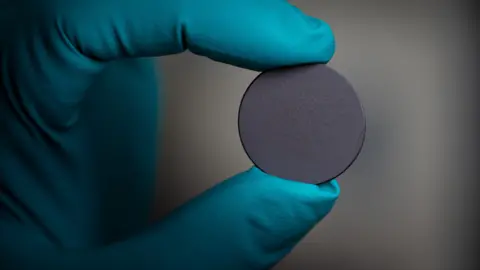
The primary focus of this miniature space factory is the production of advanced materials for semiconductors. These tiny, yet incredibly powerful, components are the bedrock of modern electronics, essential for everything from everyday smartphones and computers to critical infrastructure like 5G communication networks, electric vehicles, and advanced aerospace systems. The quality of these semiconductors directly impacts the performance, efficiency, and reliability of the devices they power. Space Forge aims to revolutionize this industry by exploiting the unparalleled manufacturing environment found beyond Earth’s atmosphere.
The advantages of manufacturing in space are profound, particularly when it comes to materials science. Semiconductors rely on a highly ordered, precise three-dimensional atomic structure to function optimally. On Earth, the omnipresent force of gravity poses significant challenges to achieving this perfect arrangement. Gravity induces phenomena like sedimentation and convection currents within molten materials, leading to imperfections, impurities, and structural defects in the final product. In the microgravity environment of space, these gravitational disturbances are virtually eliminated. Atoms can align themselves with exceptional precision, forming crystal lattices that are far more uniform and defect-free than their terrestrial counterparts.
Furthermore, the natural vacuum of space offers an inherently sterile manufacturing environment. On Earth, even in highly controlled cleanrooms, there remains a constant battle against microscopic contaminants that can compromise material purity. In orbit, the near-perfect vacuum means that foreign particles and gases simply cannot "sneak in" during the manufacturing process. This dual advantage of microgravity and vacuum allows Space Forge to produce semiconductors with an unprecedented level of purity and structural integrity. Josh Western, CEO of Space Forge, eloquently highlights this transformative potential: "The work that we’re doing now is allowing us to create semiconductors up to 4,000 times purer in space than we can currently make here today." Such an astronomical improvement in purity translates directly into superior performance, greater energy efficiency, and extended lifespan for electronic components, driving advancements in fields from high-performance computing to renewable energy.
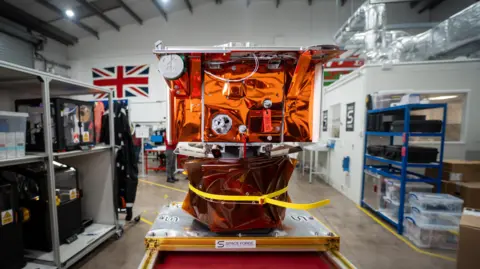
The recent mission involved not just launching the factory, but rigorously testing its core systems. From their mission control in Cardiff, the Space Forge team has been meticulously monitoring and commanding the orbital factory. A key validation point was the successful activation of the furnace and its ability to reach and sustain temperatures of around 1,000C. This intense heat is crucial for the material processing required to form advanced semiconductors. Veronica Viera, the company’s payload operations lead, shared the palpable excitement surrounding a pivotal moment: receiving images beamed back from the satellite, showcasing glowing plasma inside the furnace. "This is so important because it’s one of the core ingredients that we need for our in-space manufacturing process," she explained. "So being able to demonstrate this is amazing." The successful generation of plasma at such high temperatures in a space environment confirms the viability of the critical heating and processing steps for future material synthesis. This achievement is not merely a technical success; it’s a profound validation of the entire concept of operating complex industrial processes in the harsh vacuum of space.
Looking ahead, Space Forge is already charting a course for significant expansion. The current demonstrator mission is a proof of concept, paving the way for larger, more capable orbital factories. The team plans to develop and deploy a bigger space factory – one with the capacity to manufacture semiconductor material sufficient for an estimated 10,000 chips. This scaling up of production is vital for transitioning from experimental demonstrations to commercially viable manufacturing operations. The economic implications of being able to produce such high-value, high-performance materials in space are immense, potentially creating new global supply chains and reducing reliance on traditional, geographically concentrated manufacturing hubs.
However, manufacturing in space is only half the challenge; the other half lies in safely returning these valuable materials to Earth. This necessitates robust re-entry technology capable of protecting sensitive payloads from the extreme conditions of atmospheric re-entry. Space Forge is actively developing and testing its innovative heat shield, aptly named Pridwen, after the legendary shield of King Arthur. This advanced shield will be deployed on future missions to safeguard the spacecraft and its precious cargo from the intense friction and temperatures experienced during re-entry. The ability to repeatedly and reliably return materials to Earth is a game-changer, establishing a truly end-to-end space manufacturing and delivery system. This focus on reusability and safe return also aligns with growing calls for more sustainable practices in the space industry, minimizing orbital debris and maximizing efficiency.
Space Forge’s pioneering work is part of a broader, rapidly accelerating trend in the global space industry known as In-Space Manufacturing (ISM). Other companies and research institutions worldwide are also looking skyward, exploring the potential of microgravity for an array of applications. These include the production of ultra-pure pharmaceuticals, the creation of artificial tissues and organs for medical research, the fabrication of advanced optical fibers like ZBLAN which exhibit superior properties in microgravity, and the development of novel alloys with unique characteristics. The microgravity environment allows for crystal growth and material mixing in ways that are simply not possible under Earth’s gravity, opening up entirely new avenues for scientific discovery and industrial production.
Libby Jackson, Head of Space at the Science Museum, succinctly captures the significance of these developments: "In-space manufacturing is something that is happening now." She acknowledges that "it’s the early days and they’re still showing this in small numbers at the moment." However, she emphasizes the transformative potential: "But by proving the technology it really opens the door for an economically viable product, where things can be made in space and return to Earth and have use and benefit to everybody on Earth. And that’s really exciting." This sentiment underscores the long-term vision: a paradigm shift in industrial production, where the unique advantages of space are harnessed to create products that enhance life on Earth.
The journey from a "microwave-sized" demonstrator to a full-scale orbital factory producing thousands of advanced semiconductor chips is still ongoing, but Space Forge’s success in deploying its factory and activating its furnace in space represents a definitive step forward. It showcases the ingenuity of UK engineering and scientific ambition, validating the core principles of in-space manufacturing. As the company continues to refine its processes, scale its operations, and perfect its re-entry technology, the promise of purer, more efficient, and globally impactful materials manufactured beyond our planet moves ever closer to widespread realization, ushering in a new era of space-based industry.







 Ramos Leo
 Nakalama John
 George Anjay
 atisusanti