Roy Suryo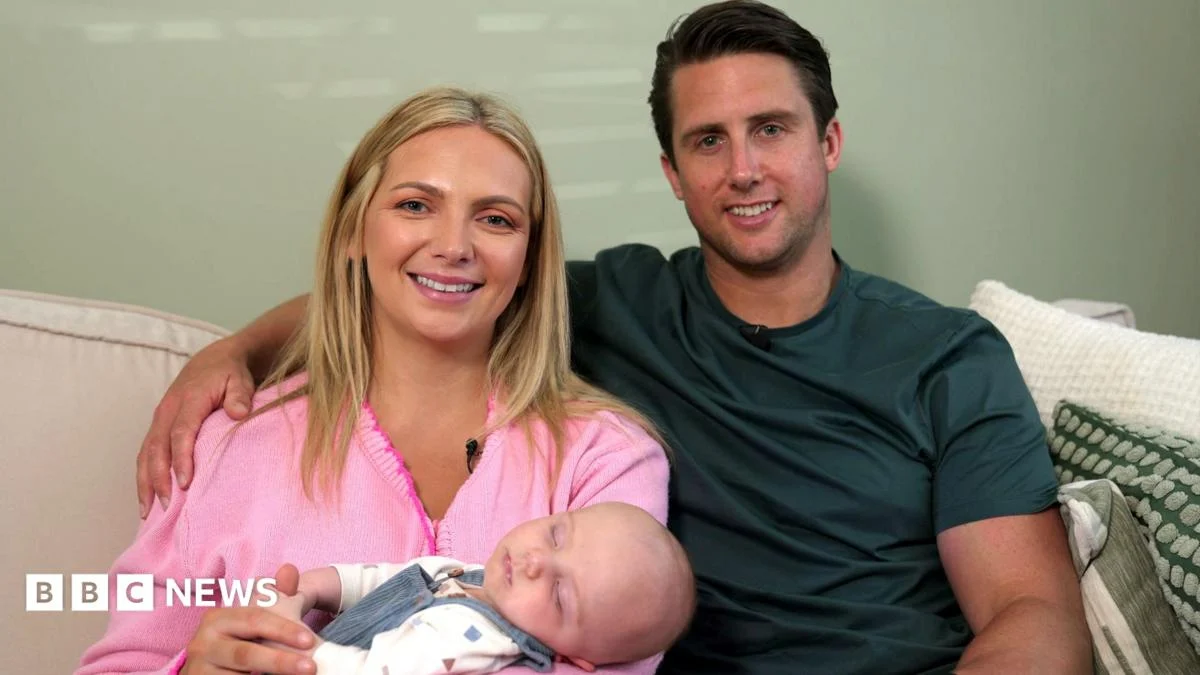
In a medical marvel that redefines the boundaries of prenatal care, doctors have successfully performed groundbreaking surgery on an unborn baby, correcting a severe birth defect while the infant was still safely within the womb. Maisie Savage, a 29-year-old teacher from London, traveled to the United States to undergo this life-saving procedure at 26 weeks gestation. Her son, Theo, now a thriving five-month-old, was born with gastroschisis, a rare condition where the abdominal wall does not form correctly, leading to the intestines developing outside the body. The innovative surgery involved partially exposing Maisie’s womb and then, using sophisticated keyhole techniques, gently guiding Theo’s external organs back into his developing abdomen. Theo is one of only three babies globally to have benefited from this pioneering clinical trial, offering immense hope for families facing similar devastating diagnoses.
Theo’s parents, Maisie and her partner, 36-year-old teacher Josh French, have spoken of their profound relief and gratitude for the successful outcome. "He’s a little miracle, isn’t he?" Maisie shared with BBC News, her voice filled with emotion. They readily acknowledge how drastically different their reality could have been. Gastroschisis, while a serious condition, affects approximately one in every 3,000 babies born in the UK each year. In less complex cases, affected newborns typically require weeks of intensive care, nutritional support via feeding tubes or intravenous lines, and subsequent corrective surgeries. However, Theo’s situation was far more severe, classified as complex gastroschisis, which carries significantly graver prognoses. Without intervention, such cases can necessitate up to six months in neonatal intensive care, multiple surgeries, prolonged intravenous feeding potentially lasting up to two years, and in the most tragic instances, an intestinal transplant. Even with the highest standards of medical care, the mortality rate for complex gastroschisis can be as high as one in ten babies.
Initially, Maisie and Josh were unaware of any complications with their unborn child. "Going towards a 20-week scan, we were purely just excited to have an image of our baby," Josh recalled. "We didn’t know he was going to be a ‘he’ at the time." The discovery of Theo’s gastroschisis was a profound shock, described by Josh as "incredibly scary." By 24 weeks gestation, specialist doctors at London’s prestigious Great Ormond Street Hospital (GOSH) were preparing the expectant parents for the challenging first six months of Theo’s life. However, upon recognizing the complexity of his condition, they referred Theo to Texas Children’s Hospital in Houston, a world-renowned institution at the forefront of fetal medicine.
At Texas Children’s Hospital, a dedicated team of fetal and pediatric surgeons, spearheaded by the pioneering Dr. Michael Belfort, was leading the first-of-its-kind clinical trial aimed at repairing complex gastroschisis in utero. Dr. Belfort, the clinical lead for the trial, has a distinguished track record in fetal surgery, having previously led similar groundbreaking procedures on babies with spina bifida while they were still in the womb.
Maisie was informed that she would need to relocate to Texas immediately and remain there for the remainder of her pregnancy. "It was a huge decision," she admitted, underscoring the immense personal sacrifice involved. As a crucial step within the trial protocol, Maisie first traveled to Leuven Hospital in Belgium. There, specialists administered a specialized Botox injection through her womb directly into Theo’s abdominal wall. This innovative step was designed to relax the abdominal muscles, thereby facilitating the surgical repair of the defect. Following this preparatory procedure, the family then journeyed to Texas, where the pivotal surgery took place in November of last year, when Maisie was 26 weeks pregnant.
The waiting period for Theo’s father, Josh, was agonizing. "The length of that day, it felt like a week," he recounted, describing the intense anxiety of not knowing the precise details of each stage of the operation. Maisie’s uterus was carefully exposed to allow for optimal positioning of both the uterus and the baby. The amniotic fluid was then drained and replaced with carbon dioxide (CO2) gas, creating a stable and expanded surgical space within the womb. Utilizing advanced keyhole surgical instruments, Theo’s external organs were meticulously and gently guided back into his abdomen. Once the organs were in place, the abdominal defect was carefully stitched closed.
The surgical intervention left Maisie with a scar that was notably larger than a standard C-section incision. The added challenge for Maisie was that, unlike mothers recovering from childbirth, she still had another 14 weeks of pregnancy to endure with this internal healing process. She described experiencing discomfort as Theo would kick inside her, sometimes impacting her scar. "It was a hard recovery," Maisie reflected, "But, it was worth it." The fetal surgery proved to be an unqualified success. Theo was carried to full term and was born in February via a vaginal delivery in Texas, a testament to the efficacy of the prenatal intervention.
Dr. Michael Belfort, obstetrician and gynecologist-in-chief at Texas Children’s Hospital, expressed his profound satisfaction with the remarkable outcomes. "The mother, the baby, the surgery, the time of the surgery, the fact that we had zero complications during the fetal surgery and after the fetal surgery, just remarkable," he stated, highlighting the flawless execution and exceptional results of this groundbreaking procedure. The success of Theo’s surgery represents a significant leap forward in the field of fetal medicine, offering a beacon of hope for countless families facing the prospect of severe congenital birth defects. This pioneering approach not only saves lives but also dramatically improves the quality of life for infants, mitigating the long-term complications often associated with conditions like complex gastroschisis. The collaboration between international medical teams and the bravery of parents like Maisie and Josh are paving the way for a future where more babies can be born healthy and thriving, regardless of the challenges they face before birth.




 George Anjay
 Nakalama John
 Ramos Leo
 Nana Banana