Nakalama John
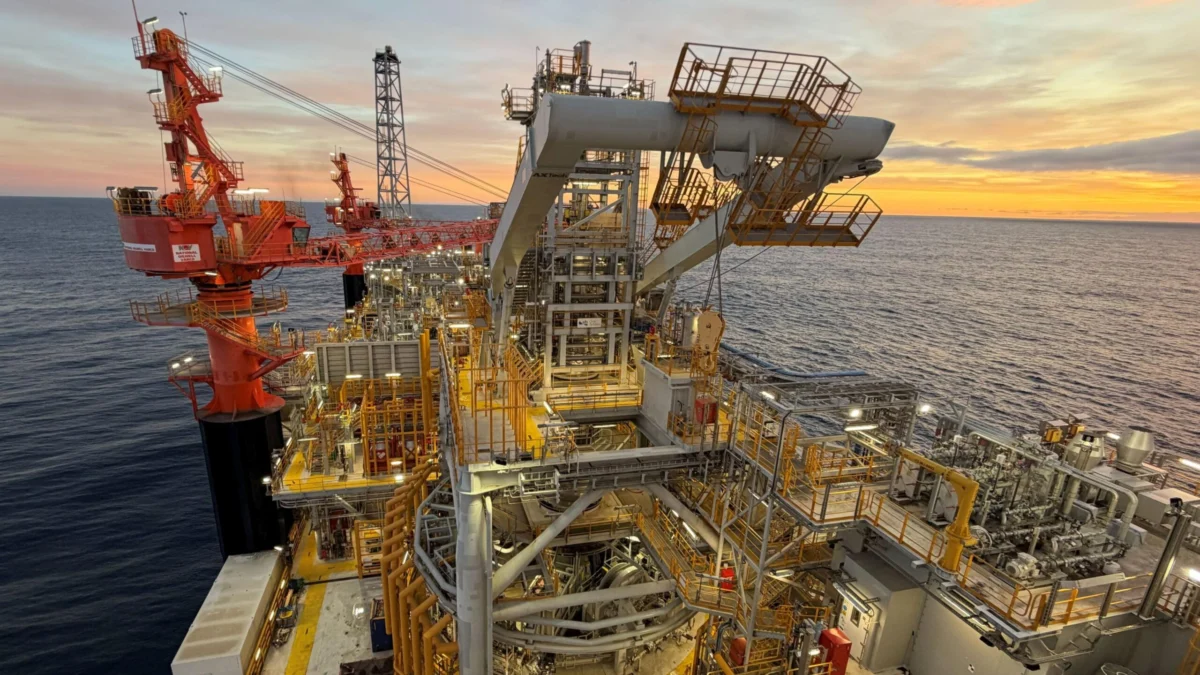
When the reporting team landed by helicopter at Rosebank, this formidable oil field was not only at the epicentre of a burgeoning political storm but also braced for a literal one. The arrival on a Wednesday morning came just hours after the UK government had controversially granted consent for gas production from the Jackdaw field in the North Sea. However, the focus of national debate was already shifting to this wild and remote patch of the North Atlantic – the next monumental decision looming for Energy Secretary Miatta Fahnbulleh. Rosebank dwarfs Jackdaw in scale, promising higher greenhouse gas emissions but also holding the potential for far greater financial returns for its operators, Adura and Ithaca.

This summer, the reporting team had journeyed to Jackdaw, located 150 miles east of Aberdeen. Now, they were making history as the first journalists to set foot on Rosebank. Their mission was twofold: to meticulously scrutinise a project that stands at the heart of the UK’s intense debate on climate change, energy policy, and economic strategy, and to offer a rare, intimate glimpse into the challenging yet compelling reality of offshore life. The timing was particularly poignant, arriving just days before Storm Boelo was forecast to unleash strong winds and heavy rain upon the already tempestuous waters.
"It’s good fun, it’s interesting, every day can change," remarked Nicola Boyd, the helideck operator, her smile a warm welcome as the team struggled out of cumbersome lifejackets and survival suits. Boyd, a veteran of offshore operations for nearly a decade, has spent a year working on Rosebank. Her routine involves two demanding weeks on the vessel, followed by three weeks of well-deserved leave back on land. "It’s a job I love," she affirmed, her enthusiasm undimmed by the inherent rigours of her environment.

Life on Rosebank demands not just passion but also a robust constitution. Unlike the fixed Jackdaw platform, this installation, positioned 80 miles northwest of Shetland, is a colossal floating production, storage, and offloading vessel (FPSO) named the Petrojarl Rosebank. Chartered by the field’s owners from Aberdeen-based Altera, the vessel provided a constant, gentle roll on the North Atlantic swell throughout the 48-hour visit. Yet, these conditions could be deceptively mild. Ewan Leonard, a lead mechanical technician and an Orkney islander known for his understated manner, described the winter weather as "a bit of a challenge." He recalled a recent "30m heave" – a massive swell – underscoring the extreme nature of the environment. Chris Brett, CEO of Altera, starkly confirmed this, stating that the area west of Shetland is considered "as harsh as you get anywhere in the world" within the industry. Regardless of one’s stance on the oil and gas sector, the sheer magnitude of human ingenuity and engineering prowess required to operate in such conditions is undeniably impressive.
The 122 individuals aboard the Petrojarl Rosebank possess deep reserves of skill, ingenuity, and a steely resilience. The jobs are well-paid, and according to Ewan Leonard, the facilities on board are exceptional. "We have single-man cabins, there’s good gym facilities, there’s a lot of rec rooms here," he detailed. Douglas Hogge, a production supervisor tasked with overseeing the safe extraction of oil and gas, echoed these sentiments. "There’s the gym, the sauna," he said, adding, "you can obviously go and get some fresh air. There’s plenty of fresh air out there." There’s even a cinema, offering a rare escape from the relentless expanse of the sea.

The culinary experience also garnered universal praise. "As you’ve seen yourself, the food is fantastic on board, so no complaints," Leonard chuckled. Talented chefs work tirelessly day and night, sending out a diverse array of delicious dishes, from hearty braised ox cheek to fresh mackerel and succulent pork loin, ensuring the crew is well-fed and morale remains high. As dusk descends and the night shift prepares for duty, sometimes with the unusual combination of fillet steak and chocolate brownie pudding for breakfast, the vessel transforms into a glowing labyrinth against the gloom. Its decks are a bewilderingly complex tapestry of pipes, valves, and bright yellow steelwork, a testament to its intricate function.
The ship is designed for stability, rotating around a fixed central point known as the turret to face directly into the prevailing weather, thereby mitigating the impact of the elements on those on board. Should production gain approval, oil and gas will be pumped up through this turret from the vast reserves below. The Rosebank field is estimated to contain between 300 million and 500 million barrels, enough to sustain operations for perhaps 25 years. "For myself and a lot of the guys, that would see us out to retirement," remarked Douglas Hogge, his words encapsulating the profound personal stake many workers have in the project’s future. "We need to see this approved," he asserted.

However, environmental campaigners vehemently disagree. Groups like Uplift and Greenpeace have been campaigning to halt Rosebank for years, achieving some notable successes. "The future of the energy sector in the UK is renewable energy," stated Tessa Khan, executive director of Uplift. Consent for production at Rosebank was initially granted under the Conservative government in 2023. But in a significant legal victory for campaigners in 2025, the Court of Session in Edinburgh ruled that the approvals for both Rosebank and Jackdaw were unlawful. The judge, Lord Ericht, determined that the environmental impact of actually burning the fossil fuels in cars, homes, and factories had not been adequately considered. This ruling allowed developers to continue preparatory work but stalled actual oil and gas production until more detailed environmental assessments could be provided and reviewed by the government and regulators.
"We think Rosebank would be a disastrous decision and a terrible deal for ordinary people across this country," Khan argued, imploring Prime Minister Andy Burnham to prioritise renewables in his ambitious quest to re-industrialise the nation. "If the government’s interested in building investor confidence, giving the green light to a major new oil field is going to do the opposite," she contended, highlighting the perceived contradiction between new fossil fuel projects and climate commitments.

The long-term trajectory for the oil and gas industry is undeniably one of decline. It has been a quarter of a century since oil production peaked, and in recent years, jobs in the sector have been disappearing at a much faster rate than new ones are being created in renewable energy fields like wind and solar power.
The oil extracted from Rosebank would be loaded onto tankers via a gigantic hose and nozzle, resembling the super-sized pump of an enormous floating filling station. From there, it would be sold on the international market, most likely transported to continental Europe for refining. Opponents argue that this international sale demonstrates the project’s minimal benefit to the UK and thus it should be rejected. Supporters, however, counter that UK and European energy markets are interdependent, and the project would generate millions in tax revenue for the Treasury.

Neil McCulloch, chief executive of Adura – an 80% owner of Rosebank and a joint venture between Shell and the Norwegian state energy firm Equinor – maintains an optimistic outlook. He points out that Rosebank contains not only oil but also gas, which would be piped to Shetland and then on to the St Fergus terminal in Aberdeenshire, with the potential to heat 500,000 British homes at peak production. McCulloch further argues that approval for Rosebank could pave the way for four more Jackdaw-sized gas developments in the waters west of Shetland: Tornado, Tornado East, Tobermory, and Suilven. "We would like to proceed with them," he affirmed, hinting at a potential surge in fossil fuel production that campaigners deeply fear. Tessa Khan warns that such a surge would exacerbate the deadly and damaging impacts of climate change for everyday Britons, from teachers and nurses to firefighters and families worried about their children, while simultaneously generating "huge profits for companies that are already incredibly profitable."
As the impending UK government decision draws near – sources indicating an announcement before Christmas – a strange mood permeates Rosebank. The recent decision in favour of Jackdaw has undeniably buoyed spirits on board, yet it has also sharply highlighted the precariousness of their own project. For now, most workers expressed a determination to simply focus on their jobs, with their unique rhythms and unusual restrictions – no quick trips to the shops, no alcohol, and the frequent missing of special occasions back home.

For some on board, the cravings are intensely personal. Steward Liam Davidson eagerly anticipates seeing his French bulldog, Bailey, at the heliport upon his return from his fortnight on board. "My wee dog’s at the heliport when I arrive," he shared, "I do miss her." For Nicola Boyd, it’s the simple comforts of her double bed and a pizza delivery. "I love seeing the family, but for me, it’s the pizza," she confessed.
However, even the most basic comforts can be delayed. As Boyd helped the reporting team into their survival suits for departure, the Met Office issued an amber weather warning for much of Scotland. For Rosebank, it seems, stormy seas lie ahead, whether literal or political.



 George Anjay
 Ramos Leo
 atisusanti
 Roy Suryo