George Anjay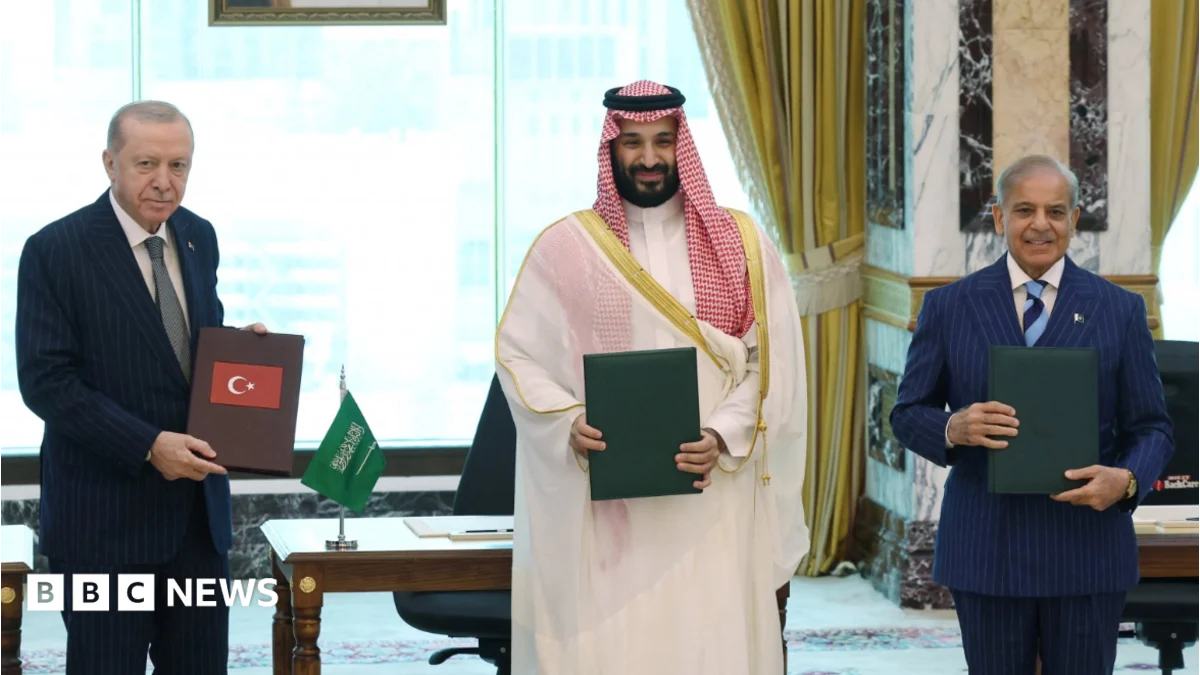
In a significant development signaling a new strategic alignment in a volatile region, Saudi Arabia, Turkey, and Pakistan have formalized a groundbreaking defense pact, the "Mecca Joint Defence Agreement," underscoring a shared commitment to collective security and mutual defense. This agreement, announced on Friday by Pakistan’s foreign ministry, declares that an attack on any one of the three signatory nations will be considered an attack against all, establishing a powerful deterrent against potential aggressors and a framework for coordinated responses to regional threats. The pact, described by a Turkish official as "purely defensive in nature," arrives at a critical juncture as escalating tensions between Iran and its proxies, and the United States and Israel, threaten to engulf the Middle East in wider conflict.
The geopolitical landscape that prompted this historic accord is fraught with peril. The recent escalation of attacks launched by Iran and its allied forces targeting strategic locations within Saudi Arabia and other Gulf Cooperation Council (GCC) states, following what Iran perceived as attacks by the US and Israel on February 28th, has dramatically heightened regional anxieties. These retaliatory actions, which have included the blockade of vital shipping lanes, have disrupted global supply chains and underscored the fragility of regional stability. The Red Sea, a critical artery for international trade, has become a particular flashpoint, with Iran-backed Houthi rebels in Yemen, who control the northern parts of the country, intensifying their campaign against internationally recognized Yemeni government forces. These forces are themselves supported by a Saudi-led coalition.
In a move that directly impacted Saudi Arabia, the Houthis last month declared a "maritime embargo" against the Kingdom. This declaration was not merely symbolic; it was accompanied by a series of targeted attacks on Saudi airports, vital oil facilities, and commercial tankers transiting the Red Sea. These actions, aimed at crippling Saudi Arabia’s economy and disrupting its energy exports, have forced Riyadh to adopt a more robust defensive posture. In response to the escalating Houthi threat, Saudi Arabia has initiated its own series of retaliatory strikes against Houthi positions in Yemen. Concurrently, the Kingdom has taken the proactive step of forming a new naval coalition, specifically designed to bolster security and protect shipping in the strategically vital Red Sea and the Gulf of Aden. The Mecca Joint Defence Agreement can be seen as a natural extension of these defensive efforts, pooling resources and strategic intent among key regional players.
The "Mecca Joint Defence Agreement" is a clear manifestation of the growing unease shared by these three predominantly Sunni Muslim nations regarding the escalating conflict between Iran and the US-Israel axis. The lack of a clear resolution to this protracted confrontation, coupled with the United States’ apparent struggle to contain the widening regional repercussions, has spurred these countries to seek a more direct and unified approach to their security. The agreement pledges mutual support, a cornerstone of collective defense, though it notably abstains from providing specific details regarding the precise obligations of each member state. This deliberate ambiguity might allow for flexibility in responding to diverse threats, enabling tailored support based on the specific nature and scale of any incident.
The strategic contributions of each signatory nation lend significant weight to the agreement. Saudi Arabia, as one of the world’s largest oil producers and a significant purchaser of defense equipment, brings immense financial power and considerable diplomatic influence to the alliance. Its vast resources can underwrite joint military operations, provide logistical support, and fund advanced defense technologies. Turkey, a formidable power in its own right, commands the second-largest military force within NATO, a testament to its extensive operational experience and advanced military capabilities. Furthermore, Turkey has cultivated a sophisticated domestic defense production capacity, enabling it to develop and manufacture advanced weaponry, drones, and other critical military assets. This self-sufficiency in defense production can significantly reduce reliance on external suppliers and enhance the alliance’s overall operational autonomy.
Perhaps the most potent strategic asset brought to the table by Pakistan is its status as a nuclear power. This possession of nuclear weapons provides an unparalleled deterrent against any large-scale conventional or unconventional aggression. The implicit threat of nuclear retaliation significantly raises the stakes for any potential adversary, offering a powerful layer of security that complements the conventional military strengths of Saudi Arabia and Turkey. The combination of Saudi Arabia’s financial clout, Turkey’s advanced military industrial complex and NATO-aligned forces, and Pakistan’s nuclear deterrent creates a formidable strategic bloc, capable of projecting power and deterring a wide range of threats.
The context of the agreement cannot be divorced from the ongoing conflict between Israel and Iran, a situation that shows no immediate signs of de-escalation. This protracted conflict has created a volatile environment, characterized by proxy warfare, cyberattacks, and the constant threat of direct confrontation. The repercussions of this conflict are felt across the region, impacting trade, security, and political stability. The United States, a long-standing ally of both Saudi Arabia and Turkey, and a key partner in regional security, finds itself in a challenging position, attempting to manage the fallout from this complex geopolitical struggle. The signing of the Mecca Joint Defence Agreement suggests that these three nations, while still valuing their alliances, are also seeking to enhance their independent strategic capabilities and create a more robust regional security architecture that is less reliant on external powers.
The strategic implications of this pact are far-reaching. It represents a consolidation of power among key Middle Eastern and South Asian states, creating a potential counterweight to regional hegemons and a more diversified security network. The focus on mutual defense suggests a shared understanding of the threats facing the region, particularly those emanating from Iran and its proxies. The agreement’s emphasis on a purely defensive nature, as stated by the Turkish official, aims to assuage concerns from international partners and avoid perceptions of aggressive posturing. However, the very existence of such a pact, involving nuclear-armed Pakistan and militarily significant Saudi Arabia and Turkey, will undoubtedly reshape regional power dynamics and influence the calculus of all actors involved.
The "Mecca Joint Defence Agreement" is more than just a treaty; it is a statement of intent. It signifies a collective determination to safeguard national sovereignty, protect vital economic interests, and maintain regional stability in an increasingly uncertain world. As the conflict between Iran and the US-Israel axis continues to simmer, and the threat of wider conflagration looms, this defense pact between Saudi Arabia, Turkey, and Pakistan stands as a crucial development, signaling a new era of strategic cooperation and a unified front against shared security challenges. The precise operational modalities and the full extent of each nation’s commitment will likely unfold over time, but the foundation for a more secure and coordinated regional defense has undeniably been laid.




 Nakalama John
 Ramos Leo
 Nana Banana