
 atisusanti
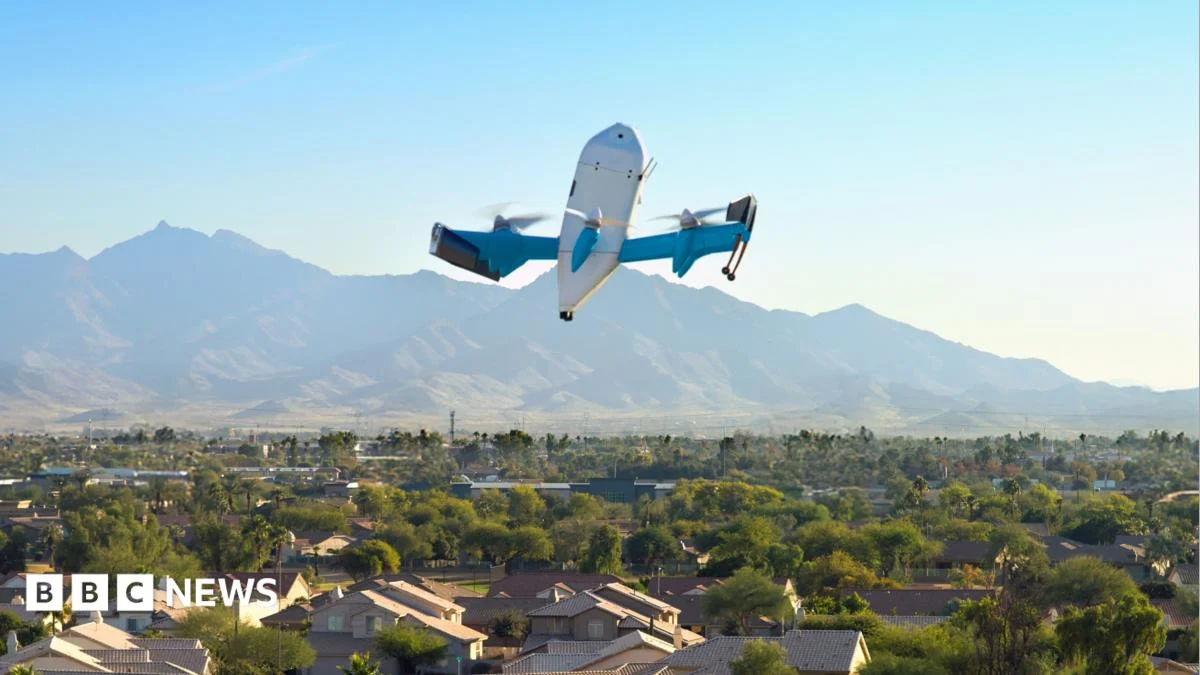
Schmidt is one of a growing number of people living with the pervasive hum of drones dispatched by e-commerce giants like Amazon and retail behemoths such as Walmart, all vying to revolutionize home deliveries. What was once a futuristic novelty is rapidly becoming an integrated element of everyday life for many across the United States. Amazon Prime Air, a pioneer in this burgeoning sector, is on an aggressive expansion trajectory, aiming to bring its delivery services to nearly 500 cities and towns, capable of transporting items that fit within the confines of a shoebox. This expansion extends beyond American borders, with services already launched to customers in and around Darlington in the north of England. The landscape is also populated by a proliferation of smaller, specialized drone delivery services. In select US cities, consumers can now indulge in the convenience of ordering culinary delights, from pizzas to ice cream, delivered directly by air.
Even in urban environments where ambient noise is a constant companion, the distinctive whine of drones seems to possess a uniquely irritating quality. While the steady drone of traffic can often blend into the background sonic tapestry, the sudden, high-pitched whine of a drone’s rotors can sharply pierce the everyday hum. Antonio Torija Martinez, a professor specializing in acoustic engineering and psychoacoustics at the University of Salford, observes that this sound tends to be "particularly noticeable, even when overall sound levels are relatively low." Unlike conventional aircraft, drones operate at significantly lower altitudes, frequently traversing directly over residential areas. This proximity, Torija Martinez explains, can expose communities that have historically been insulated from substantial aircraft noise, rendering them potentially more sensitive to alterations in their local soundscape. He further elaborates on research indicating that human responses to noise are amplified when the source is perceived as "novel, intrusive, or frequent." Consequently, individuals who directly benefit from a drone delivery service, for instance, might exhibit a reduced level of annoyance. However, Torija Martinez issues a stern warning: as the drone sector continues its rapid expansion, complaints regarding drone noise are almost certain to escalate. "At the moment we are seeing some of these problems localized in some areas, but… as the drone sector expands, more and more of these complaints will happen." In the United States, the Federal Aviation Administration (FAA) holds regulatory authority over commercial drones. Yet, the agency has faced criticism for its perceived leniency in permitting drone delivery operations that generate considerable noise. The FAA maintains that operators and local community leaders bear the primary responsibility for addressing and resolving any concerns raised by residents.
The critical question arises: can technological advancements effectively muffle the irritating buzz of these aerial couriers? Enter Greenjets, a startup that has embarked on a mission to address both the "noise level and the frequency of that noise," as articulated by Darren James, the company’s lead for future technologies. This London-based enterprise has engineered a novel propulsion system, which they claim can achieve a reduction in drone noise by an impressive two-thirds. Traditional drones typically rely on exposed, spinning propellers that slice through open air, generating the characteristic high-pitched whine. Greenjets, in contrast, encases its spinning blades within a pod. This design serves a dual purpose: to effectively muffle the sound and to direct the noise away from the ground, thereby minimizing its impact on those below. The company’s system further contributes to noise reduction through a slower rotor speed and the strategic use of materials engineered to dampen vibration noise. The impetus for developing quieter drones extends beyond merely appeasing neighbors weary of incessant aerial deliveries. Greenjets’ low-noise technology has already found practical applications in critical sectors, being utilized by police and harbor security teams in Germany. It has also proven invaluable to conservationists in Africa, who employ it to track poachers from above without raising suspicion. Military operations also stand to gain significantly from quieter drones. Battlefield drone operators have a vested interest in minimizing noise signatures to avoid alerting enemy forces to the approach of their unmanned vehicles. Robert Tollast, a research fellow at the Whitehall think tank The Royal United Services Institute (RUSI), notes, "There are some efforts to reduce the sound of drones. The US Special Forces are interested, at an experimental stage." However, Tollast emphasizes that for larger drones deployed in conflict zones, such as those seen in the war between Russia and Ukraine, speed often takes precedence over stealth. "Make it faster, not less quiet, seems to be the approach," he observes.
For Greg Sharrow, a Detroit-based entrepreneur, the genesis of his pursuit of quieter drone design can be traced back to 2012. He was tasked with the challenging feat of broadcasting a classical music performance, and a drone appeared to be the only viable solution for capturing specific, difficult angles. However, the inherent noisiness of contemporary drones presented a significant obstacle. "I knew that most of the noise from the drone was coming from the propeller, not the motor," he recalls, pinpointing the tips of the blades as the primary culprits for generating noise as they interacted with the air. This realization prompted a fundamental question: "what would a tipless propeller look like and how would it function?" His innovative answer was a propeller featuring twisted, loop-shaped blades with no discernible points. Initially, Sharrow found it more practical to test his propeller designs in water rather than repeatedly launching drones, which led to the development of a less noisy boat propeller. Currently, however, his company, Sharrow Engineering, is dedicating its efforts to the advancement of "ultra-quiet" drone rotors. "We have validated that the technology works in drone applications and that it is dramatically quieter," Sharrow confidently states.
Companies at the vanguard of drone delivery services are also actively engaged in efforts to mitigate the noise generated by their fleets. A spokesperson for Amazon confirms that the company has implemented "measurable sound improvements" to its drones. Their latest models incorporate custom-designed propellers that, according to the company, produce "almost half the perceived sound of the prior generation, with a milder tone." Wing, a drone manufacturer whose vehicles are utilized for Walmart deliveries, asserts that its propellers are meticulously engineered to minimize noise emissions. Furthermore, the company strategically varies its flight paths to preclude repetitive overflights of any single residence or neighborhood, aiming to distribute the sonic impact. For individuals like Schmidt, who are increasingly frustrated by the pervasive drone noise, the most desirable resolution would be the complete cessation of drone deliveries in their vicinity. "I would like them to completely stop until they figure out how their services stop being a nuisance," she expresses, articulating a sentiment shared by many seeking respite from the escalating airborne clamor. The quest for quieter drone technology is not merely an academic pursuit; it is an imperative for the widespread and sustainable integration of this transformative technology into our daily lives, addressing the growing concerns of communities and paving the way for a more harmonious coexistence between humans and their increasingly common aerial companions.




 Ramos Leo

 Roy Suryo

 Nana Banana
 George Anjay

 Nakalama John
