
 Ramos Leo
Sir Chris Bryant, the UK government’s representative in Northern Ireland, has adopted a resolute stance, emphasizing the constitutional and legal duty of the devolved Executive to manage its own finances. During recent talks, he reportedly presented a set of stringent conditions for any potential budget deal, including commitments to generate additional revenue and improve fiscal discipline within the Executive. "They really have to take me seriously when I say there is no more money," Sir Chris underscored, conveying the UK Treasury’s unwillingness to provide further unconditional financial injections. This tough approach highlights the Westminster government’s desire for greater fiscal responsibility from Stormont, particularly after years of political instability and reliance on central government funding.

The Executive, comprising power-sharing parties like Sinn Féin and the Democratic Unionist Party (DUP), finds itself in a challenging position. The intricate balance of governance in Northern Ireland requires broad consensus, making agreement on contentious financial matters inherently difficult. The region has a history of political impasses, and the current budget crisis represents another significant hurdle for the recently restored devolved administration. Without an agreed budget, government departments are forced to operate under emergency spending allocations, typically restricted to 95% of the previous year’s budget, a measure that risks critical services running out of funds by January.
Following intense one-to-one meetings with Sir Chris Bryant, First Minister Michelle O’Neill of Sinn Féin expressed the ongoing difficulty in reaching a breakthrough, stating there was still "no white smoke." O’Neill highlighted her impatience with the UK government and firmly rejected any "lectures" on financial management, signaling the Executive’s belief that the current funding model is inadequate. Her primary focus remains on securing a budget deal that would allow for crucial public sector pay awards, which have been delayed, leading to widespread discontent and the threat of industrial action across vital services like healthcare and education. The image of the Sinn Féin delegation, including Michelle O’Neill, John O’Dowd, Mary Lou McDonald, and Caoimhe Archibald, reflects the collective effort from the party to navigate these complex discussions.

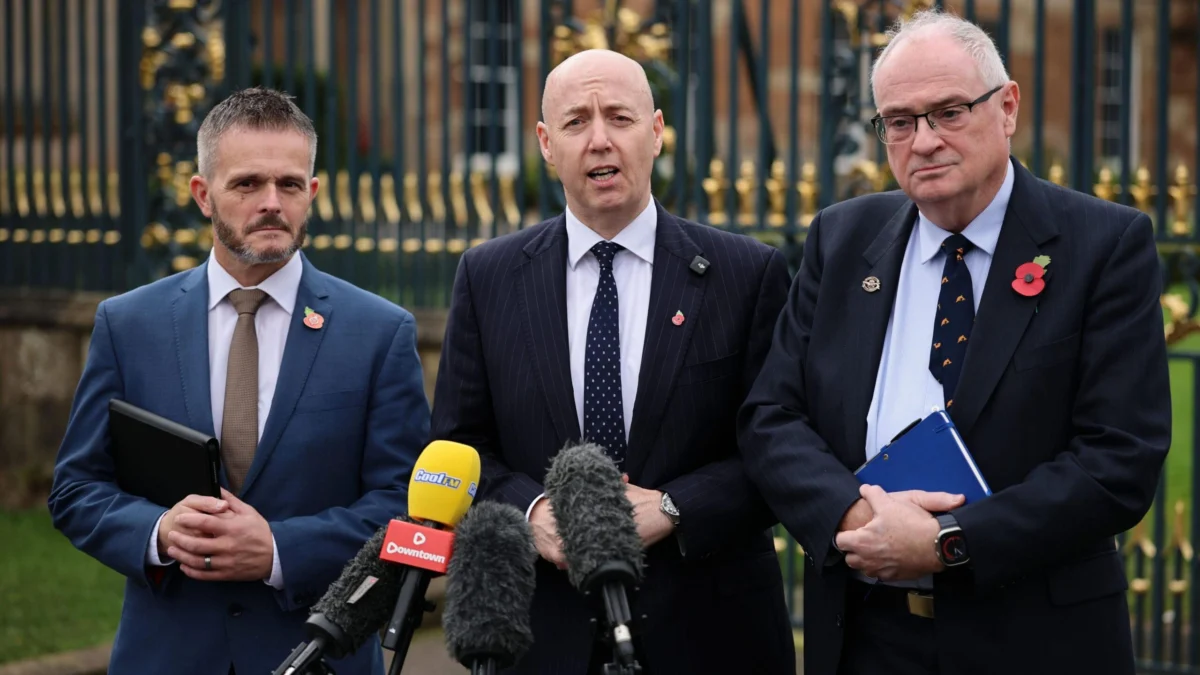
Gavin Robinson, the leader of the Democratic Unionist Party, echoed a sense of pessimism regarding the talks. He observed that any perceived optimism about a swift resolution was "not matched by the reality inside" the negotiating room. Robinson reiterated the DUP’s position that without additional resources, achieving a balanced budget is impossible. He warned of dire consequences, stating that without a budget, "there will be no legal ability to do what it is we think the executive needs to do, and what we want it to do." The DUP delegation, including Education Minister Paul Givan, deputy leader Michelle McIlveen MLA, deputy First Minister Emma Little-Pengelly, and Communities Minister Gordon Lyons, also arrived at Hillsborough Castle for meetings, underscoring the cross-party nature of the crisis.
Sir Chris Bryant, speaking on BBC Newsline, reaffirmed that it is the "legal responsibility and duty" of the Executive to set its own budget. He described the talks ending without agreement as "a bit frustrating" but maintained a hopeful outlook, emphasizing his desire to "get a move on." He stressed the fundamental principle that "whatever the total envelope is you have to live within it," pushing the Executive to prioritize within existing financial constraints. Crucially, Sir Chris indicated that he would only intervene to set a budget for Northern Ireland if explicitly requested by the Executive parties, a scenario that would represent a significant step back for devolved governance. He insisted that the Executive "should be able to put together their budget but they have to decide what their priorities are."

A key point of contention revolves around the UK’s devolution funding formula, commonly known as the Barnett formula. Stormont ministers argue that this long-standing mechanism no longer provides sufficient funds to cover their mounting spending pressures, particularly in light of the urgent need to deliver pay awards for public sector workers to achieve parity with their counterparts elsewhere in the UK. The UK government had offered an additional £525m for the current year, but the Executive deemed this insufficient to bridge the substantial funding gaps. A request to "front-load" a larger portion of a three-year financial package into the current year was also rejected by Westminster, further complicating the Executive’s financial planning.
The conditions put forth by Sir Chris Bryant are understood to include a commitment from the Executive to raise an additional £200m in revenue during the 2027/28 and 2028/29 financial years. This demand for local revenue-raising measures, such as potential adjustments to local taxes or charges, signals a shift towards greater financial self-reliance for Northern Ireland. Furthermore, he has called for improved "discipline" regarding promises and the delivery of pay parity to public sector workers, implying a need for more realistic and sustainable financial planning within Stormont.

Ulster Unionist Party leader Jon Burrows, pictured with Health Minister Robbie Butler and Steve Aiken, articulated the gravity of the situation. While not wanting to sound "defeatist," he acknowledged the real possibility that a budget resolution might not be reached in time to prevent widespread strike action by healthcare workers and other public sector employees awaiting overdue pay uplifts. The looming threat of strikes adds another layer of urgency and potential disruption to an already strained public service landscape.
The budget negotiations have been ongoing for several months, with Finance Minister John O’Dowd recently warning that a "crunch point" was rapidly approaching. Following a recent Executive meeting, O’Dowd indicated his intention to present a range of options to his ministerial colleagues in the coming days, though he did not publicly disclose their nature. The repeated rejection of requests, such as the "front-loading" of funds, underscores the limited flexibility the Executive perceives it has within the current financial framework.

The implications of failing to agree on a budget are far-reaching and severe. Beyond the immediate operational restrictions of 95% emergency spending, there are specific consequences for households. Sir Chris Bryant has explicitly stated that a promised £100 cost-of-living payment cannot be disbursed to households in Northern Ireland until an Executive budget is formally agreed. This linkage adds a direct public impact to the political deadlock, further increasing pressure on the parties. The UK government’s recent budget under Chancellor Andy Burnham did provide an additional £270m for public services in Northern Ireland, with £131m available this year. However, this sum, while welcome, has evidently not been enough to break the impasse. In light of the persistent stalemate, Sir Chris Bryant has confirmed that he is actively exploring contingency measures. These measures would involve him passing a budget bill at Westminster, effectively bypassing Stormont, should the devolved parties fail to reach an agreement. Such a move, while ensuring financial continuity, would be a significant assertion of central government authority and could be seen as undermining the autonomy of the Northern Ireland Executive, further complicating the delicate balance of devolution.


 Nana Banana
 George Anjay
 Nakalama John
 atisusanti
