
 atisusanti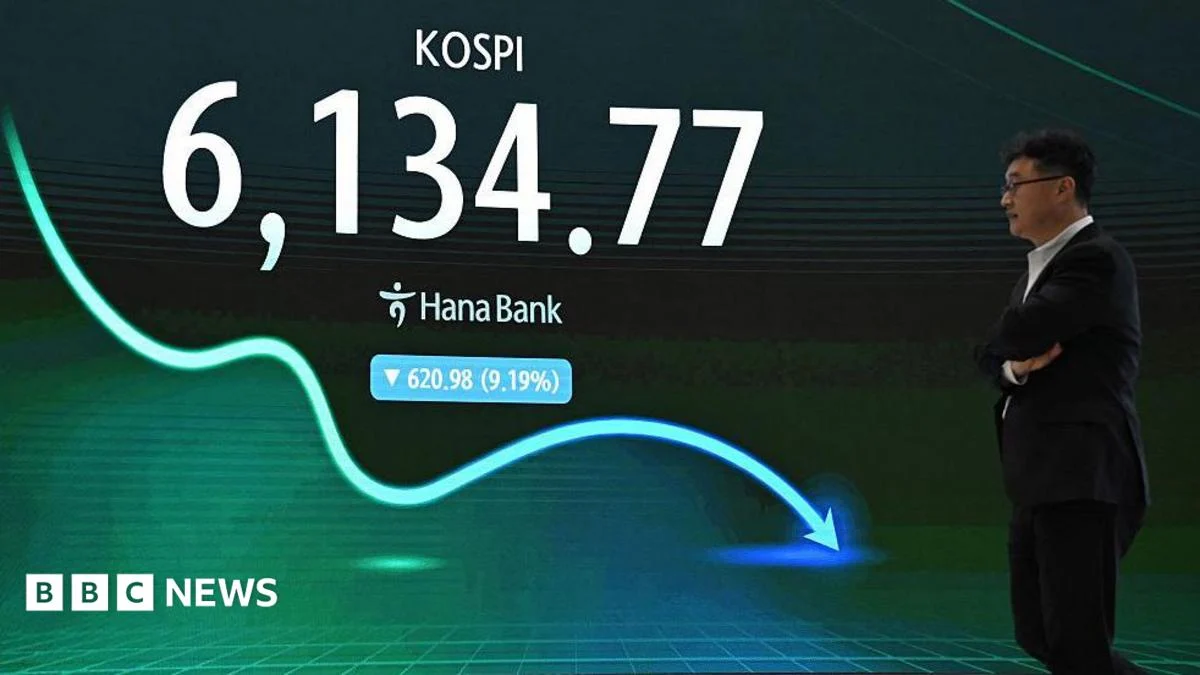
Shares in major chip firms have fallen sharply in the US and Asia as a sell-off in artificial intelligence-related stocks deepened, sending shockwaves through global markets. The dramatic downturn, fueled by growing investor apprehension about the sustainability of the AI boom and escalating competition, has erased trillions of dollars in market capitalization and triggered significant volatility in key technology hubs.
Trading on South Korea’s benchmark Kospi index was temporarily halted on Tuesday morning after plummeting by an alarming 8%. The downward spiral continued unabated after the 20-minute circuit breaker was lifted, with the index ultimately trading around 10% lower. This sharp contraction was predominantly driven by technology behemoths, with both Samsung Electronics and SK Hynix, two of the world’s largest memory chip manufacturers, experiencing precipitous declines of approximately 12%. The Kospi’s vulnerability to such dramatic swings has become a recurring theme this year, with the tech-heavy index having been subjected to eight circuit breaker halts designed to curb panic selling.
The current turmoil follows a significant jolt to investor sentiment on Monday, when AI chip giant Nvidia, a company that had become synonymous with the AI revolution, fell by 5% in New York. This decline, while seemingly modest in isolation, was enough to see Nvidia relinquish its coveted position as the world’s most valuable listed company to perennial tech titan Apple. The rapid ascent and subsequent stumble of Nvidia have underscored the speculative nature of the current AI investment landscape.
South Korea’s market, in particular, has become a focal point of this volatility. The Kospi had witnessed an extraordinary surge, more than doubling in value from the start of the year to mid-June. However, the subsequent correction has been equally swift and brutal, with the index shedding around a third of its gains since its peak. This heightened volatility in recent months has been attributed, in part, to the influx of a large number of retail investors drawn to the allure of AI-driven growth.
The ripple effect of the AI sell-off was palpable across global markets. In the United States, SK Hynix’s US-listed shares plummeted by 7.5% on Monday, falling to a level significantly below the offer price of $149 when it made its record-breaking debut on the Nasdaq on July 9th. This sharp decline in a key AI component supplier signals a broader reassessment of valuations within the sector.
Japan’s Nikkei 225 index, also heavily weighted with technology companies, mirrored the downturn, trading nearly 3.8% lower on Tuesday morning. The interconnectedness of the global semiconductor supply chain means that a sell-off in one major market inevitably impacts others.
The catalyst for the latest wave of fear appears to have originated from a Wall Street Journal report on Monday, indicating that Nvidia is in discussions to provide approximately $250 billion for OpenAI, the creator of ChatGPT, as part of a colossal data-center project. While the details of such a massive investment underscore the immense potential perceived in AI, it also highlights the sheer scale of capital being deployed, raising questions about the return on investment and the long-term viability of these ventures. The BBC has reached out to both Nvidia and OpenAI for comment on these reports.
The decline in Nvidia’s valuation allowed Apple to reclaim its status as the world’s most valuable company. The iPhone maker, which has seen its own stock rise by about 25% this year, has benefited from its diverse product ecosystem and strong brand loyalty, providing a degree of stability amidst the AI frenzy. However, even Apple is not entirely immune to the broader market sentiment surrounding technology stocks.
The core of the current investor unease lies in a fundamental question: can the immense investments being poured into artificial intelligence translate into sufficient profitability to justify these astronomical valuations? Governments and corporations worldwide are committing hundreds of billions of dollars to the development of AI capabilities, from advanced algorithms and large language models to the specialized hardware required to power them. Yet, some analysts are voicing concerns that the revenue generation models for many AI applications are still nascent, and the path to sustained profitability may be longer and more arduous than initially anticipated.
Compounding these concerns is the growing threat of intensified competition, particularly from Chinese chip makers. In a move that underscores the burgeoning capabilities of China’s domestic semiconductor industry, shares in the country’s biggest memory chip maker, ChangXin Memory Technologies (CXMT), soared by nearly 470% as they made their debut on the Shanghai Stock Exchange on Monday. CXMT, which manufactures dynamic random-access memory (Dram) chips essential for AI data centers, mobile phones, PCs, tablets, and a wide array of other electronic devices, announced plans to utilize the majority of the proceeds from its initial public offering (IPO) to expand production capacity and bolster its research and development efforts.
The impressive debut of CXMT highlights the strategic importance that China places on achieving self-sufficiency in critical technologies like semiconductor manufacturing. This burgeoning domestic supply chain poses a significant competitive challenge to established global players, potentially leading to increased price pressures and a more fragmented market. The combination of speculative froth in AI valuations and the intensifying competitive landscape has created a potent cocktail of uncertainty for investors, leading to the broad-based sell-off observed across chip stocks in both the US and Asia. The coming months will be crucial in determining whether the AI boom can withstand these pressures and transition from a period of intense hype to one of sustainable, profitable growth.




 Roy Suryo

 Nakalama John
 Ramos Leo
