George Anjay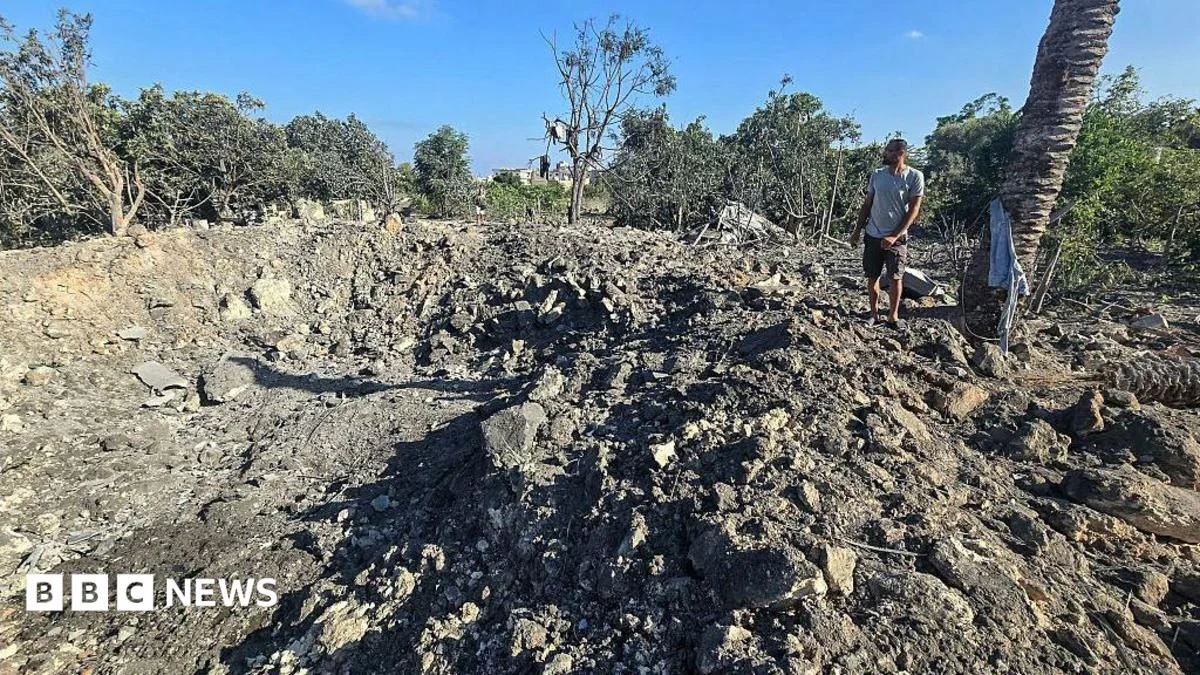
The Israeli military has announced that two of its soldiers have been killed in combat in southern Lebanon, after it launched retaliatory strikes that killed at least one person. The soldiers died and four others were seriously injured when an explosive device blew up in an area where they had been operating on Wednesday, according to Israeli media. Later in the day, the military said it had begun conducting strikes in Lebanon in response to what it called a "blatant violation" of the ceasefire by Hezbollah. The Iran-backed armed group has not commented. The Lebanese health ministry said one man was killed and 12 other people were injured in an Israeli strike in the southern town of Tibnin. Strikes were also reported in several towns to the west including Mansouri, where the Israeli military issued its first evacuation order for more than a month. It came as Israeli and Lebanese officials attended another round of US-sponsored talks in Rome aimed at maintaining the ceasefire that ended a conflict between Israel and Hezbollah. In late June, the three countries agreed a trilateral framework that should see the Israeli military gradually withdraw from territory it is occupying in southern Lebanon in exchange for the disarmament of Hezbollah. Two weeks ago, the Lebanese army was allowed to deploy to one of the first "pilot zones", after Israeli troops pulled out of the village of Zawtar al-Gharbiyeh. Hezbollah has rejected the agreement, saying the provisions linking Israel’s withdrawal to the group’s disarmament cross "all red lines".
The two soldiers killed on Wednesday were the first Israeli military fatalities in Lebanon since June 28. Israeli media cited an initial military investigation as saying that an improvised explosive device (IED) blew up around noon as troops entered a building in the southern town of Majdal Zoun, in Tyre district, during an operation to demolish Hezbollah infrastructure. It was not clear when the IED was planted and how it was detonated, according to the reports. Later on Wednesday, the Israeli military said it had begun carrying out "precise strikes" in southern Lebanon and ordered residents of Mansouri to evacuate ahead of "forceful action" there. Both statements accused Hezbollah of violating the ceasefire but gave no details. Lebanon’s state-run National News Agency reported that the deadly strike in Tibnin, 18km (11 miles) east of Majdal Zoun, hit the prayer hall at the town’s cemetery. On Wednesday night, NNA reported a "violent" escalation in Tyre district, with air and artillery strikes hitting Mansouri, Majdal Zoun and Burj al-Shamali, where the health ministry said eight people were injured. An Israeli military source told Israeli media that it had issued the evacuation order for Mansouri because displaced residents had returned to their town "under the auspices of the Lebanese army, which established a checkpoint in the area in violation of the agreements". The source said the town was inside the Israeli-declared "security zone" – a 10km (six-mile) deep strip of occupied Lebanese territory running along the border – and "military activity that endangers the lives of Lebanese civilians" was taking place there. The evacuation order was the first issued in southern Lebanon since June 14, when residents of 29 towns and villages were told to flee their homes.
On Wednesday morning, the mayor of Mansouri, Haidar Madihli, told local media that Israeli warplanes had carried out four strikes on buildings and villas in the Ghazaleh neighbourhood on the outskirts of the town, causing extensive damage to the targeted structures. The strikes triggered a wave of displacement, with families filling cars with their belongings and heading towards Tyre, the largest city in the south, he said. Madihli added that around 120 families had returned to Mansouri after the June 19 ceasefire, but that the number had steadily fallen as Israeli strikes intensified. In recent days, only 40 to 50 families remained in the town. The UN’s humanitarian office said late on Tuesday that more than 820,000 people displaced in Lebanon by the conflict between Israel and Hezbollah had begun returning to their home areas following a reduction in hostilities. However, the UN said about 360,000 other people remained displaced across Lebanon, including 26,000 living in government shelters. Lebanon was drawn into the war between Israel, the US and Iran on March 2, when Hezbollah launched rockets into Israel in retaliation for a strike that killed Iran’s supreme leader. Israel responded by launching a bombing campaign across Lebanon and invading a significant part of the country’s south. At least 4,333 people have been killed during the conflict, including 392 women and 253 children, according to the Lebanese health ministry. Since the ceasefire was announced, the ministry has recorded the killing of 353 people. Israeli authorities say 40 Israeli soldiers and four civilians have been killed on both sides of the border during the conflict.
The escalating tensions underscore the fragile nature of the ceasefire that ended a brutal conflict between Israel and Hezbollah. The recent exchange of fire, marked by the deaths of Israeli soldiers and Lebanese civilians, highlights the ongoing risks of renewed hostilities. The presence of Hezbollah, an armed group with significant influence and military capabilities, remains a central challenge to regional stability. The trilateral framework, aimed at de-escalating the situation through withdrawal and disarmament, faces significant hurdles, particularly Hezbollah’s outright rejection of the disarmament provisions. This rejection signals a deep distrust and a fundamental disagreement over the terms of peace. The deployment of the Lebanese army to pilot zones represents a cautious step towards implementing the agreement, but it is overshadowed by the broader political impasse. The incident in Majdal Zoun, where the IED targeted Israeli soldiers during an operation against Hezbollah infrastructure, suggests a continued cat-and-mouse game along the border. The precise timing and detonation method of the IED remain under investigation, but the immediate Israeli response of targeted strikes in southern Lebanon indicates a swift retaliation policy. The evacuation order for Mansouri, a town within the Israeli-declared "security zone," further illustrates the ongoing military activities and the potential for civilian endangerment. The return of displaced residents to Mansouri, facilitated by the Lebanese army, has been interpreted by Israel as a violation of the agreements, adding another layer of complexity to the already strained relations. This interpretation suggests that Israel views any Lebanese army presence within the security zone as a challenge to its security interests and a potential precursor to Hezbollah’s resurgence. The mayor of Mansouri’s account of the Israeli strikes paints a grim picture of destruction and renewed displacement, contradicting the general trend of returning refugees reported by the UN. The UN’s report on the return of displaced persons, while offering a glimmer of hope, is juxtaposed with the reality of ongoing conflict and the continued displacement of thousands. The broader context of the war, which began with Hezbollah’s rocket launches and Israel’s subsequent military response, has resulted in a significant loss of life and widespread destruction. The current surge in violence, though on a smaller scale than the full-blown conflict, serves as a stark reminder of the underlying animosities and the potential for a rapid escalation. The casualties reported by both the Lebanese health ministry and Israeli authorities paint a grim picture of the human cost of this protracted conflict. The events of Wednesday have reignited fears of a wider conflagration, jeopardizing the fragile peace and the efforts of international mediators. The coming days will be crucial in determining whether the current tit-for-tat exchanges will de-escalate or spiral into a more serious confrontation. The international community will be closely watching to see if diplomatic channels can be effectively utilized to prevent further bloodshed and to revive the stalled peace process.



 Nakalama John
 Ramos Leo
 Nana Banana