atisusanti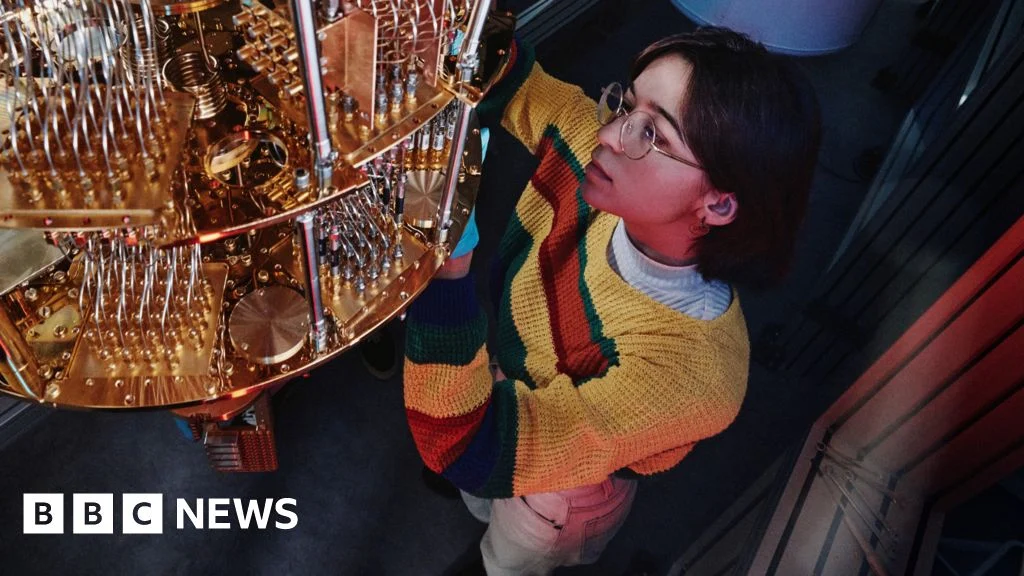
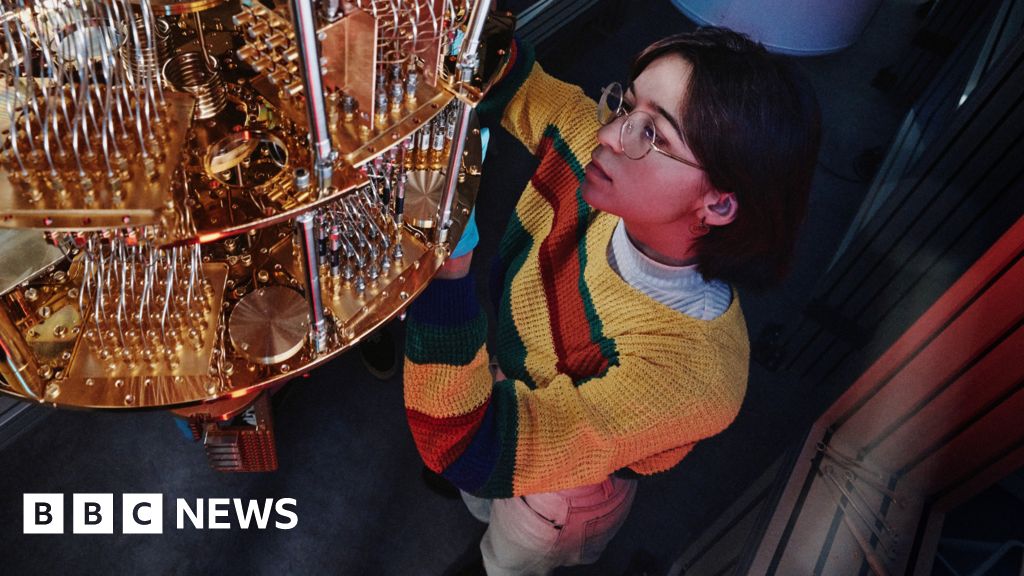
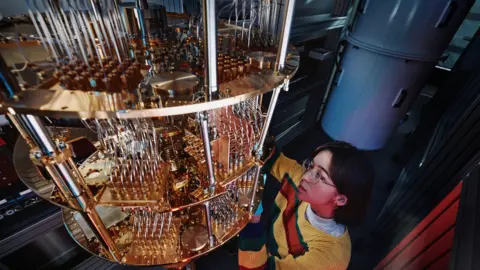
In a cutting-edge laboratory on the western periphery of Paris, a city synonymous with art and culture, a different kind of revolution is brewing. Amidst the gentle flow of the River Seine and the quiet hum of trams gliding past modern glass structures adorned with blooming cherry blossoms, a technician named Rémi meticulously adjusts a complex piece of machinery with a wrench. This intricate apparatus, a striking cascade of gold and silver cylinders interwoven with a dense network of wires, is a cryostat. Its purpose is to achieve an extreme state of cold, slowing down activity to the very brink of molecular stillness, reaching temperatures of minus 273 degrees Celsius – absolute zero. At this profound frigidity, even the most minute particles achieve a state of near-immobility, shielded entirely from external environmental interference.
Housed within the deepest cylinder of this cryostat is a compact, similarly coloured gold and silver casing. Inside this, a microscopic chip resides, a portal to a realm of physics that challenges our everyday understanding of reality. This chip is where the phenomena first theorized by Albert Einstein and his contemporaries come alive: the quantum leap. Here, particles spontaneously transition between energy levels in ways that are not only predictable and reproducible but also appear to defy the classical mechanics governing our observable world. Surrounding this central setup are several other vertical cylinders, resembling an array of different-sized water heaters. Each one houses a cryostat, much like the one Rémi is working on. These are not mere appliances; they are quantum computers.
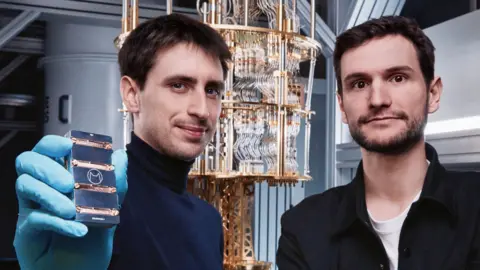
This is the domain of Alice & Bob, a pioneering French quantum computing company. In the coming months, the company is set to inaugurate a significantly larger facility just north of Paris. This ambitious $50 million (£37 million) expansion will feature a state-of-the-art test and run facility designed to accommodate increasingly powerful machines, alongside a meticulously controlled clean room dedicated to the fabrication of their proprietary chips. While the name "Alice & Bob" might evoke images of a confectionery brand, the 200-strong team, predominantly composed of bright minds in their twenties and thirties, are engaged in groundbreaking scientific endeavors that, according to co-founder and CEO Théau Peronnin, will soon translate into substantial commercial success.
"Physicists once harbored doubts about the feasibility of harnessing the peculiar behaviors of quantum particles," Peronnin explains, his gaze sweeping across the bustling laboratory. "Those doubts have since vanished. We now possess definitive proof that these principles work. In just a few years, we will have reliable quantum computers capable of integration with High-Performance Computing (HPC) systems in data centers, thereby exponentially augmenting their computational power." He emphasizes the transformative nature of this technology: "This isn’t merely about incremental speed improvements. It’s about achieving a level of computational speed so profoundly different that it redefines what is possible. We will unlock the capacity to solve problems that are currently utterly intractable for classical computers."
The implications are staggering. "It will render medicine an exact science," Peronnin states, a hint of a smile playing on his lips, acknowledging he’s only half-joking. "Currently, the development of new pharmaceuticals relies heavily on a process of trial and error." Quantum computers, however, will enable the execution of vast computational simulations to meticulously analyze how different molecular structures interact, thereby identifying effective treatments and predicting potential side effects with unprecedented accuracy. The company that first succeeds in building a reliable, scalable quantum computer stands to gain an immense advantage, a "winner-takes-all" scenario, Peronnin predicts, echoing the trajectory of early pioneers in classical computing like IBM. He is optimistic that a French entity, perhaps even Alice & Bob, will emerge victorious in this global race.
The most formidable hurdle in the field of quantum computing is its inherent fragility, which often leads to errors. Classical computers perform calculations by manipulating electrical currents within silicon chips. In contrast, quantum computers utilize qubits, where the unique quantum properties of individual electrons or photons are harnessed for computation. The primary challenge for researchers lies in the delicate nature of these quantum states, which are highly susceptible to decoherence – a loss of quantum information due to environmental interference, or "noise."
Many current approaches combat this fragility through extensive redundancy, as Peronnin elaborates. This involves employing thousands of physical qubits to represent a single "logical" qubit, employing a "majority vote" system to detect and correct errors. However, this strategy demands significant scale and incurs substantial costs. Alice & Bob has forged a distinct path. Their innovative "cat qubits," named in homage to Schrödinger’s famous thought experiment, are ingeniously designed to self-correct a portion of these errors. "It’s a feature built into the design from the outset," Peronnin asserts. "We have discovered a method to continuously compensate for signal losses." This inherent error correction capability promises a dramatic reduction in the complexity and cost of the quantum computing process compared to approaches heavily reliant on redundancy.
Peronnin notes that major players are increasingly gravitating towards similar innovative concepts. Google, for instance, acquired Atlantic Quantum, while other companies are exploring variations of cat qubit technology. He confidently states that Alice & Bob now stands "shoulder to shoulder" with its American competitors. The company is recognized as one of France’s "national champions" under the PROQCIMA program, a government-backed initiative dedicated to advancing the development of practical quantum computers. France’s commitment to this nascent field extends far beyond Alice & Bob. The nation boasts companies that collectively explore the entire spectrum of qubit types, representing the diverse pathways physicists believe will lead to the realization of the first reliable and ultra-powerful quantum computer.
Olivier Ezratty, an academic whose comprehensive 1500-page compendium, "Understanding Quantum Technologies," is a widely downloaded free resource, observes the burgeoning quantum landscape in France. "If you examine the quantum computing sector in France, we currently have six active companies, with two more in the incubation phase," he states. He identifies four other "important" French quantum computing firms: Pasqal, Quandela, Quobly, and C12. A common advantage shared by these companies, according to Ezratty, is their "very favorable position" in terms of machine cost and energy efficiency.
Beyond France, Finland’s IQM emerges as a significant European player, having announced in February its intention to become the first European quantum company to be publicly listed. The United Kingdom also boasts two notable entities: Oxford Quantum Circuits (OQC) for hardware development and Riverlane, which focuses on quantum operating systems. IQM and Pasqal have already deployed quantum computers that are contributing to high-performance computing installations across Europe. Several French firms, including Pasqal and Quandela, have already placed their quantum computers within industrial settings, such as with the industrial gases firm Air Liquide. Alice & Bob is poised to follow suit in the near future.
While these machines may not yet fully realize the ultimate promise of quantum computing, their deployment into the wider world is crucial. It facilitates the training of a new generation of specialists, who will be adept at leveraging the full potential of these revolutionary systems when they mature. "At present, the machines we possess are no more powerful than your smartphone," Peronnin admits. "We are currently on the initial, flatter segment of the exponential growth curve."

In the global quantum race, France possesses several distinct advantages. The nation is home to some of the world’s most prestigious institutions for physics education, including the École Polytechnique and the École Normale Supérieure. "In recent years, French physicists alone have been awarded three Nobel Prizes!" Peronnin exclaims, highlighting the caliber of talent. This intellectual prowess is critical, he argues, on what is a surprisingly level playing field. "Ultimately, this is a mathematical challenge. There are no inherent advantages derived from legacy technologies, unlike in classical computing. Therefore, there is no reason for apprehension."
The primary obstacle, according to Peronnin, is the mobilization of sufficient capital. "However, Europe is by no means impoverished, and this represents a significant technological opportunity for Europe to recalibrate the global landscape, fostering strategic autonomy and cultivating leading economic players." There is a palpable sense that while Europe may have missed opportunities in numerous technological revolutions of recent decades, particularly in transitioning from research to industrial application, the quantum computing era could prove to be different. "We possess the inherent capabilities to succeed. It is a matter of self-belief. As French people, we often tend to be somewhat skeptical of American overconfidence, but in this arena, we must adopt a more assertive stance. Otherwise, progress will stagnate, and that would be a profound shame. We find ourselves in a far stronger position today than anyone could have reasonably anticipated."



 George Anjay
 Nakalama John
 Ramos Leo