
 George Anjay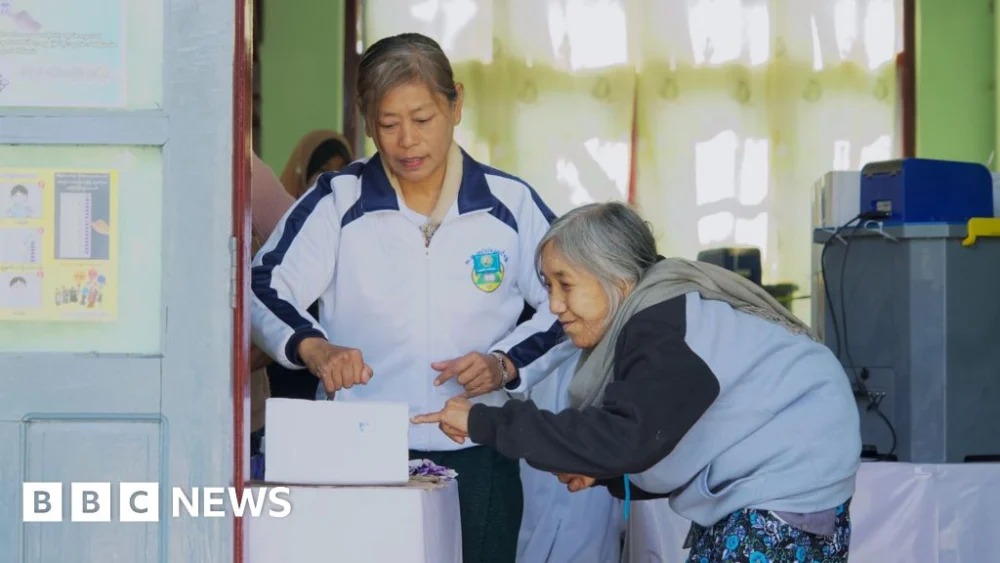
Polls in Myanmar have closed after a protracted and widely criticized third and final stage of voting, widely decried by international observers and opposition groups as a "sham" election. The process, spanning several weeks, has been characterized by the exclusion of popular opposition parties and the impossibility of voting in vast swathes of the nation, a direct consequence of a devastating five-year-long civil war that continues to rage. The overwhelming expectation is a landslide victory for the dominant party directly backed by the ruling military junta, a regime that has vehemently rejected international condemnation, maintaining its assertions of the election’s freedom and fairness.
The final round of voting encompassed approximately one-fifth of the country’s 330 townships, including major urban centers like Yangon and Mandalay. Six political parties, notably the military-backed Union Solidarity and Development Party (USDP), fielded candidates across the entire nation. An additional 51 parties, alongside independent candidates, opted to contest elections at the state and regional levels. This final stage followed two preceding rounds held on December 28th and January 11th, both of which yielded overwhelming victories for the USDP. This outcome starkly contrasts with the 2020 general election, the last free and fair election held in Myanmar, where the USDP secured a mere 6% of parliamentary seats.
The BBC team’s observation at a polling station in Nyaungshwe, Shan State, during the final round presented an image of an orderly and peaceful electoral process. Housed within a spacious school, shaded by magnificent rain trees, the polling station was staffed by an abundance of volunteers and officials. They efficiently guided voters through the process, including the utilization of newly introduced, locally manufactured electronic voting machines. At first glance, one could easily mistake this for a genuine democratic exercise, a far cry from the "sham" that critics allege it to be.
However, the veneer of orderliness on polling day belied a preceding campaign period fraught with an atmosphere of fear and intimidation. A pervasive sense of inevitability permeated the nation, with the understanding that little would fundamentally change following the USDP’s predetermined victory. Throughout the BBC team’s travels in southern Shan State, they were under constant surveillance by a significant contingent of police and military officials. While their demeanor was consistently polite, their persistence in monitoring was undeniable. This heightened security presence made it exceedingly difficult to elicit any candid opinions about the election from local residents, who appeared deeply apprehensive of potential repercussions.
The constitutional framework, meticulously drafted by the military, dictates the subsequent steps following the announcement of the final election results. Within the next two months, Parliament is scheduled to convene to elect a new president. The near-universal expectation is that this position will be filled by the leader of the 2021 coup, General Min Aung Hlaing. This transition is widely perceived not as a shift in power, but as a cosmetic change, with the military regime effectively retaining control, albeit cloaked in civilian attire. A significant stipulation of this transition is that General Min Aung Hlaing will be compelled to relinquish his command of the armed forces. While his successor is certain to be a loyalist, their grip on the military’s ranks is anticipated to be less secure. It is an open secret that many senior officers harbor reservations about his leadership and strategic decisions concerning the country. The potential for a more diverse range of voices within the political landscape could foster broader internal debate regarding Myanmar’s future direction. Furthermore, this scenario, however distant it may currently appear, offers a glimmer of hope for the initiation of steps towards resolving the protracted civil war.
The current military junta seized power in Myanmar in February 2021, orchestrating a coup that ousted the democratically elected civilian government led by Nobel Peace Prize laureate Aung San Suu Kyi. She remains under detention, and her National League for Democracy (NLD), along with numerous other opposition groups, has been formally dissolved. The military has been engaged in a brutal conflict against both the People’s Defence Forces (PDFs), resistance groups formed in opposition to the coup, and established ethnic armed organizations (EAOs) that maintain their own independent militias. The military has suffered significant territorial losses in a series of major setbacks since the coup. However, it has managed to regain control of substantial areas this year, a resurgence facilitated by crucial support from key international allies, notably China and Russia.
The ongoing civil war has exacted a devastating toll on Myanmar, resulting in thousands of fatalities, displacing millions of citizens, crippling the nation’s economy, and creating a profound humanitarian crisis. The situation has been further exacerbated by a catastrophic earthquake in March and a significant reduction in international aid funding, plunging an already vulnerable population into deeper distress. The elections, therefore, are taking place against a backdrop of immense suffering, widespread displacement, and economic devastation, further amplifying the criticisms of their legitimacy and fairness. The exclusion of significant political forces and the ongoing conflict render the electoral process fundamentally flawed, failing to represent the will of the majority of the Myanmar people. The international community’s widespread condemnation underscores the perceived lack of democratic integrity, labeling the elections as a preordained outcome designed to legitimize the military’s continued grip on power rather than a genuine expression of the people’s choice. The future trajectory of Myanmar, under a purportedly new civilian leadership that remains inextricably linked to the military, hangs precariously in the balance, with the prospect of genuine peace and democratic reform appearing increasingly distant.



 Roy Suryo

 Nakalama John
 atisusanti
 Ramos Leo
