George Anjay
The question of what it feels like to negotiate with Russian representatives during the ongoing war in Ukraine is one that resonates deeply, especially as peace talks, mediated by the United States, have so far yielded minimal tangible results four years after Russia’s full-scale invasion. Anticipation is building for another round of these crucial discussions, likely to take place in Geneva later this week. In a candid interview with the BBC’s diplomatic correspondent, Paul Adams, Sergiy Kyslytsya, a key member of Ukrainian President Zelensky’s delegation, offered a unique perspective on these high-stakes military-to-military discussions. Kyslytsya revealed that, in this specific military context, the interactions are markedly business-like, largely devoid of the political rhetoric and historical revisionism that often characterizes Moscow’s broader diplomatic engagements.
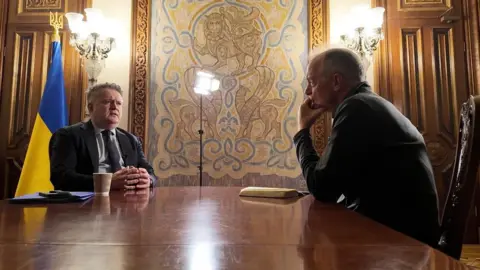
"The military has a better understanding of what is going on in the battlefield," Kyslytsya stated during a meeting at the presidential palace, his words carrying the weight of recent experience. He elaborated on the potential disconnect, adding, "It’s another thing whether they [the Russians] are capable, or not, of reporting [back] directly…without cooking or changing the information." This distinction highlights the complex layers of communication and potential manipulation that can occur, even within military channels.
The inherent difficulty of ending a war, particularly one as technologically complex and geographically dispersed as the conflict in eastern Ukraine, cannot be overstated. The battlefield is a landscape where thousands of drones are deployed for both surveillance and lethal strikes within a vast “grey zone” separating the combatants. Simultaneously, approximately 200,000 Ukrainian civilians remain in the heavily fortified cities of the Donbas region, a testament to the enduring human cost of the conflict. This intricate reality makes the technical aspects of disengagement extraordinarily challenging.
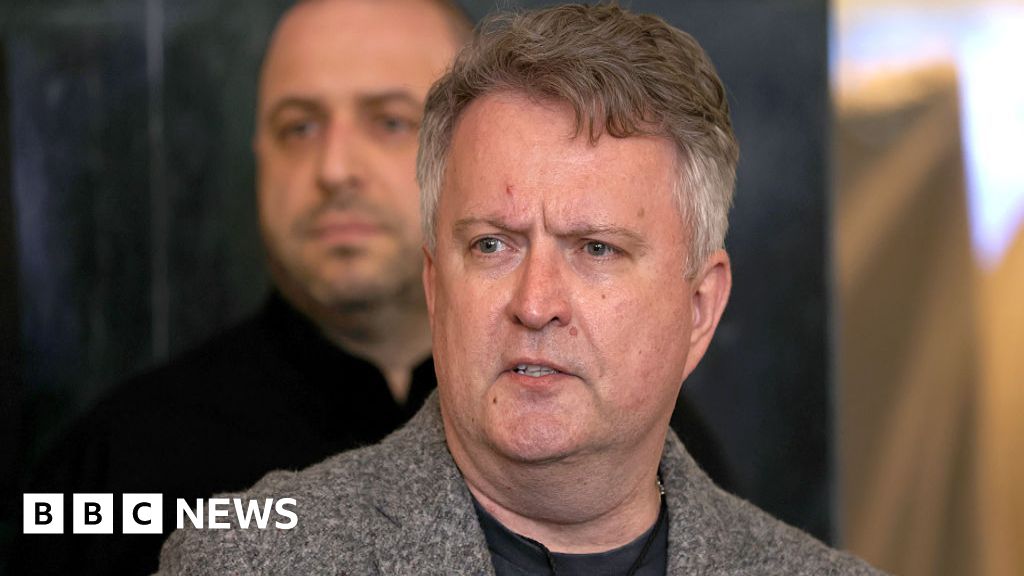
"You have to have a clear set of rules and protocols," Kyslytsya emphasized, underscoring the fundamental requirements for any de-escalation. "And a way to verify and monitor." He indicated that a significant portion of this groundwork, establishing these critical protocols, has been completed, a process greatly facilitated by the active and diligent involvement of American officials. Notable among these US participants are General Alexus Grynkewich, the top NATO commander in Europe, and Dan Driscoll, the Secretary of the Army, whose expertise has been invaluable in shaping the technical framework for potential agreements.
While it is strategically disadvantageous for Kyiv to openly criticize representatives of the Trump administration, Kyslytsya’s praise for the US delegation’s efforts sounded undeniably genuine. "We have to credit the Americans for their commitment and their patience," he asserted, noting their unwavering presence and active participation in the meetings. "Because they sit in the meetings non-stop. They don’t only observe…they put questions and they listen to our answers." This level of engagement, he suggested, is crucial for building trust and achieving progress.
Kyslytsya also expressed positive sentiments regarding the roles played by Donald Trump’s son-in-law, Jared Kushner, whom he described as "not a novice," and the billionaire envoy, Steve Witkoff, whom he characterized as "a much wiser person than the caricature image you see in the media." These personal endorsements suggest a nuanced view of the individuals involved, moving beyond superficial perceptions. The United States, Kyslytsya confirmed, is poised to play an instrumental role in monitoring any future ceasefire, leveraging advanced technological resources, including satellite imagery and other sophisticated surveillance systems.
"We need someone who will play the role of adjudication, because if there is a violation there should be a third party that is solid [and] authoritative," Kyslytsya explained, highlighting the critical need for an impartial arbiter to address potential breaches of any ceasefire agreement. This role is particularly vital given the history of mistrust and the potential for escalation.
For eight years preceding Russia’s full-scale invasion in 2022, this monitoring function was nominally fulfilled by the Organisation for Security and Cooperation in Europe (OSCE). However, the OSCE’s limited resources and its lack of robust enforcement mechanisms ultimately rendered it largely incapable of preventing the conflict’s dramatic escalation. "It was quite an achievement [for them] just to have two UAVs flying over the territory," Kyslytsya remarked, drawing a stark contrast with the current technological landscape. "It’s kind of the Flintstones era compared to what we have today." The scale of modern drone warfare is staggering; recent reports indicate that as many as 12,000 drones may be operating over the single city of Pokrovsk at any given moment, illustrating the immense technological leap and the increased complexity of monitoring.
When asked directly about the personal emotional toll of sitting across the table from emissaries representing a leader willing to incur such immense human cost to subjugate Ukraine, Kyslytsya revealed years of practiced resilience. "I saw much worse. I spent five years in New York, three of them before the full-scale invasion. I would sit in the room with the enemy on a regular basis." This long-term exposure to adversarial diplomatic environments has undoubtedly shaped his approach and his capacity to remain focused amidst profound animosity.
One particular evening remains seared into his memory: February 23, 2022. During an emergency United Nations Security Council meeting convened to address the burgeoning crisis in Ukraine, Ambassador Kyslytsya received the devastating news that his country was under attack. Simultaneously, seven time zones to the east in Kyiv, the first distant explosions signaled the commencement of Russia’s all-out assault on Ukraine. In a scene of profound and agonizing drama, Kyslytsya desperately implored Russia’s ambassador, Vassily Nebenzia, to contact his superior, Foreign Minister Sergei Lavrov, to seek assurances that Russian troops would not invade. According to Kyslytsya, Nebenzia’s response was chillingly dismissive: "I’ve already said everything I know today. I’m not going to wake Minister Lavrov at this time." This moment marked a definitive turning point, forever altering the lives of millions. Kyslytsya remained at the UN for another three years before returning to Kyiv, carrying the weight of that night.
Should the delegations reconvene in Geneva on Thursday, Kyslytsya will be present, continuing the arduous task of delineating the contours and mechanics of a ceasefire. Yet, the ultimate resolution, he believes, hinges on a singular decision. "The war could be stopped by just one call of one person to his military chief of staff," he stated, his voice tinged with a weary resolve. "But apparently, the Kremlin dictator [Russian President Vladimir Putin] is not up to stopping the war for the time being." This poignant observation underscores the immense power vested in a single individual and the profound human desire for peace that remains, for now, unfulfilled. The intricate details of military disengagement, the sophisticated monitoring technologies, and the tireless efforts of diplomats all converge on this fundamental point: the will of one man to cease hostilities.



 Roy Suryo
 Nakalama John
 atisusanti
 Ramos Leo