atisusanti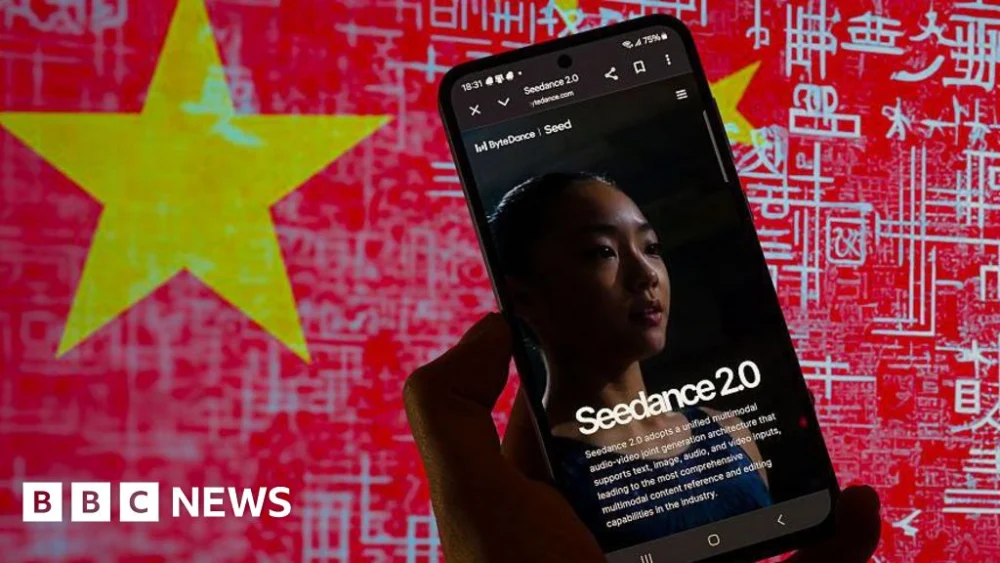
Osmond Chia, Business reporter and Suranjana Tewari, Asia Business Correspondent
A groundbreaking artificial intelligence (AI) video generation model developed by ByteDance, the Chinese tech giant behind the global phenomenon TikTok, has sent ripples of alarm through Hollywood and the wider creative industries. Dubbed Seedance 2.0, this sophisticated AI can conjure cinema-quality video, complete with intricate sound effects and dialogue, from a mere handful of text prompts. The unsettling reality of its capabilities became starkly apparent as viral clips, purportedly generated by Seedance, began circulating online, showcasing beloved characters like Spider-Man and Deadpool in dynamic, often uncanny, new scenarios. This rapid proliferation of AI-generated content, featuring instantly recognizable intellectual property, has prompted swift accusations of copyright infringement from major Hollywood studios, including Disney and Paramount. However, the concerns extend far beyond mere legal disputes, touching upon the very future of content creation and the economic landscape of the entertainment world.
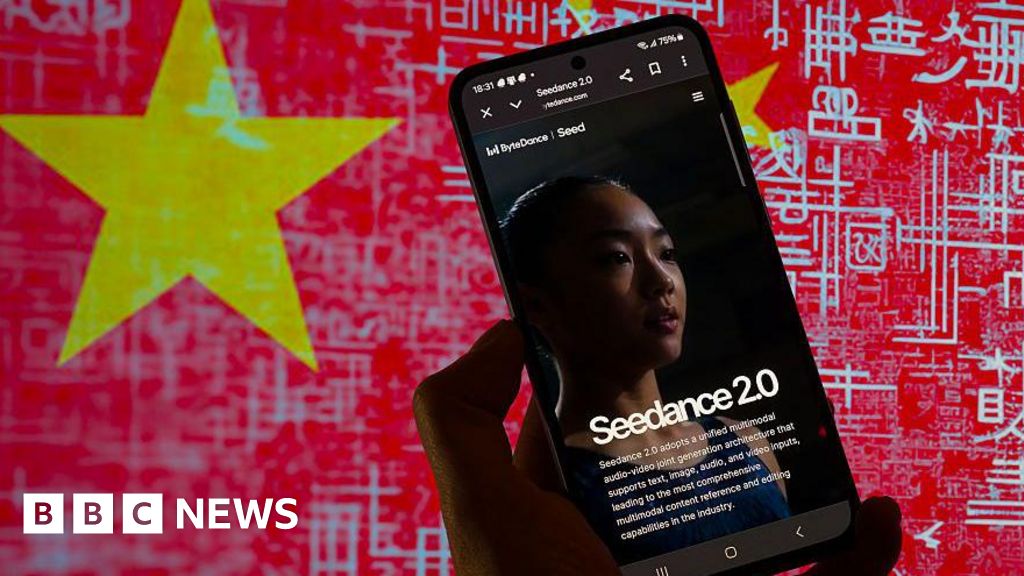
The initial launch of Seedance in June 2025 was met with relatively little fanfare. It was the subsequent release of Seedance 2.0, just eight months later, that ignited a firestorm of discussion and apprehension. Jan-Willem Blom, a representative from the creative studio Videostate, articulated the seismic shift in perception, stating, "For the first time, I’m not thinking that this looks good for AI. Instead, I’m thinking that this looks straight out of a real production pipeline." While Western AI video models have demonstrated impressive progress in translating user instructions into visually striking imagery, Seedance appears to have achieved a more holistic integration of these capabilities. Like its contemporaries, such as Midjourney and OpenAI’s Sora, Seedance excels at generating videos from concise text prompts, with some instances demonstrating its ability to produce high-quality outputs from as little as a single prompt.
The true innovation of Seedance, according to AI ethics researcher Margaret Mitchell, lies in its remarkable ability to seamlessly combine text, visuals, and audio within a unified system. This integrated approach is what sets it apart and contributes to its unnerving realism. The benchmark for Seedance’s prowess has, perhaps unconventionally, become the generation of a clip featuring Will Smith consuming spaghetti. The AI’s success in rendering a strikingly lifelike portrayal of the actor indulging in a plate of pasta is impressive enough, but the subsequent viral videos depicting Smith engaging in epic battles with a spaghetti monster, all presented with the visual fidelity and impact of a big-budget film, have truly captured the industry’s attention.
Many industry experts and filmmakers now view Seedance as ushering in a new era for video-generating technology. David Kwok, who leads Tiny Island Productions, a Singapore-based animation studio, highlights the advanced realism of Seedance’s complex action sequences, noting, "It almost feels like having a cinematographer or director of photography specializing in action films assisting you." This level of creative assistance, previously requiring significant human capital and financial investment, is now potentially within reach for a much broader spectrum of creators.

However, Seedance’s rapid ascent has been immediately complicated by the pervasive issue of copyright infringement, a growing and complex challenge in the age of advanced AI. Experts are increasingly vocal about the trend of AI companies prioritizing technological advancement over ethical considerations, often utilizing vast datasets without proper attribution or compensation. Major Hollywood entities have vociferously objected to Seedance’s apparent use of copyrighted characters, including iconic figures like Spider-Man and Darth Vader. In response, Disney and Paramount have issued stern cease-and-desist letters, demanding that ByteDance cease any unauthorized use of their intellectual property. The situation has also drawn scrutiny from international regulators; Japan, for instance, has launched an investigation into ByteDance for alleged copyright violations following the viral spread of AI-generated videos featuring popular anime characters.
This pattern of alleged copyright misuse is not unique to Seedance. In 2023, The New York Times initiated legal proceedings against OpenAI and Microsoft, asserting that their articles were used without permission to train AI models. Similarly, Reddit filed a lawsuit against Perplexity last year, accusing the AI firm of illegally scraping user posts. Disney has also raised comparable concerns with Google regarding the unauthorized use of its content. Margaret Mitchell emphasizes the paramount importance of clear content labeling to prevent deception and foster public trust in AI, arguing that these measures are more critical than the pursuit of "cooler-looking" videos. She advocates for the development of systems that meticulously manage licensing and payments, alongside robust mechanisms for individuals to contest misuse.
In a notable development that highlights the evolving landscape, Disney reportedly entered into a $1 billion deal with OpenAI’s Sora, granting them the ability to utilize characters from their expansive franchises, including Star Wars, Pixar, and Marvel. Shaanan Cohney, a computing researcher at the University of Melbourne, suggests that Seedance’s developers were likely aware of the potential copyright ramifications associated with the use of Western intellectual property but proceeded regardless, a calculated risk taken to gain significant marketing traction. "There’s plenty of leeway to bend the rules strategically, to flout the rules for a while and get marketing clout," Cohney observes.

Despite the legal and ethical complexities, Seedance’s undeniable utility makes it an irresistible tool for smaller production companies. David Kwok of Tiny Island Productions recognizes that AI of Seedance’s caliber can democratize filmmaking, enabling companies like his to produce content that would otherwise be prohibitively expensive. He points to the burgeoning market for short-form videos and micro-dramas in Asia, productions that typically operate on modest budgets, often around $140,000 for as many as 80 episodes, each under two minutes. Historically, these productions have been constrained to genres like romance or family drama due to the prohibitive costs associated with visual effects. However, Kwok asserts that AI now empowers these low-budget productions to "elevate into more ambitious genres such as sci-fi, period drama and, now, action."
Seedance’s emergence once again positions Chinese technology at the forefront of global innovation. Cohney remarks, "It signals that Chinese models are at the very least matching at the frontier of what is available. If ByteDance can produce this seemingly out of nowhere, what other kinds of models do Chinese companies have in store?" This sentiment is echoed by the impact of DeepSeek, another Chinese AI model, which last year generated considerable international attention with its cost-effective large language model, quickly surpassing ChatGPT in downloads on Apple’s US App Store.
In the past year, Beijing has strategically placed AI and robotics at the core of its economic agenda, channeling substantial investment into advanced computer chip production, automation, and generative AI, with the explicit goal of securing a technological advantage over the United States. While Seedance 2.0 commanded significant media attention, other major Chinese firms discreetly launched their own generative AI tools in the lead-up to the Lunar New Year holiday. China analyst Bill Bishop noted in his newsletter that the Spring Festival is increasingly becoming an "AI holiday," with companies strategically timing their product launches to coincide with a period when millions of individuals are at home and actively exploring new applications. Bishop anticipates that 2026 could mark a pivotal year for widespread AI adoption in China, extending beyond mere chatbots to encompass AI agents managing transactions, coding tools integrated into daily workflows, and a future where video creators routinely leverage AI in their creative processes. The implications of Seedance and similar advancements suggest a fundamental reshaping of the global creative landscape, presenting both unprecedented opportunities and profound challenges for established industries.




 Roy Suryo

 George Anjay
 Nakalama John
 Ramos Leo