George Anjay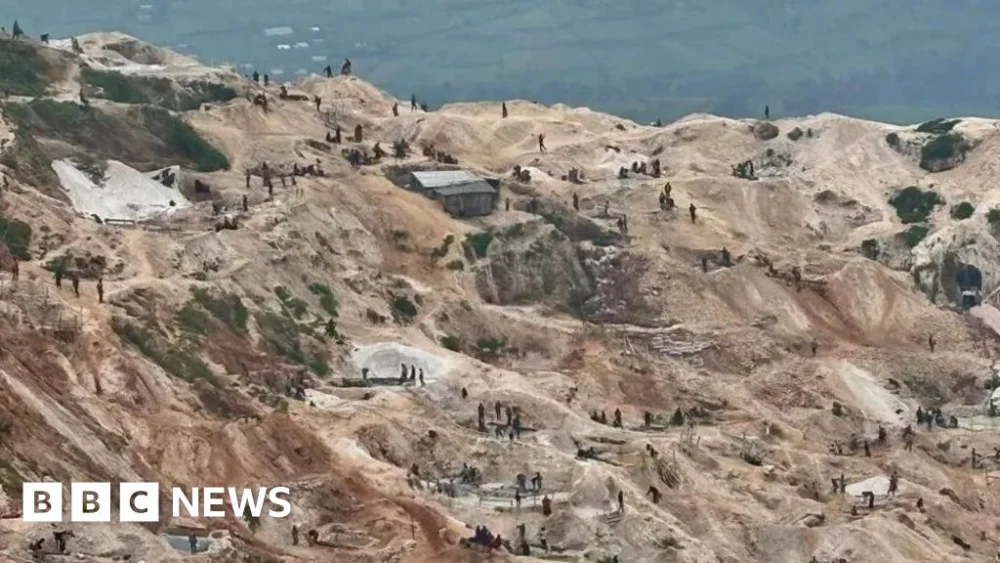
More than 200 people, including a significant number of children, have perished in a catastrophic landslide that struck a mining area in the eastern Democratic Republic of Congo, according to official government figures. The disaster occurred on Tuesday in Rubaya, a region renowned as the DRC’s most significant source of coltan, a critical ore for the global electronics industry. The area is currently under the control of M23 rebels.
The Ministry of Mines, in a strongly worded statement, attributed the tragedy directly to the actions of the M23 rebels, accusing them of permitting extensive illegal mining operations without the implementation of any rudimentary safety standards. This lack of regulation, the ministry contends, created the conditions for the devastating collapse. The M23 rebel group has not yet issued a public statement in response to these accusations. However, a source speaking anonymously from within Rubaya told the BBC that the collapse was a consequence of attacks by government forces and claimed that only six individuals had lost their lives. The government has not yet officially responded to this counter-claim.
The mines in Rubaya are of immense global importance, believed to hold approximately 15% of the world’s entire coltan supply and a substantial portion, half, of the Democratic Republic of Congo’s own coltan deposits. This metallic ore is highly sought after due to its tantalum content, a rare element crucial for the production of high-performance capacitors found in a vast array of electronic devices, from smartphones and laptops to advanced medical equipment and military technology. The high global demand for these components directly fuels the relentless pursuit of coltan.
Since the beginning of 2024, the M23 movement has maintained a firm grip on Rubaya. The town is strategically located approximately 70 kilometers (45 miles) west of Goma, the provincial capital of North Kivu. The ongoing conflict and rebel control have created a volatile and insecure environment, significantly complicating any efforts to assess and address humanitarian crises.
The Congolese authorities have stated that the immediate rescue efforts following Tuesday’s landslide were severely hampered by the perilous conditions on the ground. They pointed to restrictions imposed by the rebels on civilians as a major impediment to effective search and recovery operations. Furthermore, the Ministry of Mines highlighted the absence of official oversight at the mining site, which has left the workers completely exposed, lacking even the most basic safety protections and protocols.
"The provisional toll counts more than 200 compatriots who lost their lives, including 70 children and numerous wounded," the ministry stated, underscoring the immense human cost of the disaster. The sheer scale of the reported fatalities, particularly the high number of children, paints a grim picture of the vulnerability of the population in this conflict-ridden region.
The BBC’s ability to independently verify the exact death toll in this remote and inaccessible area is severely limited. Humanitarian agencies and major medical facilities have minimal or no access to Rubaya, and telecommunications are frequently disrupted, making real-time reporting and verification extremely challenging. Information often relies on limited on-the-ground sources and official statements, which can be subject to political influence.
Many of the injured individuals have reportedly been evacuated to hospitals in Goma for urgent medical attention. The logistical challenges of transporting casualties from such a remote and insecure location are immense, highlighting the desperate situation faced by survivors and aid workers.
The Congolese authorities had previously declared a ban on mining activities in the Rubaya area last year. However, this ban was rendered largely ineffective as the M23 rebels had already seized control of the mines by that time, effectively dictating the terms of extraction and exploitation.
A BBC team that visited the Rubaya site in July 2025 observed firsthand the dangerous conditions under which miners were operating. They witnessed individuals digging manually to extract the precious mineral, often in precarious and unstable terrain. The vast expanse of the mining area was dotted with dangerous pits, underscoring the inherent risks faced by those involved in this informal and unregulated industry. The image provided with this report, an overhead shot of the Rubaya mine, depicts a landscape heavily altered by mining, with terraced, bare earth and visible groups of miners, illustrating the scale of the activity and the challenging environment.
Over the past year, the M23 movement has been responsible for significant territorial gains across the mineral-rich eastern regions of the Democratic Republic of Congo. Their advances have increasingly encompassed areas known for their coltan deposits, further consolidating their control over vital natural resources.
International concern is also focused on the alleged illicit export of minerals from the DRC. UN experts have presented evidence suggesting that minerals originating from the Democratic Republic of Congo are being channeled and exported through neighboring Rwanda. Rwanda has consistently and vehemently rejected these accusations, leading to ongoing diplomatic tensions and investigations.
In a recent development, the Rubaya mining site was reportedly added to a shortlist of assets that the Congolese government intends to offer to the United States under a minerals cooperation framework, according to reports from the Reuters news agency. This move signifies the strategic importance of the region’s mineral wealth and the government’s efforts to attract international investment and partnerships, even amidst the ongoing conflict and instability.
More about the conflict in DR Congo:
The Democratic Republic of Congo has been plagued by decades of conflict, largely fueled by competition over its vast mineral wealth. Numerous armed groups, including the M23, vie for control of resource-rich territories, leading to widespread violence, displacement, and humanitarian crises. The eastern part of the country, particularly North Kivu province, has been a persistent hotbed of instability. The M23 rebellion, which re-emerged in late 2021, has been particularly effective in its military campaigns, capturing significant territory and displacing hundreds of thousands of people.
The international community, including the United Nations, has been actively involved in peacekeeping and diplomatic efforts to stabilize the region. However, the complex nature of the conflict, involving multiple armed actors, regional dynamics, and economic interests, has made lasting peace elusive. The exploitation of natural resources, including coltan, gold, and diamonds, is often cited as a primary driver of the conflict, with armed groups using illicit mining and trade to fund their operations.
The ongoing humanitarian crisis in eastern DRC is one of the most severe in the world, with millions in need of food, shelter, and medical assistance. The lack of access to affected areas, due to insecurity and logistical challenges, further complicates aid delivery. The international community faces the dual challenge of addressing the immediate humanitarian needs of the affected population while also working towards a sustainable political solution to the underlying causes of the conflict. The tragic events in Rubaya serve as a stark reminder of the devastating human cost of this protracted crisis and the urgent need for greater international attention and concerted action.



 Roy Suryo
 Nakalama John
 atisusanti
 Ramos Leo