atisusanti
Zaman’s groundbreaking work was profoundly inspired by the ancient Japanese art form of kirigami. Unlike its cousin, origami, which solely relies on folding paper to achieve three-dimensional shapes, kirigami elegantly incorporates cutting as well. This dual approach is famously employed in the creation of intricate paper pop-up cards. For many years, both origami and kirigami have served as a rich wellspring of inspiration for engineers. These venerable techniques possess the remarkable ability to imbue materials with astonishing and often unpredictable behaviors. However, the journey from artistic principle to practical, widespread application has historically presented a significant challenge.
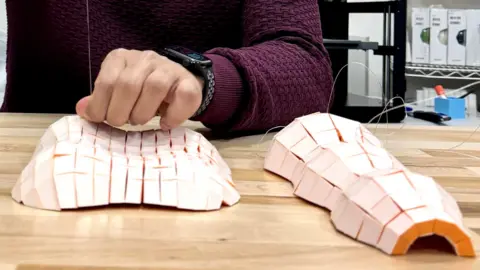
In Zaman’s specific endeavor, he and his colleagues have pioneered a method of 3D printing a unique material. This material is ingeniously segmented into robust, square-shaped tiles. The precise angles of the sides of these tiles, coupled with the meticulous nature of the cuts that delineate them, dictate that when the material is compressed, it spontaneously unfolds into a pre-determined three-dimensional form. This form can be as varied as a chair, a structure reminiscent of a tent, or even a gracefully curved container. The team has developed a sophisticated computer program that masterfully translates a three-dimensional model into its flat, grid-like precursor. A pull-cord is then seamlessly integrated into this flat form. This groundbreaking research was detailed in a paper published in December, offering a glimpse into the future of material transformation. "You could, in theory, construct much larger structures, even entire buildings, using this technology," Zaman enthuses.
Looking towards the other end of the scale, this revolutionary technology holds immense promise for the creation of microscopic structures. These tiny constructs, when activated, could autonomously unfurl to precisely deliver therapeutic drugs to specific sites within the human body. Zaman reveals that he and his research team are actively engaged in collaborative research within this burgeoning field.
However, a significant hurdle in translating the principles of origami and kirigami into tangible engineering applications often lies in the inherent complexity these techniques can introduce. The renowned Miura fold, a technique developed by Japanese astrophysicist Kōryō Miura, involves folding a sheet of material into a series of parallelograms, enabling it to achieve an exceptionally compact folded state. The original intention behind this innovation was to devise efficient storage solutions for solar arrays intended for satellites and spacecraft. In a testament to its potential, in 1995, a Japanese satellite successfully deployed a solar panel that had been folded using the Miura fold. Nevertheless, Mark Schenk, a recognized expert in origami-inspired engineering at the University of Bristol, points out that "There are often simpler methods to achieve the same outcome."
He further elaborates on the inherent difficulties in scaling up origami-based designs for larger applications and in utilizing them with materials beyond paper. Paper, he notes, is remarkably forgiving, capable of enduring numerous folds and refolds without succumbing to damage. "Origami is still not a commonly adopted technique in practical engineering applications," Schenk observes. However, this landscape may be on the cusp of a significant transformation.

Schenk highlights that the mathematical understanding of origami-like structures has advanced dramatically in recent decades. This progress has paved the way for the emergence of numerous startup companies and university spin-outs dedicated to the development of products inspired by origami and kirigami principles.
One such pioneering startup is Stilfold, based in Sweden. "We are industrializing a more straightforward method for forming sheet metal, drawing heavily on the principles of origami," explains Jonas Nyvang, the chief executive and co-founder of the company. Stilfold employs a blunt wheel to create precise creases in sheet metal. This process induces a curve or bend in the material, simultaneously enhancing its rigidity. "It’s akin to the way you hold a slice of pizza," Nyvang illustrates. Concurrently, a Finnish project known as Fold2 has been exploring the utilization of intricately folded cardboard to design packaging inserts engineered to provide superior protection for products during transit.
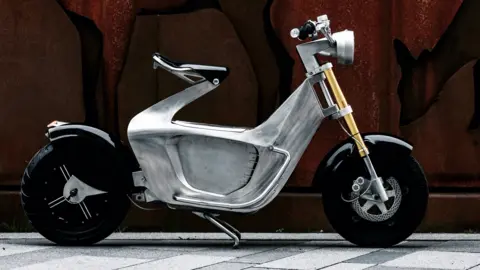
For Stilfold, the paramount advantage of applying this folding technique to metal lies in its ability to reinforce the material without the necessity of numerous brackets, screws, or additional supports. This significantly reduces the overall material volume required, thereby lowering both the cost and the embodied carbon emissions associated with any product manufactured using this innovative method. "We can achieve approximately a 20-30% material reduction simply by introducing stiffness through folding," Nyvang proudly states. Stilfold has successfully developed a sophisticated robot capable of creasing sheet metal, and to date, the company has leveraged this technique to manufacture chassis for 200 gleaming metallic electric motorcycles, which are now being dispatched to eager customers. Nyvang further reveals that Stilfold is actively collaborating with the esteemed Swedish automotive firms Volvo and Scania, exploring the potential for developing novel, lightweight components for their cars and trucks.
However, fostering wider adoption of this transformative technology may present its own set of challenges. Nyvang acknowledges that it can sometimes prove difficult to persuade engineers to embrace a fundamentally different approach to their established practices.
Despite these potential obstacles, the prospect of harnessing origami to enhance existing technologies is, for many, an incredibly tantalizing one. Moneesh Upmanyu at Northeastern University in the United States, alongside one of his PhD students, was awarded a patent last year for a groundbreaking design that ingeniously utilizes origami principles to create robust yet foldable wing structures. This innovative design essentially incorporates a flexible, corrugated internal structure within the wing, reminiscent of an accordion. This internal architecture grants the wing the remarkable ability to fold down rapidly or to flex with exceptional ease.
Such a wing could, for instance, be engineered to subtly bend its edges, mirroring the way birds manipulate their feathers to achieve greater stability during flight. "Birds are truly capable of morphing their wings," Upmanyu observes. "They have perfected this highly efficient method of flight." It is conceivable that aircraft and wind turbines could one day emulate this biological marvel. Upmanyu suggests that such a wing could possess the capability to automatically and dynamically respond to variations in air pressure, utilizing an integrated valve-based system to meticulously adjust its shape.
The path from these nascent ideas to fully realized products will undoubtedly require substantial research and significant investment. In the interim, the traditional, time-honored art of paper-folding origami continues to captivate and enchant enthusiasts worldwide. Yet, it is important to note that this pursuit is not universally embraced. "For me, it’s an academic interest; it’s my profession," admits Mark Schenk, who candidly states he has little personal inclination towards creating paper origami models. "My mother, funnily enough, is exceptionally skilled at it."




 Nana Banana

 George Anjay
 Ramos Leo