
 Nakalama John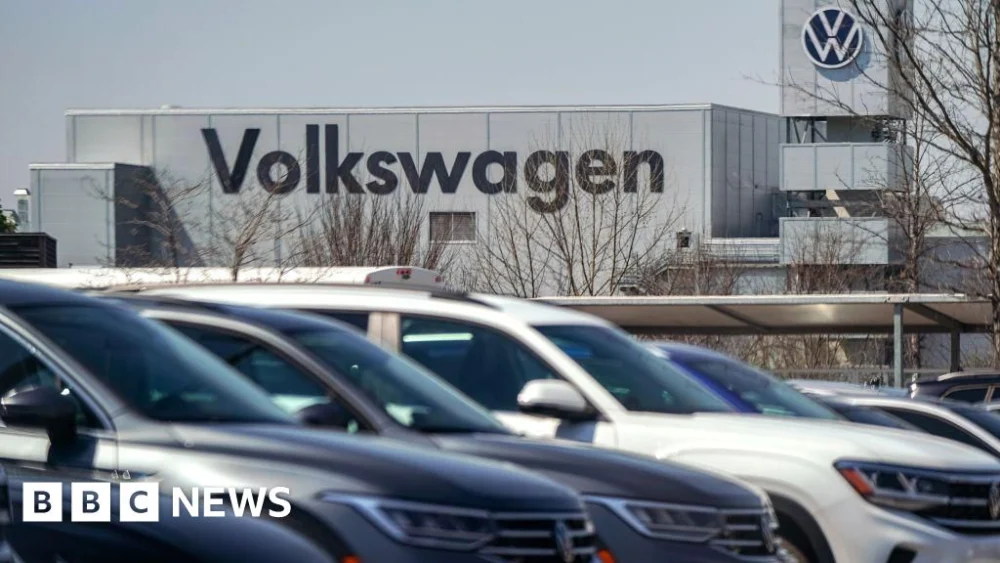
Chief Executive Officer Oliver Blume conveyed the gravity of the situation to shareholders, emphasizing that the job reductions would be implemented throughout the group’s extensive German footprint. This strategic overhaul comes on the heels of a reported 44% drop in post-tax profits for 2025, a financial blow attributed to a confluence of external pressures and internal restructuring demands. The company cited crippling US import tariffs, relentless competition from burgeoning Chinese automotive manufacturers, and the colossal restructuring costs associated with its ambitious shift towards electric vehicles (EVs) as primary drivers of its financial woes.
The financial figures paint a clear picture of the challenges Volkswagen faces. The group’s net profit after tax plunged from €12.4 billion (£10.7 billion; $14.4 billion) to a significantly reduced €6.9 billion (£6.1 billion; $8 billion) in the past year. This substantial decline underscores the urgent need for robust cost-cutting measures and a re-evaluation of its operational model. While the firm projects a recovery in the coming year, its finance chief, Arno Antlitz, has underscored the imperative of "rigorously" reducing costs to ensure long-term viability and profitability.
"In total, around 50,000 jobs are due to be cut by 2030 across the Volkswagen Group in Germany," Blume stated in a letter to shareholders included in the firm’s annual report. His candid assessment, "We are operating in a fundamentally different environment," highlights the profound paradigm shift occurring within the global automotive industry. This current wave of job cuts builds upon a prior agreement struck with unions to eliminate more than 35,000 positions across the country by 2030. That earlier initiative was framed as a "socially responsible manner" to achieve some €15 billion (£12.4 billion) in savings, and the new, larger figure suggests an acceleration and intensification of these efforts. "Socially responsible" typically implies a combination of early retirement schemes, voluntary severance packages, and internal reskilling programs to minimize compulsory redundancies and support affected employees in their transition.
One of the most significant external pressures on Volkswagen stems from the escalating US import tariffs. These tariffs, often imposed as a protective measure for domestic industries or in response to international trade disputes, directly increase the cost of Volkswagen vehicles entering the American market. This erodes their price competitiveness against locally produced cars or imports from countries not subject to similar tariffs, ultimately squeezing profit margins and potentially reducing sales volumes in a crucial global market. The unpredictable nature of trade policies adds another layer of complexity to strategic planning for multinational corporations like Volkswagen.
Simultaneously, the European and global automotive markets are experiencing an unprecedented surge in competition from Chinese manufacturers. Historically, China was a highly lucrative market for German carmakers, known for their engineering prowess and brand prestige. However, Chinese brands such as BYD, Nio, Xpeng, and Geely have rapidly advanced, particularly in the electric vehicle segment. They benefit from strong domestic government support, often lower production costs, faster innovation cycles, and a deep understanding of local consumer preferences. These companies are now aggressively expanding into Europe, offering technologically advanced EVs at highly competitive price points, directly challenging the market share and profitability of established players like Volkswagen. The speed at which Chinese competitors can bring new models to market, often integrating cutting-edge digital features, contrasts sharply with the longer development cycles traditionally seen in legacy automakers.
The transition to electric vehicles, while crucial for the future of the automotive industry, has also imposed immense financial burdens on Volkswagen. This shift necessitates colossal investments in research and development for battery technology, electric powertrains, and sophisticated software systems. Furthermore, existing manufacturing plants must be re-tooled and upgraded, and entirely new production facilities, particularly for batteries, need to be built. The development of a robust charging infrastructure, although often a shared responsibility with governments and energy companies, also demands significant capital outlay and strategic planning from automakers. These "restructuring costs" are substantial and weigh heavily on current profitability, even as they lay the groundwork for future success. The initial profit margins on many EV models are also often lower than those for traditional internal combustion engine (ICE) vehicles, particularly in the early stages of market penetration and scale-up, creating a challenging financial environment.
Looking ahead, Volkswagen projects a core profit margin of between 4% and 5.5% for 2026. This forecast, potentially lower than the 4.6% achieved this year, highlights the ongoing struggle to restore robust profitability. Finance chief Arno Antlitz explicitly warned that the group’s current profit margin was "not sufficient in the long run," underscoring the urgency of the situation. "We can only realise this if we continue to rigorously reduce costs," he asserted, adding, "That is what we will focus on in the coming months." This focus will likely extend beyond job cuts to include a holistic review of all operational expenditures, supply chain efficiencies, procurement processes, and the complexity of its vast product portfolio.
The automotive industry is in the midst of a profound transformation, and Volkswagen’s actions mirror similar restructuring efforts seen across other legacy automakers globally, including Stellantis, Ford, and General Motors. These companies are all grappling with the dual challenges of funding the expensive transition to electric and autonomous vehicles while maintaining profitability in their traditional ICE businesses, all against a backdrop of global economic uncertainties, geopolitical tensions, and evolving consumer demands. The need to invest heavily in software development, which is becoming as critical as hardware in the modern car, also presents a new and costly frontier for traditional manufacturers. Volkswagen, a company deeply intertwined with Germany’s industrial identity, faces the complex task of shedding thousands of jobs while simultaneously investing billions in future technologies to remain competitive in a rapidly changing world. The decisions made in the coming months will be pivotal in determining its trajectory for decades to come.



 Ramos Leo
 Roy Suryo
 Nana Banana

 atisusanti