Nana Banana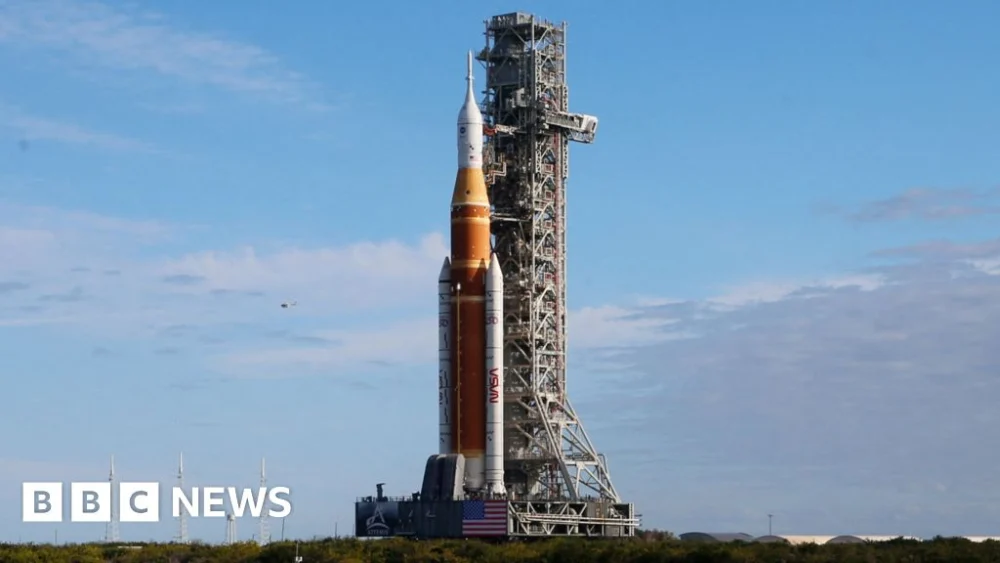
NASA’s monumental Space Launch System (SLS) rocket, the towering centerpiece of the Artemis II mission, has been successfully transported to Launch Pad 39B at the Kennedy Space Center in Cape Canaveral, Florida. This critical milestone signifies the commencement of final preparations for humanity’s first crewed voyage around the Moon in over five decades, marking a profound step forward in the Artemis program’s ambitious goal of returning humans to the lunar surface and eventually establishing a sustained presence.
The colossal 98-meter-tall (322-foot) rocket, integrated with its Orion spacecraft, embarked on its deliberate 6.5-kilometer (4-mile) journey from the iconic Vehicle Assembly Building (VAB). This intricate maneuver, which saw the immense stack carried vertically atop the massive crawler-transporter, spanned nearly 12 hours. The slow-moving spectacle, traversing at a top speed of a mere 1.3 kilometers per hour (0.82 mph), was a testament to the meticulous engineering and operational precision required for such an undertaking, drawing live coverage and global attention as it trundled towards its launch position. The journey began at 07:04 local time (12:04 GMT) and concluded with its precise docking at Launch Pad 39B at 18:41 local time (23:42 GMT).
Now securely in position, the SLS and Orion stack will undergo a series of exhaustive final tests, checks, and a crucial "wet dress rehearsal." This comprehensive exercise involves fueling the rocket and practicing the entire launch countdown procedure, stopping just short of ignition. These rigorous simulations are indispensable for ensuring every system is primed and personnel are prepared for the high-stakes 10-day Artemis II mission, which will carry four astronauts on a historic trajectory around the Moon.

The mission’s launch window is currently targeted for the earliest possible date of 6 February. However, NASA has also identified subsequent launch opportunities later in February, as well as in March and April, acknowledging the complexities of orbital mechanics and the necessity of flexibility in spaceflight scheduling. This flexibility underscores the agency’s steadfast commitment to safety over expediency, a principle consistently reiterated by mission officials.
The Artemis II crew – NASA astronauts Reid Wiseman, Victor Glover, and Christina Koch, alongside Canadian Space Agency (CSA) astronaut Jeremy Hansen – were present at the Kennedy Space Center, witnessing firsthand the awe-inspiring procession of their future ride to the Moon. In just a few weeks, these four pioneers will be strapped into the Orion spacecraft, perched atop the most powerful rocket in the world, ready to embark on a journey that will etch their names into the annals of space exploration.
This mission holds immense historical weight, as it represents the first time humans will venture to the Moon since the Apollo 17 mission in December 1972, which saw Gene Cernan and Harrison Schmitt become the last people to walk on the lunar surface. Artemis II is not designed to land on the Moon but rather to validate the Orion spacecraft’s life support systems, test crucial operational procedures, and assess the human experience in deep space, laying vital groundwork for the subsequent Artemis III mission, which aims to land astronauts at the Moon’s South Pole.
NASA has indicated that Artemis III is projected for launch "no earlier than" 2027, though many experts believe 2028 is a more realistic timeframe given the technological challenges and development timelines. The success of Artemis II is paramount to de-risking these future lunar landings and establishing a sustainable human presence on and around the Moon.
For the astronauts, the anticipation is palpable. Christina Koch, who will become the first woman to fly a lunar mission, expressed her calm readiness: "Astronauts are the calmest people on launch day. And I think… it feels that way because we’re just so ready to fulfil the mission that we came here to do, that we’ve trained to do." Her sentiments reflect the intense preparation and unwavering focus that define the astronaut corps.
Jeremy Hansen, the first Canadian to venture to the Moon, articulated the broader impact he hopes the mission will have: "The Moon is something that I’ve taken for granted. I’ve looked at it my whole life, but then you just glance at it and glance away. But now I’ve been staring at it a lot more, and I think others will be joining us and staring at the Moon a lot more as there will be humans flying around the far side and that is just good for humanity." His words encapsulate the mission’s power to inspire wonder and rekindle humanity’s connection with its celestial neighbor.
The Artemis II mission profile involves an initial two days spent in Earth orbit, a crucial phase for checking out all spacecraft systems before committing to the translunar injection burn. "We’re going to be going into an orbit almost right away that is 40,000 miles out – like a fifth of the way of the Moon," Koch revealed to BBC News. "We will have the Earth out the window as a single ball, something none of us have seen in that perspective. And then we’re going to travel a quarter of a million miles away… we’re going to do a lot of science and operations along the way." This initial orbital phase provides an unprecedented opportunity for the crew to observe Earth from a unique vantage point and ensure the Orion capsule is performing optimally for its deep-space journey.
Once en route to the Moon, the crew will perform a free-return trajectory, looping around the far side of the Moon. During this lunar flyby, the astronauts will dedicate approximately three hours to lunar observation, gazing at its cratered surface, capturing images, and studying its geology. This invaluable data will directly inform the planning and preparation for future lunar landings, particularly those targeting the challenging and scientifically rich South Pole region, believed to harbor significant water ice resources.

A critical component of the Orion spacecraft, the European Service Module (ESM), plays an indispensable role in the mission’s success. Manufactured in Bremen, Germany, by Airbus as the European Space Agency’s (ESA) contribution to the Artemis program, the ESM is a sophisticated powerhouse that provides essential functions for the crew capsule. Sian Cleaver, a spacecraft engineer at Airbus, highlighted its significance: "The European Service Module is so important – we basically can’t get to the Moon without it. It provides the propulsion that Orion needs to get us to the Moon."
Beyond propulsion, the ESM’s expansive solar arrays are responsible for generating all the electrical power necessary for the spacecraft’s operations. Furthermore, it houses critical life support systems, including large tanks of oxygen and nitrogen, which are meticulously mixed to create breathable air, along with water supplies, ensuring the astronauts’ survival throughout their journey. This international collaboration underscores the global nature of modern space exploration and the shared commitment to advancing human endeavors beyond Earth.
Inside their pristine cleanroom facilities, the dedicated team at Airbus continues to build more ESM modules for subsequent Artemis missions. Each module requires approximately 18 months to assemble, but thousands of engineering hours are invested in its design and meticulous construction, reflecting the paramount importance of perfection in every component. "We’ve got to get those astronauts to the Moon and then back again, completely safely," Cleaver emphasized, articulating the ultimate priority of the entire Artemis team.
Despite the excitement, the Artemis program has faced years of delays, leading to considerable pressure on NASA to accelerate the timeline for these crewed missions. However, the U.S. space agency has consistently maintained its unwavering stance that safety will never be compromised. John Honeycutt, chair of the Artemis mission management team, reiterated this commitment: "I’ve got one job, and it’s the safe return of Reid and Victor and Christina and Jeremy. We’re going to fly when we’re ready… crew safety is going to be our number one priority." This assurance is a cornerstone of NASA’s operational philosophy, especially for human spaceflight.

As the SLS rocket stands majestically on Launch Pad 39B, bathed in the Florida sun, the world watches with bated breath. Artemis II is more than just a mission; it is a declaration of humanity’s enduring spirit of exploration, a bridge between the heroic past of Apollo and a future where humans live and work on the Moon, poised to take the next giant leap to Mars. The stage is set for an epic journey that promises to inspire generations and redefine our place in the cosmos.




 Roy Suryo
 George Anjay
 Ramos Leo
 atisusanti