Nana Banana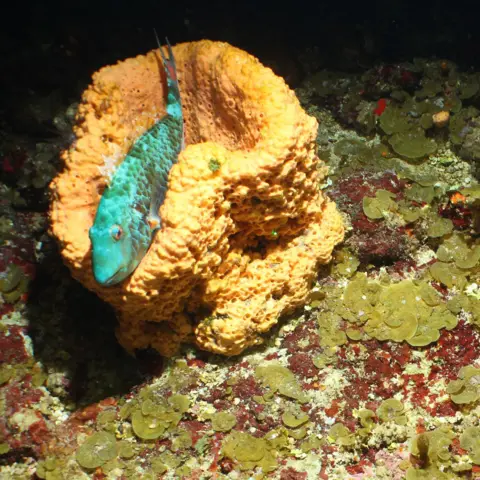
The enigmatic depths off the dazzling coastlines of Britain’s Caribbean territories, long shrouded in mystery, have finally yielded their secrets. A groundbreaking scientific expedition, the first of its kind to venture beyond the familiar shallows of these islands, has unveiled a spectacular tapestry of previously unknown underwater landscapes and an astonishing array of life. Among the monumental discoveries are a sprawling underwater mountain range, an immense "blue hole" that rivals the region’s most famous, vibrant coral reefs seemingly untouched by the ravages of climate change, and numerous sea creatures never before documented.
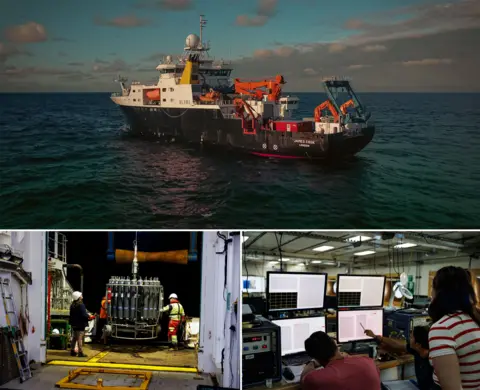
For an intensive six weeks, researchers aboard the British research ship RRS James Cook operated around the clock, deploying sophisticated cameras and specialized equipment designed to withstand the crushing pressures of the deep ocean. Their tireless efforts recorded astonishing footage from depths reaching an incredible 6,000 meters (19,700 feet). The challenging mission navigated the poorly charted waters surrounding the Cayman Islands, Anguilla, and Turks and Caicos, often relying on decades-old maps riddled with inaccuracies and vast, unexplored regions. The UK Centre for Environment, Fisheries and Aquaculture Science (CEFAS), the driving force behind this monumental endeavor, has now shared its extraordinary footage and findings exclusively with BBC News, offering a tantalizing glimpse into these hidden realms.
The British government holds a vital responsibility for safeguarding the natural heritage of these islands, which are home to a staggering proportion of Britain’s unique species – up to 90% are found within these and other British Overseas Territories. With these unprecedented discoveries now brought to light, scientists are urgently emphasizing the critical need to protect this "relatively pristine" environment from the ever-growing threats of climate change, ocean acidification, and pollution.
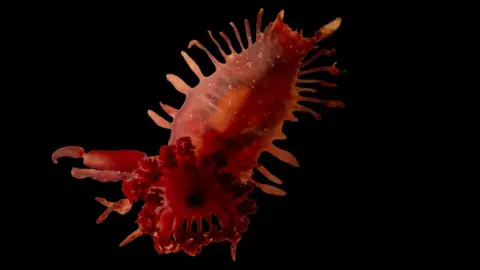
Dr. James Bell, the lead scientist guiding the expedition from the RRS James Cook, expressed his awe at the revelations. "This is the first step into environments people have never seen, and in some cases didn’t know existed," he remarked, his voice reflecting the excitement of discovery. He recounted a recent find: "Just yesterday we found a kind of type of swimming sea cucumber, and we still don’t know what it is." Dr. Bell characterized the biological diversity encountered as "really, really astonishing," underscoring the profound significance of their work. The expedition was not just a solo scientific venture but a collaborative effort, with scientists from the three Caribbean islands actively participating, ensuring local knowledge and expertise were integrated into the research.
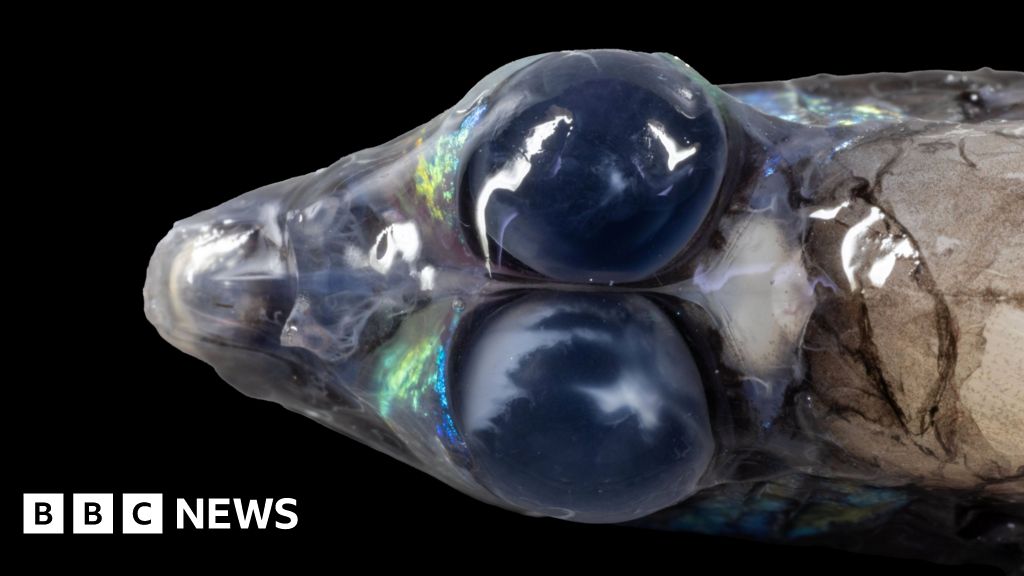
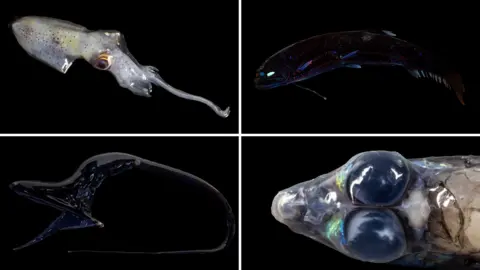
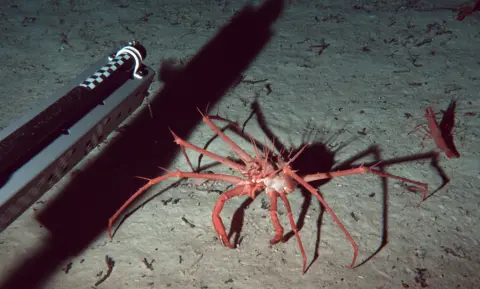
The sheer scale of the expedition’s documentation is impressive. The team cataloged nearly 14,000 individual specimens and identified 290 distinct types of marine creatures, though further detailed scientific analysis is required to confirm whether many of these represent entirely new species. The deep-sea cameras captured images of creatures that appear straight out of science fiction. There was the mesmerizing pelican eel (Eurypharynx pelecanoides), a creature of the abyss with an enormous, gulper-like mouth and a glowing pink tail that flashes a vivid red to lure unsuspecting prey into its cavernous jaws. They encountered the barreleye fish (Opisthoproctus soleatus), famed for its tubular eyes that point upwards, allowing it to spot the faint silhouettes of its prey against the dim light filtering from the surface. Another remarkable find was a dragonfish (Neonesthes) equipped with a bioluminescent rod beneath its chin, likely used to attract food in the perpetually dark environment. These adaptations are crucial for survival in the extreme conditions of the deep sea, where light is scarce and food is precious.
Navigating the uncharted waters presented significant challenges. Dr. Bell vividly described the perils of exploring an unnamed underwater mountain, which they later christened Pickle Bank, located north of Little Cayman island. "We’re not sure how close to it we are. It’s quite difficult to map it without running the risk of running aground," he admitted to BBC News while the ship carefully maneuvered. Through meticulous sounding and imaging, the team eventually determined that this colossal submarine peak rises dramatically from a depth of 2,500 meters (8,200 feet) to within a mere 20 meters (65 feet) of the sea surface.
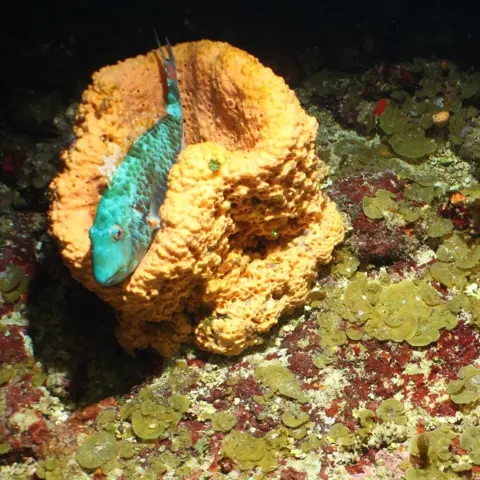
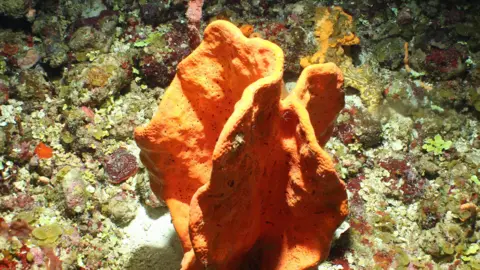
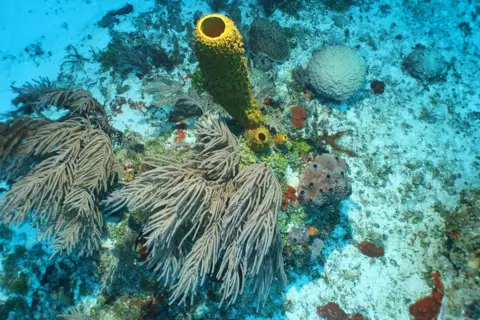
The footage from Pickle Bank is a revelation. It depicts a mountainside ablaze with color – bright blue, yellow, and orange hues – teeming with an extraordinary abundance of life. Golden towers of coral grow alongside massive brain corals, creating intricate, vibrant formations. Fish dart gracefully between the delicate branches of gorgonian whip coral, while jelly-like orange sea sponges dot the landscape near ancient black coral structures. This particular reef stands out as one of the healthiest and most diverse in the entire region, exhibiting a remarkable resilience. It appears to be miraculously free from the devastating stony coral tissue loss disease that has plagued other Caribbean reefs. Scientists hypothesize that its considerable depth and the mountain’s steep slopes provide a protective buffer, shielding it from the surface-level environmental stressors.
These deep-water, or mesophotic, reefs are particularly significant because their greater depths generally insulate them from the escalating ocean temperatures that have severely damaged an estimated 80% of the world’s shallow-water corals since 2023 due to climate change. This makes them potential refugia for coral species struggling in warmer waters. The expedition’s advanced deep-sea cameras and echo-sounders, meticulously lowered from the ship’s side, mapped nearly 25,000 square kilometers (9,700 square miles) of the sea-floor. In total, they captured over 20,000 high-resolution photos, revealing not only the vibrant corals but also glowing lanternfish and alien-like cephalopods, further underscoring the incredible biodiversity.
Dr. Bell highlighted the fundamental challenge of deep-sea exploration: "We know the surface of Mars or the Moon better than we know the surface of our own planet. You send a satellite around them and map them in a few weeks." He continued, "We can’t do that for our ocean. We have to map it bit by bit using acoustic instruments on ships." This underscores the painstaking and costly nature of deep-ocean research, making each discovery all the more valuable.
In the waters off Turks and Caicos, the team made another astonishing discovery that was completely absent from existing sea charts. They found an extremely steep mountain ridge, towering 3,200 meters (10,500 feet) high and stretching an impressive 70 kilometers (45 miles) along the seabed, west of a location known as Gentry Bank. The sheer scale and unexpected presence of this submarine feature drastically alter previous understandings of the regional seafloor topography.
Perhaps one of the most dramatic finds occurred 75 kilometers south of Grand Turk, where the researchers were astonished to discover a massive, vertical sinkhole – a "blue hole" – that had formed when an ancient cave system collapsed inwards. This colossal crater measures approximately 300 meters (980 feet) wide and plunges to a depth of 550 meters (1,800 feet) below sea level. "Imagine taking an ice cream scoop out of the sea-floor. That’s what we saw," Dr. Bell described, emphasizing its striking, almost perfectly circular form. The team believes its steep, plunging walls could make it the deepest blue hole in the entire Caribbean, potentially surpassing even Belize’s world-renowned Great Blue Hole in depth. While blue holes are typically barren environments, the cameras dropped into this new discovery revealed an unexpected ecosystem, with small sponges, a species of urchin called large spatangoid, and diverse fish species thriving within its dark confines.
Further north, approximately 25 kilometers (15 miles) off Anguilla, the researchers investigated long-standing rumors from local fishers who had occasionally pulled up unusual pieces of coral in their nets. The expedition confirmed these anecdotal reports, discovering a magnificent 4-kilometer (2.5-mile) long reef system characterized by intricate mosaics of coral growing within lush sponge "gardens." Here, they also found colossal black coral colonies that could be thousands of years old, making them some of the most ancient living organisms ever recorded in the deep sea. "It tells us that these environments are really pristine and healthy," Dr. Bell affirmed, highlighting the untouched nature and ecological integrity of these newly charted areas.
Scientists are intensely interested in these deep-water regions and steep submarine mountains not only for their biodiversity but also for their crucial ecological roles. Such geological features can create upwelling currents, funneling nutrient-rich waters from the deep to the surface, thereby creating productive feeding grounds for a wide array of marine animals and potentially new fishing opportunities for local communities.
On board the RRS James Cook, the CEFAS team worked hand-in-hand with a dedicated group of environmental experts from the Cayman Islands, Anguilla, and Turks and Caicos. These local partners, including Kelly Forsythe from the Cayman Islands Department of Environment, will play a crucial role in leveraging the expedition’s findings to enhance biodiversity management plans and identify sustainable fishing opportunities for their island communities. "Our islands were literally born from the sea. But when it comes to our offshore environments, we really haven’t had a chance before to discover what’s out there," Kelly Forsythe explained to BBC News, underscoring the profound importance of this collaborative research. The island governments’ participation in this research forms part of the broader Blue Belt Programme, a UK government initiative aimed at protecting marine environments across its Overseas Territories.
The invaluable data collected during this expedition will directly inform the UK’s efforts to fulfill its legally-binding UN commitments, particularly the global target to protect 30% of the world’s oceans by 2030 within designated Marine Protected Areas (MPAs). Dr. Bell eloquently articulated the strategic importance of their work: "Anyone can draw a box on a map and say, ‘That’s a marine protected area.’ But unless you know what’s in it, you don’t know if that’s useful at all." This research provides the foundational knowledge necessary to establish truly effective and biologically meaningful MPAs, ensuring that the protection efforts are targeted and impactful.
These extraordinary revelations from the deep Caribbean represent a monumental leap in our understanding of ocean biodiversity and topography. They underscore how much of our own planet remains unexplored and emphasize the urgent need for continued scientific investigation and robust conservation strategies. As these hidden worlds come into view, they present both a profound scientific marvel and a critical call to action to safeguard these newly discovered, ancient, and remarkably pristine deep-sea ecosystems for future generations.



 Ramos Leo
 atisusanti
 Roy Suryo
 George Anjay