Nakalama John
Several factors contributed to this surge in borrowing. While government tax receipts did see an increase, their positive impact was ultimately overshadowed by a rise in government spending and the specific timing of government debt interest payments. This confluence of factors led to a substantial deficit for the month, drawing renewed attention to the nation’s ongoing struggle to balance its books amidst persistent economic pressures.
Despite this sharp rise in monthly borrowing, it is crucial to consider the broader context of the financial year. Across the 11 months leading up to February, aggregate government borrowing actually showed a decrease compared to the previous year. This suggests that while February presented a challenging blip, the overall trajectory of fiscal consolidation had, until then, shown some signs of improvement. However, the February figures serve as a stark reminder of the volatility inherent in public finances and the susceptibility to various economic and operational factors.

The ONS figures provide a snapshot of the economy for the month preceding the most recent significant escalation of tensions in the Middle East, specifically the US-Israel war with Iran. While the direct impact of such an event would not be reflected in February’s numbers, the broader geopolitical landscape and its potential for further instability remain a critical consideration for future fiscal planning. Economists are already assessing the potential ramifications of an increasingly volatile global environment. Ruth Gregory, deputy chief UK economist at Capital Economics, voiced concerns about the government’s capacity to respond to such crises. She noted, "We doubt there is scope for a large-scale fiscal support package like that seen in 2022, even in more extreme scenarios in which the conflict in the Middle East escalates further." This highlights the constrained fiscal headroom available to the Treasury should external shocks necessitate significant government intervention, unlike the substantial energy and cost-of-living support packages deployed during the energy crisis.
In response to the figures, the Treasury reiterated its commitment, stating it had the "right economic plan" in place and adding that the UK was "better prepared for a more volatile world." This statement underscores the government’s intention to maintain fiscal discipline and build resilience, even as it navigates a complex global economic landscape. The government’s strategy often involves a careful balance between managing the national debt, investing in public services, and stimulating economic growth.
Further analysis of the February borrowing increase points to the intricate mechanics of public finance. Nabil Taleb, an economist at PwC UK, explained that the rise "partly reflects the timing of payments, with some interest due at the end of January falling into February because of the intervening weekend." This illustrates how seemingly minor calendar shifts can introduce significant month-on-month volatility into borrowing figures, as large financial obligations are moved from one accounting period to the next. Such timing effects can sometimes obscure underlying trends, making it challenging to interpret a single month’s data in isolation.

The leap to the second highest borrowing for February on record, a figure not adjusted for inflation, represents a sharp reversal from the record surplus recorded in January. January typically sees a surplus due to the influx of self-assessment tax receipts, providing a temporary boost to the public finances. The contrast between these two consecutive months highlights the seasonal and structural fluctuations inherent in the UK’s tax collection and spending patterns.
Lindsay James, investment strategist at Quilter, succinctly captured this about-turn in public sector finances, attributing it "largely due to record levels of interest payable, highlighting the sheer scale of debt interest the government is now facing." The cost of servicing the national debt has become a significant and growing burden. With elevated inflation rates prompting the Bank of England to raise interest rates, the government’s borrowing costs have surged. A substantial portion of the UK’s debt is linked to inflation (RPI-linked gilts), meaning that as inflation rises, so too do the payments due to bondholders. This creates a challenging feedback loop where high inflation directly increases the government’s expenditure on debt servicing, even as it erodes the real value of the debt itself over time.
James further noted that there were initially "glimmers of hope that government borrowing was beginning to be reined in as tax rises helped to create the largest January surplus on record." However, she concluded that "The latest data out this morning, however, has put a swift end to that picture," indicating that the positive momentum from January was not sustained. This underscores the ongoing fiscal challenge and the difficulty of achieving consistent improvements in public finances.
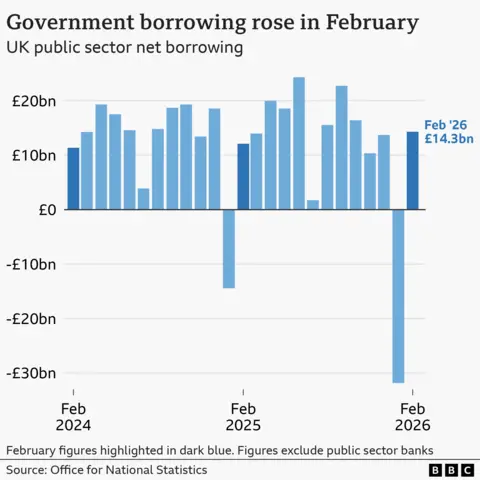
The broader picture of the UK’s national debt remains a significant concern. The ONS provisionally estimated public sector net debt, excluding public sector banks, to be at 93.1% of the size of the UK economy at the end of February 2024. This debt-to-GDP ratio remains at levels last witnessed in the early 1960s, a historical high that highlights the substantial financial liabilities accumulated over recent decades, particularly following the 2008 financial crisis, the COVID-19 pandemic, and the energy crisis. A high debt-to-GDP ratio can limit a government’s fiscal flexibility, potentially leading to higher interest rates on future borrowing and increasing the risk of adverse economic shocks. It also implies that a larger portion of future tax revenues will be allocated to servicing existing debt rather than funding public services or investment.
Looking ahead, these borrowing figures have significant implications for the UK’s economic outlook and future fiscal policy. The unexpected jump in February suggests that the path to reducing the national debt and balancing the budget may be more arduous than previously anticipated. It puts additional pressure on the Chancellor to demonstrate fiscal responsibility, potentially influencing decisions regarding future tax policies and spending reviews. While the government aims to reduce inflation and stimulate growth, the persistent high cost of debt servicing and the potential for external shocks mean that public finances are likely to remain under intense scrutiny. The ability to manage these fiscal challenges effectively will be crucial for maintaining economic stability and ensuring sustainable public services in the long term.




 George Anjay
 atisusanti
 Ramos Leo