Nana Banana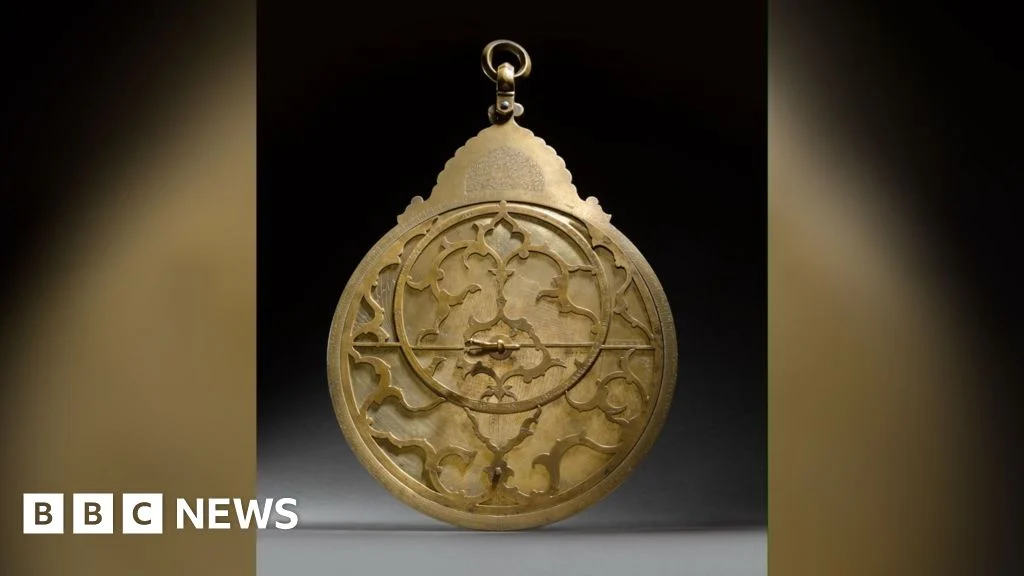
Benedict Carter, head of the department of Islamic and Indian Art at Sotheby’s, highlighted the astrolabe’s unprecedented scale and historical importance to the BBC. Its provenance is as illustrious as its craftsmanship: it was originally part of the magnificent collection of Maharaja Sawai Man Singh II of Jaipur, a prominent ruler known for his patronage of arts, architecture, and sciences. Following his passing, the astrolabe transitioned to the possession of his wife, Maharani Gayatri Devi, an iconic figure celebrated globally for her elegance, political acumen, and progressive views. It remained in a private collection for decades thereafter, adding an air of mystique to its already rich history.
Astrolabes, essentially metallic disks composed of multi-layered, interlocking components, served as indispensable tools for scholars, navigators, and astrologers for centuries. Their functions were remarkably diverse and complex, allowing users to determine the time of day or night, map the positions of stars and planets, ascertain the direction of Mecca for prayer, and track the intricate motions of celestial bodies. Dr. Federica Gigante of the Oxford Centre for History of Science, Medicine and Technology aptly likens them to "modern-day smartphones" due to their immense versatility. "You can calculate the time of sunset, sunrise, the height of a building, the depth of a well, distance and even use them to predict the future," she explains. When used in conjunction with an almanac, these instruments were even employed for casting horoscopes, bridging the gap between scientific observation and astrological prognostication.
The lineage of the astrolabe traces back to ancient Greece, where its fundamental principles were first developed in the 2nd Century BCE. Its technology subsequently journeyed to the Islamic world by the 8th Century, undergoing significant refinement and expansion during the Islamic Golden Age. Centres of astrolabe production flourished across vast territories, from Iraq and Iran to North Africa and al-Andalus (present-day Spain), with Islamic scholars making crucial advancements in their design and functionality. It was through these scholarly exchanges and cultural connections that astrolabes eventually found their way to India, where they were embraced by local rulers and intellectuals.
This particular astrolabe was meticulously crafted in the early 17th Century in Lahore, a city that had emerged as a leading hub for astrolabe-making within the expansive Mughal Empire, a period renowned for its artistic and scientific achievements. The instrument is the creation of two brothers, Qa’im Muhammad and Muhammad Muqim, celebrated master craftsmen who belonged to the fabled "Lahore School." This school was recognized as one of the most distinguished centres of astrolabe production of its era, its expertise often passed down through generations within a single family, safeguarding its intricate techniques and knowledge. The collaboration between the brothers was rare; only two astrolabes are known to have been jointly produced by them, with the other, a significantly smaller piece, housed in a museum in Iraq.
The astrolabe was commissioned by Aqa Afzal, a high-ranking nobleman who held administrative sway over Lahore during this period. Originally hailing from Isfahan in Iran, Afzal served in several senior capacities under the illustrious Mughal emperors Jahangir and Shah Jahan, patrons of unparalleled artistic and scientific innovation. The sheer monumental size and opulent detailing of this astrolabe directly reflect the considerable stature and refined tastes of its patron, underscoring the intellectual curiosity and wealth that characterized the Mughal court.
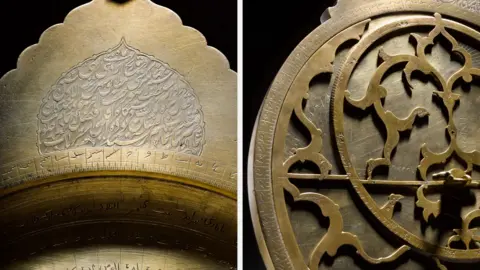
Measuring an impressive nearly 30cm (12 inches) in diameter and standing approximately 46cm (18 inches) tall, this astrolabe is a truly imposing object, weighing a substantial 8.2kg (18 pounds). These dimensions make it almost four times the size of a typical 17th-century Indian astrolabe, as noted by Benedict Carter. Beyond its scale, the instrument also boasts a striking cross-cultural synthesis: its star pointers bear their conventional names in Persian, elegantly accompanied by their Sanskrit equivalents etched in the beautiful Devanagari script. This linguistic duality not only highlights the multicultural milieu of the Mughal court but also the sophisticated scientific dialogue that existed between different intellectual traditions.
Sotheby’s describes the astrolabe as an encyclopaedia of celestial knowledge, containing inscriptions for 94 cities, each precisely marked with its respective longitudes and latitudes. Furthermore, it features 38 intricately designed star pointers, linked by delicate floral tracery that serves both an aesthetic and functional purpose. The instrument is equipped with five precision-calibrated plates, and its degree divisions are so finely rendered that they are subdivided down to an astonishing third of a degree, showcasing an unparalleled level of accuracy for its time.
This extraordinary level of detail and precision is a testament to the exceptional craftsmanship of the Lahore School, which, during this period, was operating "at its most refined," according to Carter. Here, technical exactitude, practical utility, and artistic beauty converged harmoniously, setting it apart from many earlier astrolabes produced in other parts of the Middle East, which often prioritized functionality over aesthetic embellishment. The instrument also serves as a tangible reflection of the broader scientific impetus within the Mughal court, where rulers and their courtiers demonstrated a profound interest in the advancements of astronomy and astrology, seeing them as integral to understanding the cosmos and governing their vast empire.
Dr. Gigante further emphasizes the instrument’s remarkable accuracy, stating that "it is not only big, beautiful and heavy, it is so incredibly accurate that it will give you the exact degree of altitude [of a celestial body]." She suggests that the only truly comparable instrument known to exist was likely one crafted for Abbas II of Persia, underscoring the extreme rarity and significance of the Jaipur astrolabe.
Sotheby’s anticipates intense interest from both major museums and discerning private collectors, drawn by the piece’s pristine condition, monumental size, and impeccable royal provenance. The astrolabe is entering the market with an estimated value of £1.5-2.5 million. This estimate significantly surpasses the current record for an astrolabe at auction, which is held by a much smaller Ottoman piece made for Sultan Bayezid II, sold in 2014 for just under £1 million. The combination of its historical weight, artistic brilliance, scientific importance, and royal lineage positions this 17th-century "supercomputer" as a truly exceptional offering, poised to captivate the global art and history market. The astrolabe will be exhibited in Sotheby’s London galleries from 24–29 April, offering a rare glimpse into a bygone era of scientific marvel and regal splendour.




 George Anjay
 Nakalama John
 atisusanti
 Ramos Leo