
 Nakalama John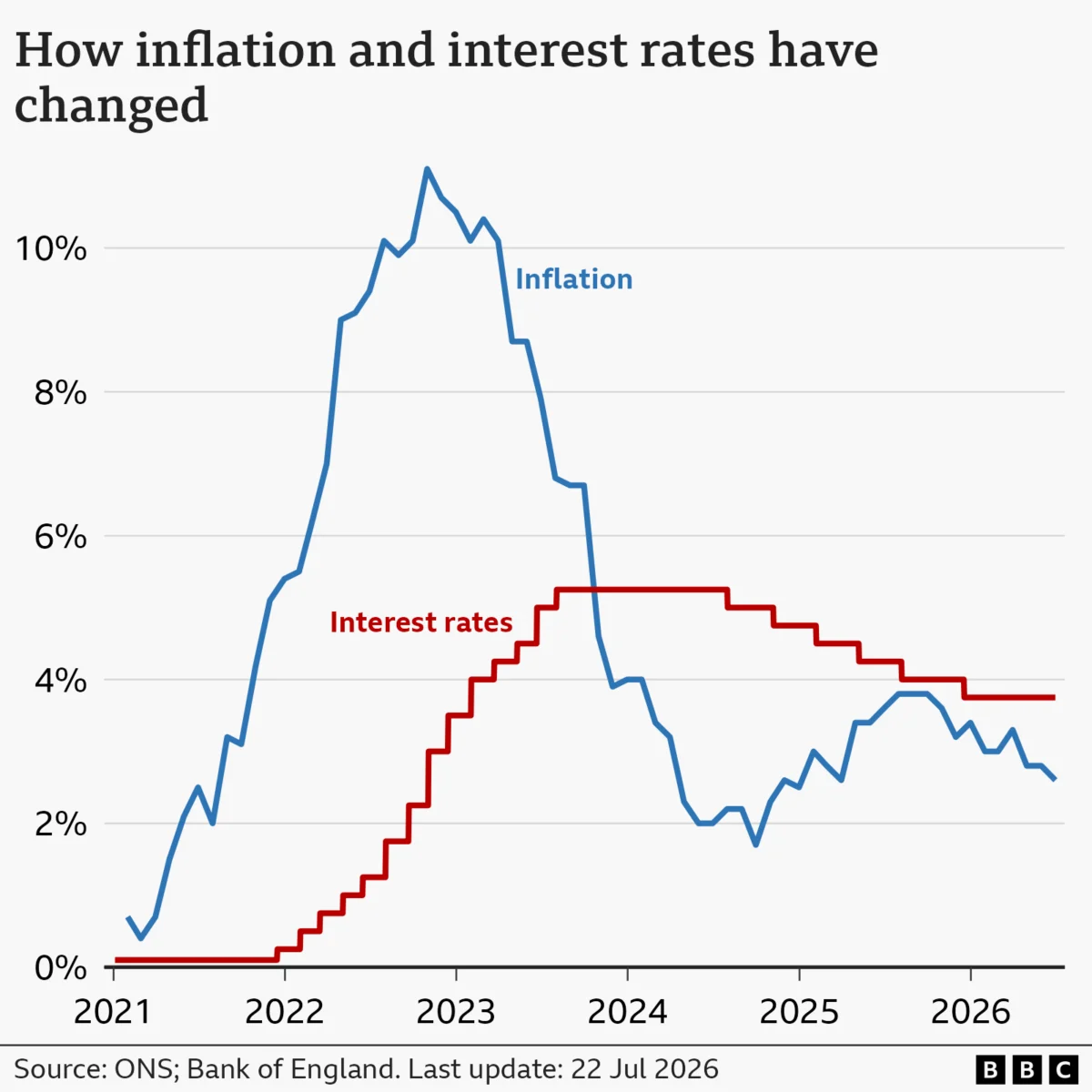
The Bank of England’s Monetary Policy Committee (MPC) has consistently held the UK’s benchmark interest rate at 3.75% for four consecutive meetings, maintaining this level since a cut in December 2025 and keeping it as the lowest point since February 2023. This steadfast approach comes amidst a backdrop of escalating global inflationary pressures, primarily fuelled by the economic repercussions of the US-Israeli conflict with Iran. Initially, financial markets and analysts had widely anticipated further rate reductions throughout 2026, but the unfolding geopolitical events have dramatically altered this outlook, making immediate cuts seem increasingly improbable. The trajectory of interest rates significantly influences a vast array of financial products, from mortgages and credit cards to personal loans and savings accounts, impacting millions of households across the nation.
Understanding Interest Rates and Their Fluctuations
An interest rate fundamentally represents the cost of borrowing money or, conversely, the return earned on savings. The Bank of England’s base rate is the pivotal figure, dictating the interest rate at which commercial banks and building societies borrow money from the central bank. This, in turn, cascades down to influence the rates these institutions offer their own customers for various financial products, including mortgage loans and savings accounts. The primary mandate of the Bank of England is to maintain price stability, specifically by keeping the UK’s inflation rate – the pace at which prices for goods and services are rising – at or close to its target of 2%.
When inflation exceeds this 2% target, as it has done significantly in recent years, the Bank typically responds by increasing the base rate. The strategic intent behind this action is to cool down the economy by making borrowing more expensive and saving more attractive. This encourages individuals and businesses to reduce their spending, thereby dampening overall demand for goods and services. A reduction in demand is expected to alleviate pressure on prices, helping to bring inflation back towards the desired target. Conversely, if inflation falls below target or the economy faces a downturn, the Bank may opt to cut rates to stimulate borrowing, spending, and economic activity.

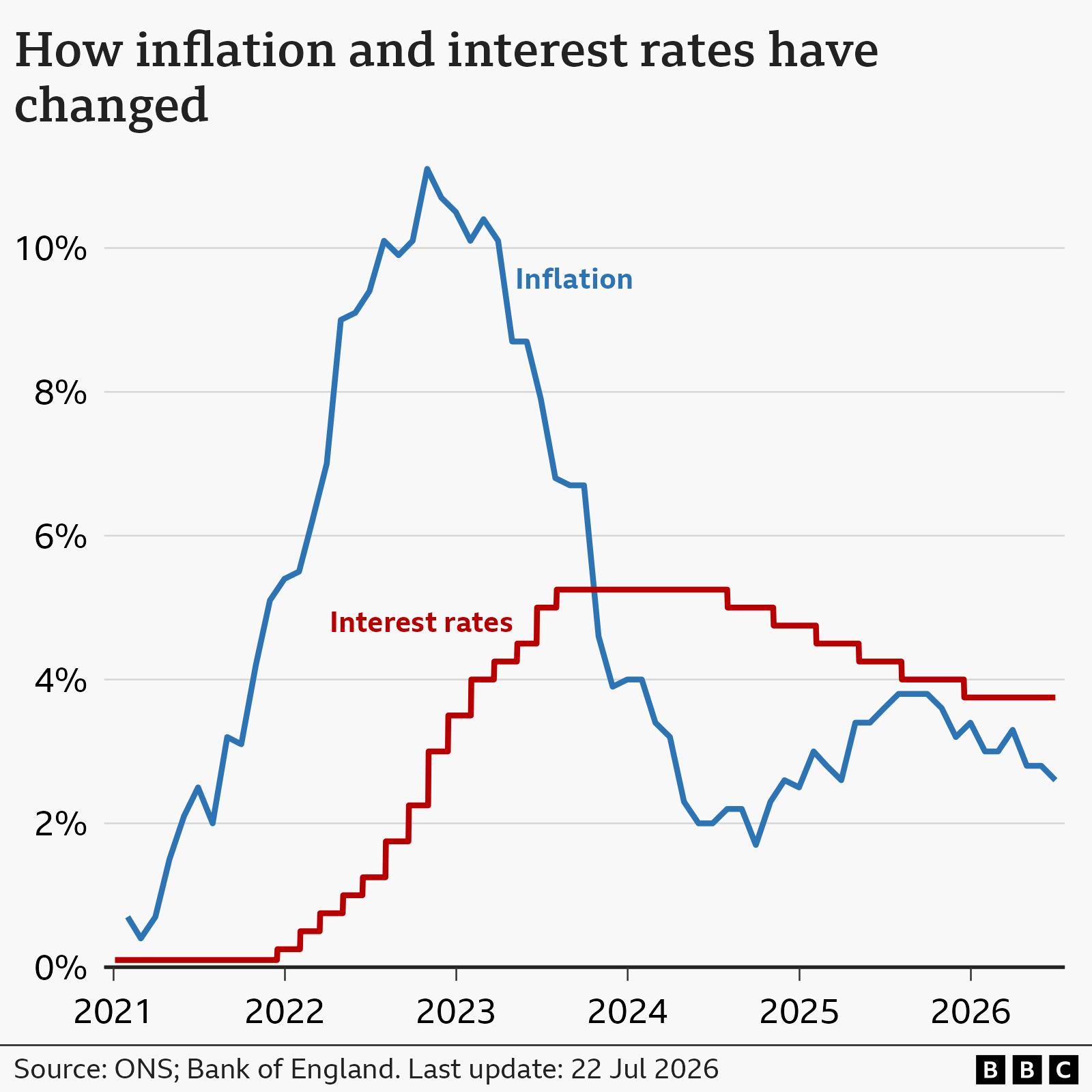
The UK has experienced a tumultuous period of interest rate changes. The Bank of England’s base rate peaked at 5.25% in 2023, a level it sustained until August 2024. Following this, the Bank initiated a series of five cuts, progressively lowering the rate to 4%. These cuts were paused in September and November 2025, with rates being held steady. A further cut occurred in December 2025, bringing the rate to 3.75%. Since then, the MPC has opted to hold rates at this level during its subsequent meetings in January, March, April, and most recently, on 18 June 2026.
Simultaneously, the main measure of UK inflation, the Consumer Prices Index (CPI), has demonstrated significant volatility. After reaching an alarming peak of 11.1% in October 2022, largely driven by the global energy crisis following the conflict in Ukraine, CPI began a substantial descent. It registered 2.6% in the year to June 2026, a slight decrease from 2.8% in the preceding month. The Office for National Statistics (ONS) attributed this recent moderation to lower fuel and food costs. However, these factors are widely perceived as temporary relief. The renewed geopolitical tensions, particularly the US-Israeli war with Iran, have reignited concerns, pushing up global energy and fuel prices and threatening to accelerate broader price rises once more.
The Future Outlook for UK Interest Rates
At the outset of 2026, market consensus and economic forecasts strongly pointed towards at least two interest rate cuts within the year, with many analysts predicting the first reduction as early as March or April. However, the subsequent eruption and intensification of the conflict in the Middle East have dramatically reshaped these expectations. The initial sharp surge in oil prices, driven by fears of supply disruptions in the region, created significant upward pressure on global inflation. While there have been temporary dips in oil prices following various ceasefire agreements, the underlying volatility remains high.
On 18 June, Bank of England Governor Andrew Bailey acknowledged the encouraging nature of recent price falls after the latest truce but issued a stark warning. He highlighted that the elevated energy prices observed over the preceding four months had already embedded "some inflationary pressure in the pipeline." Governor Bailey emphasised the Bank’s unwavering commitment to ensuring this does not translate into "sustained inflation above our 2% target."

The situation became further complicated in July when oil prices surged again after the US and Iran reportedly resumed attacks in the Strait of Hormuz. Domestically, UK household energy bills are also poised for an increase following the latest upward adjustment of the energy price cap, which took effect on 1 July. This could further exacerbate inflationary pressures within the UK economy. Given this prevailing climate of considerable economic and geopolitical uncertainty, a broad consensus among analysts suggests that the Bank of England is highly likely to maintain the base rate at 3.75% at its forthcoming MPC meeting scheduled for Thursday, 30 July.
Impact on Mortgages, Loans, and Savings Rates
Mortgages:
Mortgages represent one of the most significant financial commitments for many households, with government data from the English Housing Survey indicating that just under a third of UK households are homeowners with a mortgage. The Bank of England’s interest rate decisions have immediate and profound implications for these borrowers.
Approximately 500,000 homeowners currently hold a mortgage that "tracks" the Bank of England’s base rate. For these individuals, any adjustment in the base rate directly translates into a corresponding change in their monthly repayments. A rate cut would result in lower monthly outgoings, providing financial relief, while a rate hike would increase their payments. An additional 500,000 homeowners are on Standard Variable Rates (SVRs). While these rates are not directly tied to the base rate, lenders typically choose to pass on changes in the base rate, albeit with some discretion and often with a delay.
The vast majority of mortgage customers, accounting for around 87% of all borrowers, are on fixed-rate deals. For these homeowners, their current monthly payments remain unaffected by immediate rate changes, as their interest rate is locked in for a set period. However, the prevailing market interest rates, heavily influenced by the Bank’s base rate and broader economic sentiment, significantly determine the terms of their next mortgage deal. Many fixed-rate borrowers face a "mortgage cliff" scenario. Data from Moneyfacts, a financial information service, shows that as of 22 July, the average rate for a new two-year fixed-rate mortgage stood at 5.57%, a notable increase from 4.83% at the beginning of March. Similarly, the average rate for a five-year fixed deal rose to 5.6% from 4.95% over the same period. In contrast, the average two-year tracker rate was 4.51%.
Projections indicate that around 800,000 fixed-rate mortgages, currently enjoying interest rates of 3% or below, are expected to expire annually until the end of 2027. Borrowers transitioning from these historically low rates are likely to face substantially higher borrowing costs, leading to significant increases in their monthly repayments. This situation necessitates careful financial planning and consideration for those approaching the end of their fixed terms.
Credit Cards and Loans:
The Bank of England’s base rate also serves as a foundational influence for the interest rates charged on other forms of credit, including credit cards, personal bank loans, and car financing agreements. When the base rate falls, the cost of borrowing for lenders decreases, providing them with the opportunity to reduce the interest rates they offer to customers. Conversely, a rising base rate tends to increase these borrowing costs. However, changes in credit card and personal loan rates typically occur more slowly and with less direct correlation than with mortgages, as lenders factor in various other commercial considerations and risk assessments. This often means that consumers may not see immediate or full adjustments to their loan rates following a Bank of England decision.
Savings:
For savers, the Bank of England’s base rate is a critical determinant of the returns they can expect on their deposits. A falling base rate generally signals a reduction in the interest rates offered by banks and building societies on savings accounts, diminishing the income earned by savers. Conversely, periods of rising interest rates, such as those experienced recently, tend to be more favourable for savers, as institutions compete to attract deposits by offering higher returns.
As of 22 July, Moneyfacts reported that the average interest rate for an easy access savings account with a minimum balance of £10,000 was 2.56%. For an easy access cash ISA, the average rate stood at 2.75%. For those willing to commit their funds for a longer duration, the average rate for a one-year fixed-term savings account was 4.27%. These figures highlight the current landscape for savers, where locking money away for a fixed period generally yields better returns. However, any future cuts in the base rate would likely lead to a decline in these offerings, particularly affecting individuals who rely on interest income to supplement their overall earnings.
International Interest Rate Landscape

The UK’s interest rate policies do not exist in isolation, and its position relative to other major economies provides important context. In recent years, the UK has frequently maintained one of the highest interest rates among the G7 nations, a group comprising the world’s seven largest advanced economies.
The European Central Bank (ECB), responsible for monetary policy across the eurozone, embarked on a path of rate cuts in June 2024, reducing its main interest rate from an all-time high of 4% to 2% by June 2025. However, reacting to the inflationary pressures stemming from the Iran conflict, the ECB subsequently raised rates to 2.25% in June 2026, mirroring the global shift in economic sentiment.
Across the Atlantic, the US central bank, the Federal Reserve, had initiated a series of three interest rate cuts since September 2025, bringing its federal funds rate to a range of 3.5% to 3.75%, the lowest since 2022. However, at its June meeting, the Fed opted to hold rates steady at this level. This marked the first meeting under the new Fed chair, Kevin Warsh, who replaced Jerome Powell. Former US President Donald Trump had notably and repeatedly criticised the previous chair, Powell, for not cutting rates sooner. While Warsh is generally perceived as more amenable to rate reductions, he, like his counterparts in the UK and Europe, must now contend with the complex economic fallout from the Iranian conflict. The Fed’s next critical rate decision is anticipated on 29 July, where global developments will undoubtedly weigh heavily on their assessment. These international comparisons underscore the interconnected nature of global economies and how geopolitical events can quickly ripple through financial markets worldwide, influencing monetary policy decisions in unison.




 Roy Suryo

 atisusanti
 Ramos Leo
